Key Highlights
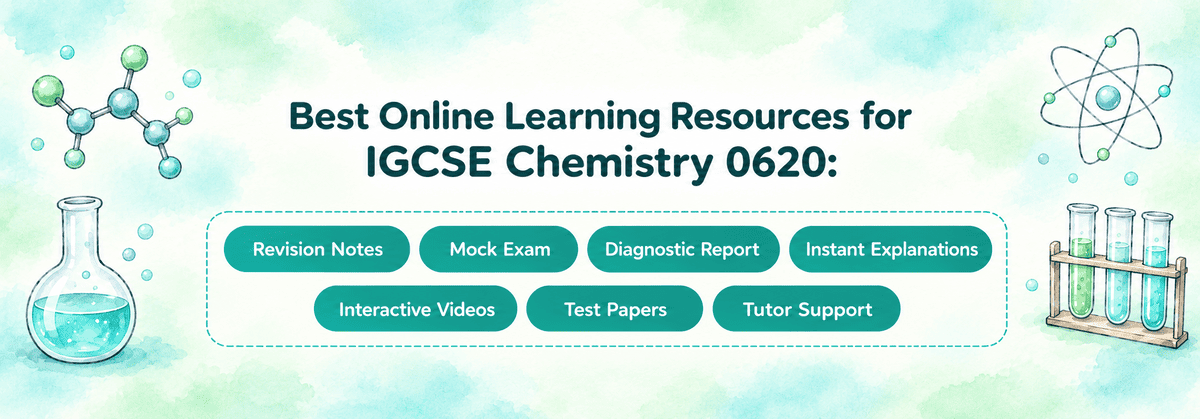
- Learn difficult concepts through Interactive Videos.
- Review key details with Revision Notes.
- Check understanding through End-of-Lesson Quizzes.
- Access eligible Instant Explanations after achieving 80% or higher.
- Practise targeted questions with Test Papers.
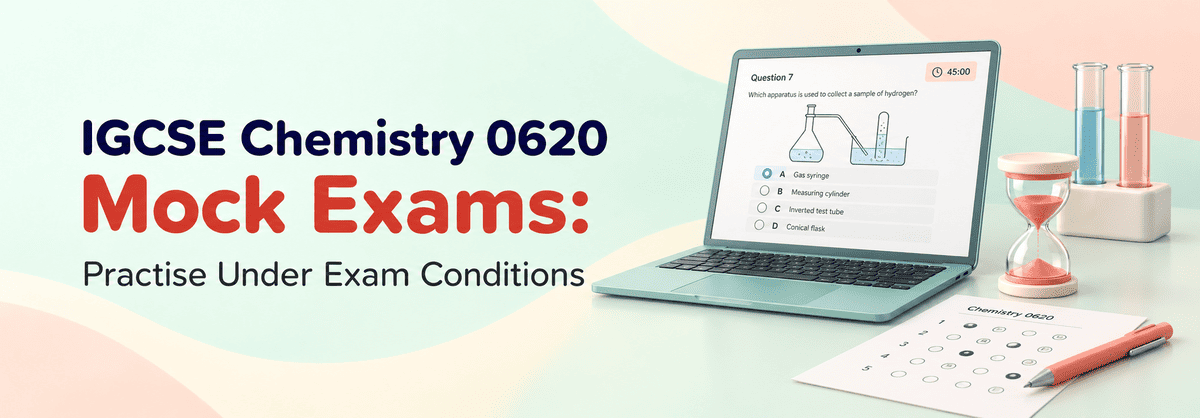
- Use Mock Exams for broader assessment.
- Review mastery through Diagnostic Reports.
- Get additional guidance through Tutor Support.
Summarize with AI


Preparing for IGCSE Chemistry 0620 involves understanding particle behaviour, explaining reactions, completing calculations and interpreting experimental information. Different resources support each stage: Revision Notes help you review definitions, equations and chemical tests, while Interactive Videos explain difficult concepts and processes step by step.
Eligible Instant Explanations help clarify End-of-Lesson Quiz questions after you achieve 80% or higher. Test Papers provide targeted exam-style practice, and a Mock Exam helps you bring different Chemistry topics together in a broader assessment. A Diagnostic Report provides insights into mastery to help prioritise revision, while Tutor Support offers guidance when a concept, calculation or experimental question remains unclear.
What Should You Look for in IGCSE Chemistry 0620 Resources?
A useful Chemistry resource should match a specific need. It should help you understand why processes happen, follow particles and structures, work through calculations, apply familiar ideas in unfamiliar situations, and interpret experimental information.
Practice and assessment resources should then help you work independently and decide what needs attention next.
Best Online Learning Resources for IGCSE Chemistry 0620
| Resource | Best Used For |
|---|---|
| Interactive Videos | Learning concepts and processes |
| Revision Notes | Reviewing and reinforcing topics |
| End-of-Lesson Quizzes | Checking understanding |
| Instant Explanations | Understanding eligible quiz questions |
| Test Papers | Targeted exam-style topical past paper practice |
| Mock Exams | Broader assessment |
| Diagnostic Reports | Reviewing broader mastery |
| Tutor Support | Additional academic guidance |
1. Interactive Videos : When a Chemistry Concept Is Difficult to Visualise
Some Chemistry topics are difficult because several ideas connect at once. You may know terms such as ionic bonding, electrolysis, or energy change but still struggle to explain what is happening and why.
Interactive Videos can help you work through particles, atomic structure, bonding, reactions, electrolysis, energetics, organic structures and experimental processes step by step.
Watch actively. Ask what is changing, why it changes, and how one stage connects with the next. Then complete the End-of-Lesson Quiz to check whether you can recall and apply what you learned.
See → Understand → Follow → Check
2. Revision Notes : When You Need to Refresh Chemistry Knowledge
Revision Notes are most useful when the concept already makes sense, but the detail needs reinforcement.
Use them to review definitions, equations, reaction conditions, chemical tests, trends, structures, and important procedures.
If you do not understand the concept, relearn it. If you understand it but cannot recall the detail, revise it.
After reviewing, close your notes and try to reproduce the equation, explain the trend or describe the process independently.
3. Instant Explanations : When a Quiz Question Does Not Make Sense
A wrong Chemistry answer may come from misunderstanding the concept, choosing the wrong equation, making a calculation error, or misreading the question.
After achieving 80% or higher in an End-of-Lesson Quiz within an Interactive Video lesson, eligible Instant Explanations can help you understand the relevant quiz questions.
Interactive Video → End-of-Lesson Quiz → 80%+ → Eligible Instant Explanation
Ask what concept was tested, where your reasoning differed, and whether the wider topic needs review. The aim is understanding, not memorising the corrected answer.
4. Test Papers : When You Need Targeted Chemistry Practice
Once the concept is clear, move into targeted exam-style practice.
HomeSchool Asia Test Papers can be selected by:
Paper Type → Topic → Difficulty Level
Practice may involve calculations, equations, data interpretation, observations, experimental questions or applying concepts to unfamiliar situations.
Afterwards, do not look only at the grade. Ask where the first error occurred. Did you misunderstand the Chemistry, use the wrong ratio, forget a condition, or misread the data?
Test Papers provide grading for the practice completed; they do not generate Diagnostic Reports.
5. Mock Exams : When You Need Broader Assessment
Mock Exams are useful when you want to bring several areas of Chemistry together.
They can help you practise recalling information independently, moving between calculations and explanations, interpreting unfamiliar information, and applying different topics within a broader assessment.
Attempt → Review → Improve → Reassess
If one area repeatedly causes difficulty, return to targeted learning or practice before attempting another broader assessment.
6. Diagnostic Reports : When You Need to Understand Broader Mastery
Diagnostic Reports provide broader mastery information that can help you prioritise revision.
| Mastery Level | Threshold |
|---|---|
| Inadequate | 80% and below |
| Adequate | 80% and above |
| Complete | 100% |
An Inadequate area needs further attention. An Adequate area has reached the 80% threshold but can still be reinforced. Complete represents 100% within the mastery framework.
Test Papers show performance on completed practice; Diagnostic Reports provide broader mastery information.
7. Tutor Support : When Chemistry Still Does Not Make Sense
Sometimes a topic remains unclear after reviewing the lesson and attempting questions. You may still be confused about a mole calculation, bonding, a reaction, an experimental procedure or a chemical equation.
Tutor Support can provide additional academic guidance when independent study is no longer resolving the difficulty.
Attempt → Identify → Ask → Understand → Apply
The aim is to understand the reasoning and then try another related problem independently.
Which IGCSE Chemistry Resource Should You Use?
| If your problem is… | Use… |
|---|---|
| “I don't understand this concept.” | Interactive Video |
| “I learned it but forgot the details.” | Revision Notes |
| “I want to check the lesson.” | End-of-Lesson Quiz |
| “I want to understand an eligible quiz question.” | Instant Explanation after 80%+ |
| “I need practice on this topic.” | Test Papers |
| “I want broader assessment.” | Mock Exams |
| “I want to understand broader mastery.” | Diagnostic Report |
| “I still cannot solve this problem.” | Tutor Support |
A Practical IGCSE Chemistry 0620 Learning Routine
A flexible routine is:
Learn → Check → Review → Practise → Assess → Diagnose → Improve → Get Support
Learn unclear concepts first, use the End-of-Lesson Quiz to check understanding, review eligible Instant Explanations after 80%+, reinforce details with Revision Notes, and move into targeted Test Papers. Use Mock Exams for broader assessment and mastery information to decide what should be revisited.
How to Make Chemistry Practice More Effective
Explain why, not only what. Connect reactions and observations with the Chemistry behind them. In calculations, track units and ratios and know what each number represents. Link structure and bonding to properties.
If a calculation or procedure goes wrong, find the first point of error rather than checking only the final answer. Practise applying familiar concepts when questions are presented differently.
How HomeSchool Asia Supports IGCSE Chemistry 0620
HomeSchool Asia combines resources for different stages of Chemistry learning. Interactive Videos and End-of-Lesson Quizzes support learning and checking; Revision Notes reinforce knowledge; eligible Instant Explanations support relevant quiz questions after 80%+; Test Papers provide targeted practice; Mock Exams support broader assessment; Diagnostic Reports provide mastery information; and Tutor Support offers additional guidance when needed.
Conclusion
The best IGCSE Chemistry 0620 resources depend on the problem you are trying to solve.
If a concept is unclear, return to learning. If you understand it but have forgotten the details, revise it. Use targeted questions to practise application, broader assessments to test preparation, and Diagnostic Reports to review mastery. If a difficult concept, calculation or experimental problem remains unclear, seek additional guidance.
Identify whether your problem is understanding, recall, calculation, application, experimental reasoning or broader preparation, then choose the resource that helps you take the next useful step.
Start Your IGCSE Chemistry (0620) Journey!

Premium Plan
- Full 12-month structured resources of all subjects.
- Full access to all Interactive Videos.
- Additional Tutor Credits to access features.
- Diagnostic Report available to all chapters.
- Downloadable Revision Notes available for all topics.
- “Get one Answer a Day” is activated for all subjects.

Custom Plan
- Full 12-month structured resources of chosen subjects.
- Full access to Interactive Videos for the chosen subject.
- Additional Tutor Credits to access features.
- Diagnostic Report available to all chapters.
- Downloadable Revision Notes available for all topics.
- “Get one Answer a Day” is activated for chosen subjects.
Frequently Asked Questions
What are the best online resources for IGCSE Chemistry 0620?
Useful resources include Interactive Videos, Revision Notes, End-of-Lesson Quizzes, eligible Instant Explanations, Test Papers, Mock Exams, Diagnostic Reports and Tutor Support.
When are Instant Explanations available?
They are available for eligible questions after achieving 80% or higher in an End-of-Lesson Quiz within an Interactive Video lesson.
How can I practise IGCSE Chemistry exam-style questions?
Use Test Papers selected by Paper Type, Topic and Difficulty Level.
Do Test Papers generate Diagnostic Reports?
No. Test Papers provide grading for the practice completed; they do not generate Diagnostic Reports.
What are the Diagnostic Report mastery levels?
They are Inadequate at 80% and below, Adequate at 80% and above, and Complete at 100%.
When should I use Tutor Support?
Use Tutor Support when a Chemistry concept, calculation, experimental question, or application remains unclear after independent study.