Key Highlights
- Use Tutor Support when independent study has not resolved a Chemistry difficulty.
- Identify the exact concept or step causing the problem.
- Ask why a chemical process happens rather than only asking for the answer.
- Separate conceptual gaps from calculation or recall errors.
- Apply the guidance to another question independently.
- Return to targeted practice once the concept becomes clearer.
- Use Tutor Support as additional guidance, not as a replacement for learning.
Summarize with AI


Sometimes doing more Chemistry questions does not solve the problem. You may remember an equation but not understand why a reaction happens, struggle to connect particle behaviour with an observation, or repeatedly make the same mistake in stoichiometry.
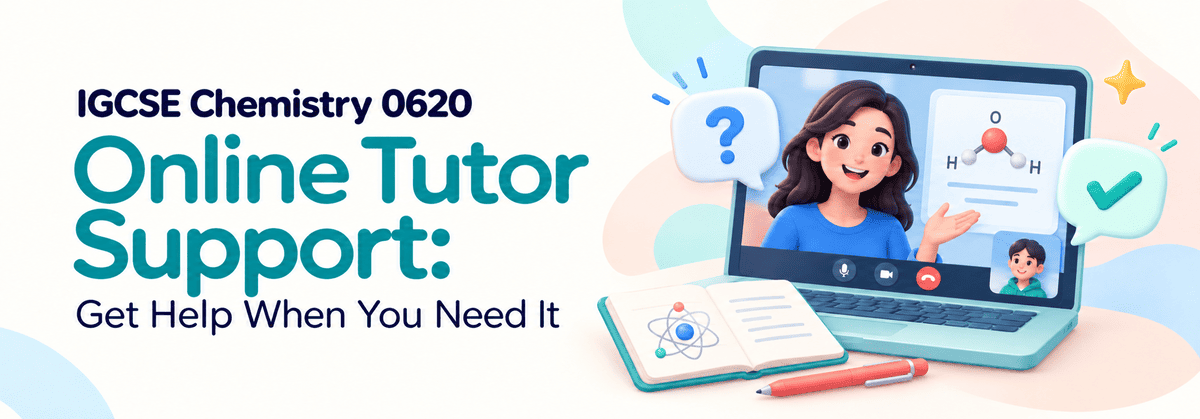
When independent learning, revision and practice are no longer resolving the difficulty, IGCSE Chemistry 0620 Online Tutor Support can provide additional academic guidance.
The goal is not simply to obtain an answer. It is to understand Chemistry well enough to apply it independently.
When Should You Use Tutor Support for IGCSE Chemistry 0620?
Tutor Support is most useful when you have already tried to understand a topic but are still stuck.
For example, you may have:
- Watched an Interactive Video but still did not understand the concept.
- Reviewed your Revision Notes but remain unsure why a chemical process occurs.
- Attempted practice questions and repeatedly made the same mistake.
- Memorised an equation but struggled to apply it.
- Reached one stage of a calculation but not known what to do next.
- Understood a familiar example but struggled when the question was presented differently.
The important distinction is whether you need more practice or more explanation.
If you understand the concept but need more questions, Test Papers may be more useful. If you cannot understand why your approach is wrong, additional guidance may be the better next step.
Identify the Chemistry Problem Before Asking for Help
“I don’t understand Chemistry” is too broad to be useful.
Try to locate the exact point where your understanding breaks down.
What Do You Already Understand?
Start with what is clear.
For example:
“I understand how to write the balanced equation, but I do not understand how to use the mole ratio.”
This is much more specific than:
“I can’t do stoichiometry.”
Where Do You Get Stuck?
Find the first stage that becomes unclear.
Is the problem:
- Understanding the chemical idea?
- Remembering a rule or equation?
- Interpreting the question?
- Selecting the correct calculation?
- Linking an observation to an explanation?
- Applying knowledge to an unfamiliar situation?
What Have You Already Tried?
Identify the method, equation, or explanation you attempted.
Even an incorrect attempt can reveal what needs clarification.
Attempt → Locate the Problem → Ask
What Chemistry Difficulties May Need Additional Guidance?
Stoichiometry
You may understand moles individually but struggle to connect relative masses, equations, reacting quantities, or concentration calculations.
The difficulty might not be arithmetic. It may be identifying which relationship should be used first.
Acids, Bases and Salts
You may remember definitions but struggle to explain how reactions differ or how a particular salt preparation method should be selected.
Electrochemistry
Students may remember terms but still struggle to connect ion movement, electrode processes and the products formed.
Chemical Energetics
A calculation may be manageable while the meaning of energy transfer, bond breaking or bond formation remains unclear.
Organic Chemistry
You may recognise functional groups but struggle to connect structures, reactions and products.
Experimental Techniques and Chemical Analysis
The challenge may be interpreting observations, choosing suitable methods or explaining what experimental results mean.
The topic name tells you where the problem appears. Tutor Support should help clarify the specific difficulty within that topic.
Ask “Why?” Instead of Only “What Is the Answer?”
Useful Chemistry support should develop reasoning.
Compare:
“What is the answer?”
with:
“Why does increasing concentration increase the frequency of successful collisions?”
or:
“Why do I use this mole ratio from the balanced equation?”
The second type of question helps you understand a transferable idea.
When asking for help, focus on:
- Why a reaction behaves in a particular way
- Why a calculation begins with a particular quantity
- Why an observation supports a conclusion
- Why one experimental method is appropriate
- Why your original reasoning failed
The goal is to understand enough of Chemistry to solve the next similar problem with less support.
Example: Getting Help With a Stoichiometry Problem
Suppose you are repeatedly stuck on reacting-mass questions.
Before asking for guidance, identify:
- Is the chemical equation balanced?
- Do you understand how to calculate moles?
- Can you identify the mole ratio?
- Do you know which quantity must be converted next?
- Are you confused by units or by the Chemistry itself?
You may discover that calculating moles is not the problem. The difficulty is understanding how the coefficients in the balanced equation determine the reacting ratio.
That is the reasoning gap to address.
Once it becomes clear, attempt another calculation without guidance to check whether the understanding transfers.
When Tutor Support May Not Be the First Step
| If your problem is… | Try first… |
|---|---|
| “I forgot a definition, equation or rule.” | Revision Notes |
| “I don't understand the concept.” | Interactive Video |
| “I want to check whether I understood the lesson.” | End-of-Lesson Quiz |
| “I need more practice with topical past paper questions.” | Test Papers |
| “I want broader assessment.” | Mock Exam |
| “I still cannot understand why my reasoning is wrong.” | Tutor Support |
Interactive Videos should remain the first resource when the underlying concept itself needs to be learned or relearned.
After achieving 80% or higher in an End-of-Lesson Quiz within an Interactive Video lesson, eligible Instant Explanations can help students understand the relevant quiz questions.
What to Do After Receiving Chemistry Guidance
Understanding an explanation while it is being given is not enough.
1. Remove the Support
Close the explanation or guidance.
2. Explain the Chemistry Yourself
Try to describe the idea in your own words.
3. Redo the Original Question
Attempt it independently.
4. Try a Different Question
Check whether the reasoning works when the values, reaction or context changes.
5. Return to Targeted Practice
Use Test Papers if you now understand the concept but need more application.
If you can only solve the question while following guidance, the difficulty has not yet been fully resolved.
A Practical IGCSE Chemistry 0620 Tutor Support Routine
- Attempt the question yourself.
- Identify exactly where you become stuck.
- Review the relevant lesson or notes.
- Form a specific Chemistry question.
- Use Tutor Support for additional guidance.
- Explain the reasoning in your own words.
- Retry the original question.
- Complete a similar question.
- Return to targeted practice.
How HomeSchool Asia Supports Independent Chemistry Learning
HomeSchool Asia supports different stages of Chemistry learning. Interactive Videos help students understand concepts, while Revision Notes reinforce learned information. End-of-Lesson Quizzes check understanding, with eligible Instant Explanations available after achieving 80% or higher. Test Papers provide targeted practice, Mock Exams support broader assessment, Diagnostic Reports provide broader mastery information, and Tutor Support offers additional academic guidance when a difficult concept or problem remains unresolved.
Conclusion
Getting help is most useful when it leads back to independent Chemistry problem-solving.
Use IGCSE Chemistry 0620 Online Tutor Support when a concept, calculation, or reasoning step remains unclear after independent study. Identify exactly where the difficulty begins, understand why the correct approach works, then remove the support and try again.
The goal is not simply to finish one difficult question. It is to understand concepts of the subject well enough to handle the next similar problem yourself.
Start Your IGCSE Chemistry (0620) Journey!

Premium Plan
- Full 12-month structured resources of all subjects.
- Full access to all Interactive Videos.
- Additional Tutor Credits to access features.
- Diagnostic Report available to all chapters.
- Downloadable Revision Notes available for all topics.
- “Get one Answer a Day” is activated for all subjects.

Custom Plan
- Full 12-month structured resources of chosen subjects.
- Full access to Interactive Videos for the chosen subject.
- Additional Tutor Credits to access features.
- Diagnostic Report available to all chapters.
- Downloadable Revision Notes available for all topics.
- “Get one Answer a Day” is activated for chosen subjects.
Frequently Asked Questions
What is IGCSE Chemistry 0620 Tutor Support?
It provides additional academic guidance when students need help understanding difficult Chemistry concepts, methods, or problems.
When should I use Tutor Support?
Use it when independent learning, revision, or practice has not resolved a specific Chemistry difficulty.
Should I try the question before asking for help?
Generally, yes. Your attempt can help identify where your understanding breaks down.
What Chemistry topics may require additional support?
Examples include stoichiometry, electrochemistry, energetics, acids and bases, organic chemistry and experimental analysis.
What if I only forgot an equation or definition?
If you already understand the concept, Revision Notes may be more appropriate.
What if I need more practice?
Use Test Papers selected through Paper Type → Topic → Difficulty Level.
What should I do after receiving guidance?
Retry the original problem independently and then apply the reasoning to a similar question.
Can Tutor Support replace Interactive Videos and practice?
No. It provides additional guidance when independent learning has not resolved the difficulty.
Do Test Papers generate Diagnostic Reports?
No. Test Papers provide grading for the practice completed; they do not generate Diagnostic Reports.