Key Highlights
- Practise by Paper Type, Topic and Difficulty Level.
- Apply Chemistry concepts instead of only rereading notes.
- Strengthen equations, calculations and structured reasoning.
- Practise experimental and data-based questions.
- Identify why particular answers are wrong.
- Use grading to review completed practice.
- Correct specific weaknesses before practising again.
Summarize with AI


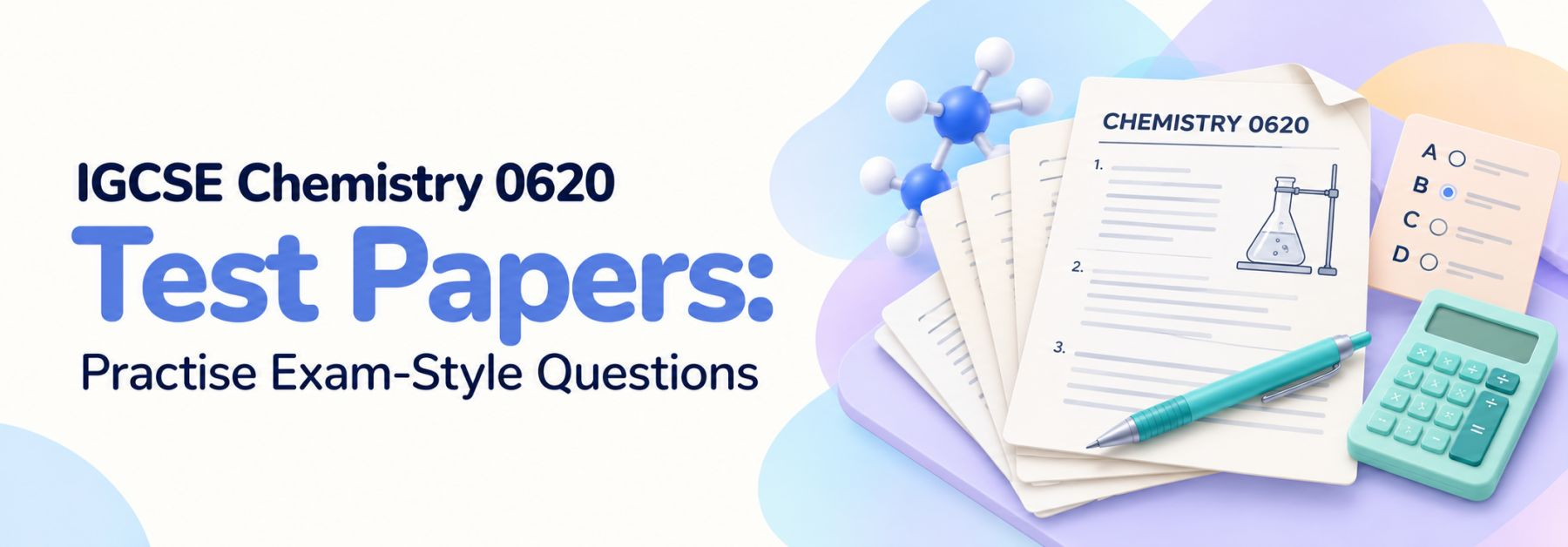
Understanding a Chemistry topic is only the first step. In an exam, you also need to recognise what the question is testing, choose the correct method and apply your knowledge accurately. IGCSE Chemistry 0620 Test Papers help you practise that transition from understanding a topic to using it independently in exam-style questions.
The goal is not simply to complete more questions. It is to use each round of practice to identify where your reasoning, calculation or interpretation needs improvement.
What Are IGCSE Chemistry 0620 Test Papers?
IGCSE Chemistry 0620 Test Papers provide targeted exam-style practice after the underlying Chemistry concept has been learned.
On HomeSchool Asia, students can select practice through:
Paper Type → Topic → Difficulty Level
This makes it possible to focus on a specific area instead of completing random questions.
For example, if you understand stoichiometry but still struggle to apply mole ratios accurately, targeted practice allows you to work specifically on that skill before moving into broader assessment.
Test Papers are most useful when you already understand the topic and now need to practise applying it independently.
Why Chemistry Practice Needs More Than Rereading Notes
Revision Notes can help you recognise definitions, equations and processes. However, recognising information is different from using it in a question.
You might be able to:
- Read a mole relationship but struggle to select it in a calculation.
- Recall a gas test but fail to recognise when it is needed in an experimental question.
- Remember a periodic trend but struggle to explain it.
- Read a balanced equation but use the wrong ratio in a calculation.
This is why practice matters.
Recognition is not the same as application.
Test Papers help you move from “I remember this” to “I can use this without guidance”.
What Should You Practise in Chemistry Test Papers?
Chemical Equations
Practise writing formulae, balancing equations and interpreting what an equation represents.
Do not check only whether the final equation looks correct. Ask whether each formula, coefficient and ratio makes chemical sense.
Calculations
Practise mole relationships, ratios, concentration, relative masses, units and multi-step calculations where relevant.
Show your working so that you can identify where an error begins.
Explanation Questions
Practise explaining Chemistry rather than simply stating facts.
This may involve particle behaviour, bonding, reactivity, energy changes, rates or trends.
Experimental Questions
Practise interpreting apparatus, observations, variables, measurements, chemical tests and data.
You should be able to connect:
Procedure → Observation → Chemical Explanation
Application Questions
A familiar idea may appear in a different context. Practice helps you recognise the underlying concept even when the wording or scenario changes.
How to Choose the Right Test Paper
Use the HomeSchool Asia selection structure:
Step 1 : Choose the Paper Type
Select the type of practice relevant to your current need.
Step 2 : Choose the Topic
Target the Chemistry area you want to strengthen.
Step 3 : Choose the Difficulty Level
Match the questions to your current stage of practice.
Paper Type → Topic → Difficulty Level
This is especially useful when you already know which area requires attention.
If you are repeatedly struggling with electrolysis, for example, targeted practice is more useful than completing unrelated questions from several topics.
How to Attempt Chemistry Test Papers Properly
Work Without Notes First
Attempt the questions independently before checking Revision Notes.
This shows whether you can retrieve and apply the Chemistry without prompts.
Show Working for Calculations
Write down equations, ratios, substitutions and units.
If the final answer is wrong, visible working helps you find the first incorrect step.
Use Precise Chemistry Language
Avoid vague descriptions in explanation questions. Use appropriate Chemistry terminology and explain the relationship the question is asking about.
Read Experimental Information Carefully
Pay attention to observations, variables, apparatus and data before deciding what the question requires.
Check Equations and Units
Review chemical formulae, balanced equations and calculation units before submitting.
Check Whether You Answered the Actual Question
A response can contain correct Chemistry but still fail to address what was asked.
How to Review Chemistry Test Paper Mistakes
Recall Error
You forgot a definition, test, formula, observation or reaction condition.
Concept Error
You could not explain the Chemistry behind the question.
Equation or Formula Error
You used the wrong formula, coefficient or chemical representation.
Calculation Error
The method may have been appropriate, but the ratio, unit, arithmetic or substitution was wrong.
Application Error
You understood the concept during revision but did not recognise how to use it in the question.
Experimental Reasoning Error
You misinterpreted an observation, variable, piece of apparatus or data.
Question Interpretation Error
You understood Chemistry but misunderstood what the question required.
The most useful habit is:
Find the first point where the solution went wrong.
A later mistake may simply be the result of an earlier one.
What to Do After a Test Paper Reveals a Weak Area
Your next step should depend on the type of error.
If You Forgot the Detail
Return to Revision Notes to refresh the relevant definition, equation, test or condition.
If the Concept Is Unclear
Return to the relevant Interactive Video and relearn the underlying Chemistry.
If the Method Is Clear but Accuracy Is Weak
Complete more targeted Test Paper practice.
If the Problem Still Does Not Make Sense
Use Tutor Support for additional academic guidance.
If You Are Ready for Broader Assessment
Move into Mock Exams when you can apply topics more consistently and want to practise switching between different areas of Chemistry.
From Targeted Practice to Broader Exam Preparation
Once you can apply an individual topic reliably, gradually move into broader practice.
A useful progression is:
Topic Practice → Mixed Practice → Mock Exam
Targeted Test Papers help you strengthen individual areas. Broader assessment then checks whether you can identify the required Chemistry when the topic is not already obvious.
A Practical IGCSE Chemistry Test Paper Routine
- Choose the Paper Type.
- Choose the Topic.
- Choose the Difficulty Level.
- Attempt the questions independently.
- Review the grade.
- Identify difficult questions.
- Classify each error.
- Correct the weakness.
- Practise again.
How HomeSchool Asia Supports Chemistry Practice
HomeSchool Asia Interactive Videos support concept learning, while Revision Notes reinforce content that students already understand. Test Papers provide targeted exam-style practice through Paper Type, Topic and Difficulty Level, while Mock Exams support broader assessment. Tutor Support can provide additional academic guidance when a Chemistry problem remains difficult after independent learning and practice.
Conclusion
Question practice is useful only when you review why your answers were right or wrong.
Use IGCSE Chemistry 0620 Test Papers to practise by Paper Type, Topic and Difficulty Level, then analyse the reasoning behind your mistakes. Correct the specific weakness before doing more questions so that each round of practice improves how you apply Chemistry independently.
Start Your IGCSE Chemistry (0620) Journey!

Premium Plan
- Full 12-month structured resources of all subjects.
- Full access to all Interactive Videos.
- Additional Tutor Credits to access features.
- Diagnostic Report available to all chapters.
- Downloadable Revision Notes available for all topics.
- “Get one Answer a Day” is activated for all subjects.

Custom Plan
- Full 12-month structured resources of chosen subjects.
- Full access to Interactive Videos for the chosen subject.
- Additional Tutor Credits to access features.
- Diagnostic Report available to all chapters.
- Downloadable Revision Notes available for all topics.
- “Get one Answer a Day” is activated for chosen subjects.
Frequently Asked Questions
What are IGCSE Chemistry 0620 Test Papers?
They are targeted exam-style practice resources designed to help students apply Chemistry concepts through questions.
How can I choose Chemistry Test Papers on HomeSchool Asia?
Use: Paper Type → Topic → Difficulty Level.
When should I start using Test Papers?
Use them after the underlying Chemistry concept is understood and you are ready to practise applying it independently.
How can Test Papers help with Chemistry calculations?
They allow you to practise selecting the correct method, using ratios and units, and reviewing where calculation errors occur.
What should I do after receiving my Test Paper grade?
Review difficult questions, classify the type of error and correct the specific weakness before practising again.
Do Test Papers generate Diagnostic Reports?
No. Test Papers provide grading for the practice completed; they do not generate Diagnostic Reports.
Do Test Papers include Instant Explanations?
No. Instant Explanations are associated with eligible End-of-Lesson Quiz questions after achieving 80% or higher.
What should I do if I keep making the same mistake?
Identify whether the repeated problem involves recall, concept, calculation, application or experimental reasoning, then target that specific issue.
When should I move from Test Papers to Mock Exams?
Move into Mock Exams when you are ready for broader assessment and want to practise bringing different Chemistry topics together.