Key Highlights
- Practise a broader range of Chemistry skills in one assessment.
- Test recall without relying on Revision Notes.
- Apply Chemistry concepts to unfamiliar questions.
- Work through calculations and experimental information independently.
- Identify why particular questions were difficult.
- Return to targeted revision or practice where needed.
- Reassess after addressing weaker areas.
Summarize with AI


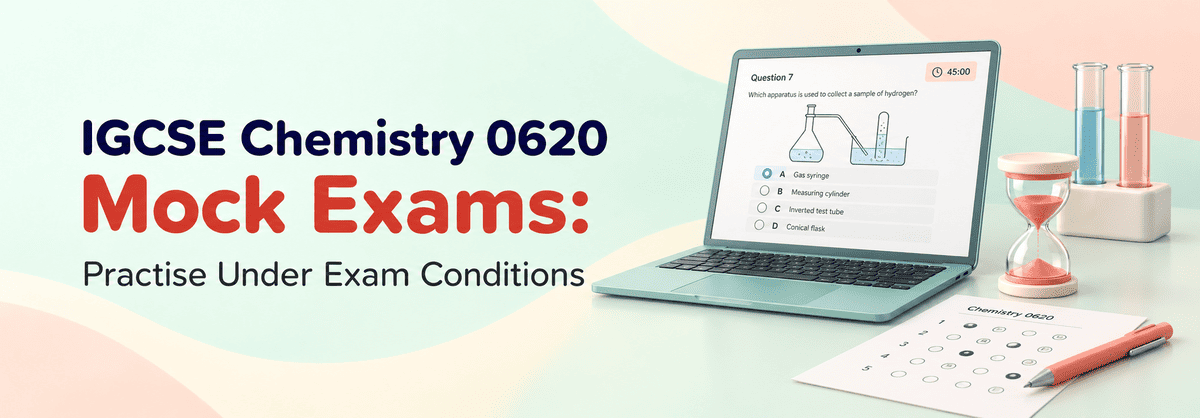
Practising one Chemistry topic at a time strengthens individual areas, but an examination requires you to move between concepts, calculations, experimental information and unfamiliar applications without relying on your notes. IGCSE Chemistry 0620 Mock Exams give you a broader way to test whether those skills work together.
A Mock Exam is most useful when you have already learned and revised the main topics and now want to see how well you can apply your Chemistry independently.
What Are IGCSE Chemistry 0620 Mock Exams?
IGCSE Chemistry 0620 Mock Exams are broader exam-style assessments that allow you to bring together different areas of Chemistry rather than practising only one topic at a time.
They are particularly useful once you have already worked through individual topics and want to check whether you can:
- Recall Chemistry knowledge independently
- Recognise which concept a question is testing
- Choose the correct calculation method
- Interpret data and observations
- Explain chemical processes
- Apply familiar ideas in unfamiliar contexts
A Mock Exam should not simply give you another score.
Its real value is showing what happens when you have to select and apply Chemistry knowledge without being told which topic to revise first.
What Does a Chemistry Mock Exam Actually Test?
A broader Chemistry assessment can reveal different types of difficulty.
Knowledge and Recall
You may forget a definition, test, equation, reaction condition, or chemical fact.
That does not always mean you do not understand the topic. Sometimes the information simply needs reinforcement.
Chemical Understanding
You may remember what happens but struggle to explain why it happens.
For example, knowing a trend or reaction is different from explaining it using particles, bonding, ions, or reactivity.
Calculations
You may select the correct method but make an error with a ratio, unit, quantity or arithmetic step.
Application
A concept may make sense during revision but become difficult when the question presents it in a different context.
Experimental Reasoning
You may struggle to interpret observations, apparatus, variables, measurements or experimental procedures.
Question Interpretation
Sometimes the Chemistry is understood, but the question itself is misread.
A useful Mock Exam review should therefore ask:
Was the problem recall, understanding, calculation, application, experimental reasoning or interpretation?
How to Prepare Before Taking a Mock Exam
A Mock Exam is more useful when obvious learning gaps have already been addressed.
Before attempting one:
- Review major Chemistry topics you have already studied.
- Revisit known weak areas.
- Refresh important equations, tests, and reaction conditions.
- Complete targeted questions on areas that still feel uncertain.
- Prepare the equipment you need.
- Choose an environment where you can work without interruption.
Most importantly, avoid using the Mock Exam as your first attempt to learn a topic.
If stoichiometry, electrolysis, or organic chemistry still does not make sense, relearn the concept first.
How to Practise Under Realistic Exam Conditions
You do not need to recreate every detail of an official examination for a Mock Exam to be useful. The aim is to make your attempt focused and independent.
Work Without Notes
Do not pause to search Revision Notes every time you forget something.
You need to see what you can recall and apply independently.
Read the Question Carefully
Identify:
- What information is given?
- What is being asked?
- Which Chemistry concept is relevant?
- Is a calculation, explanation, or observation required?
Show Your Working
For calculations, write the stages clearly.
If your answer is wrong, visible working makes it easier to identify where the mistake began.
Use Precise Chemistry Language
Avoid vague explanations when a question requires specific chemical reasoning.
Keep Moving
If one question becomes difficult, do not spend so long on it that you lose the opportunity to attempt the rest of the assessment.
Check Your Answers
Where relevant, check:
- Units
- Formulae
- Balanced equations
- Numerical working
- Significant figures
- Whether the explanation actually answers the question
Common Patterns a Mock Exam Can Reveal
You Know Facts but Cannot Apply Them
You may recall definitions and equations but struggle when the question changes the context.
This suggests that more application practice is needed.
Your Calculations Break Down Midway
Check the first incorrect step, not only the final answer.
The issue may be the method, ratio, unit, or arithmetic rather than the whole topic.
You Forget Tests or Conditions
These are often reinforcement problems. Revision Notes can help refresh the required detail.
You Misinterpret Experimental Information
You may need more practice connecting procedures, observations and chemical explanations.
You Can Describe What Happens but Cannot Explain Why
This usually points towards a conceptual gap.
Return to the underlying Chemistry rather than memorising another statement.
You Struggle When Topics Are Mixed
Topic-by-topic revision can feel easier because you already know what type of Chemistry to use. A Mock Exam removes that clue.
Practising broader assessment helps you develop method and concept selection.
From Mock Exam Result to Targeted Chemistry Improvement
Suppose a Mock Exam reveals that stoichiometry is causing difficulty.
Do not immediately take another full Mock Exam.
Instead, ask:
- Did I forget the formula?
- Do I understand the mole relationship?
- Did I choose the wrong ratio?
- Did I mishandle units?
- Was the arithmetic incorrect?
Once you identify the exact problem:
- Review or relearn it.
- Complete targeted questions.
- Check whether the same mistake still occurs.
- Return to broader assessment later.
This approach is more useful than repeatedly taking full Mock Exams without correcting the underlying issue.
Mock Exams and Diagnostic Reports
Diagnostic Reports provide broader mastery information using:
- Inadequate — 80% and below
- Adequate — 80% and above
- Complete — 100%
These mastery levels can help students decide which areas deserve further attention.
Do not treat Mock Exam or Test Paper results as automatically generating these mastery levels. Test Papers provide grading for completed practice, while Diagnostic Reports provide broader mastery information.
A Practical IGCSE Chemistry 0620 Mock Exam Routine
Use this repeatable process:
- Review the major topics you have studied.
- Address obvious weak areas.
- Attempt the Mock independently.
- Review the result.
- Identify difficult questions.
- Classify each difficulty.
- Relearn or revise where necessary.
- Complete targeted practice.
- Reassess later.
Prepare → Attempt → Review → Target → Improve → Reassess
How HomeSchool Asia Supports Mock Exam Preparation
HomeSchool Asia allows students to move between learning, revision, and assessment according to what their Mock Exam reveals. Revision Notes reinforce previously learned content, while Interactive Videos support relearning. End-of-Lesson Quizzes check understanding, with eligible Instant Explanations available after achieving 80% or higher. Test Papers provide targeted practice, Mock Exams support broader assessment, Diagnostic Reports provide broader mastery information, and Tutor Support can provide additional guidance when a Chemistry problem remains unresolved.
Conclusion
A Mock Exam is useful when it tells you more than your score.
Use each IGCSE Chemistry 0620 Mock Exam to see how well your recall, calculations, chemical understanding, application and experimental reasoning work together. Then review the questions that caused difficulty, identify the type of error, and target that specific problem before your next broader assessment.
Start Your IGCSE Chemistry (0620) Journey!

Premium Plan
- Full 12-month structured resources of all subjects.
- Full access to all Interactive Videos.
- Additional Tutor Credits to access features.
- Diagnostic Report available to all chapters.
- Downloadable Revision Notes available for all topics.
- “Get one Answer a Day” is activated for all subjects.

Custom Plan
- Full 12-month structured resources of chosen subjects.
- Full access to Interactive Videos for the chosen subject.
- Additional Tutor Credits to access features.
- Diagnostic Report available to all chapters.
- Downloadable Revision Notes available for all topics.
- “Get one Answer a Day” is activated for chosen subjects.
Frequently Asked Questions
What is an IGCSE Chemistry 0620 Mock Exam?
It is a broader exam-style assessment used to practise applying different Chemistry skills and topics together.
When should I start taking Chemistry Mock Exams?
Use them after you have learned and revised the main topics and are ready to assess your preparation more broadly.
Should I use notes during a Mock Exam?
For realistic independent practice, avoid relying on Revision Notes while completing the assessment.
What should I do after completing a Mock Exam?
Review difficult questions, identify the type of error, and choose the appropriate revision or practice response.
What if calculations are my weakest area?
Find the first stage where the calculation goes wrong, correct that specific issue, and complete targeted calculation practice.
Should I take another Mock Exam immediately after a low result?
Not necessarily. Address the main weaknesses first, practise them, and then reassess later.
Do Test Papers generate Diagnostic Reports?
No. Test Papers provide grading for the practice completed; they do not generate Diagnostic Reports.
What are the Diagnostic Report mastery levels?
They are Inadequate at 80% and below, Adequate at 80% and above, and Complete at 100%.