Key Highlights
- Learn difficult Chemistry concepts step by step.
- Visualise particle, bonding, and reaction processes.
- Follow calculations and chemical reasoning more clearly.
- Connect structures with properties.
- Check understanding through End-of-Lesson Quizzes.
- Access eligible Instant Explanations after achieving 80% or higher.
- Move into independent practice once the concept makes sense.
Summarize with AI


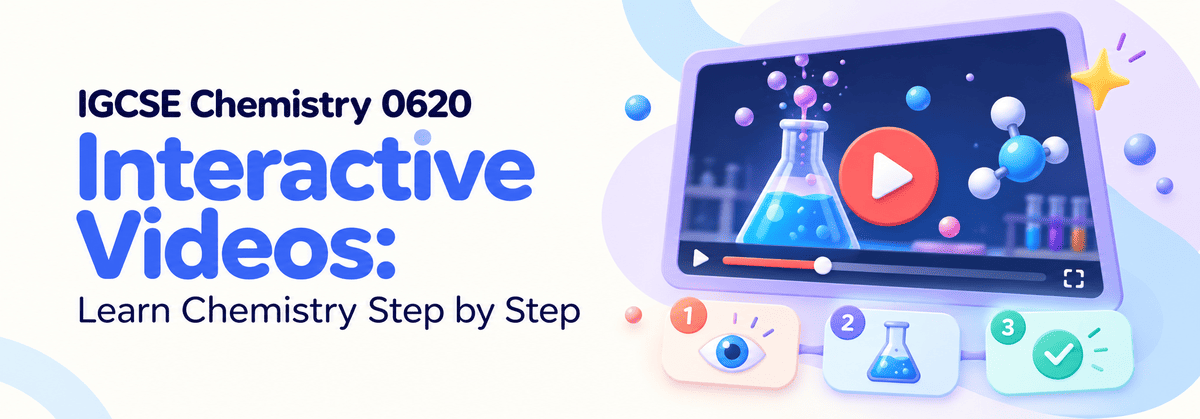
Some IGCSE Chemistry 0620 topics are difficult because the important changes happen at the particle, ionic, or molecular level. You may remember the final fact but still struggle to explain why it happens. Interactive Videos can help you follow Chemistry step by step, connect diagrams and processes with explanations, and check whether the concept still makes sense when you answer independently.
Why Some IGCSE Chemistry Concepts Are Difficult to Learn From Notes Alone
Chemistry combines things you can observe with things you cannot see directly.
A reaction may produce a colour change, gas or precipitate, but understanding it often requires thinking about particles, ions, electrons or bonding. The same applies to electrolysis, energy changes, diffusion and chemical calculations.
For example, memorising that an ionic compound conducts electricity when molten is different from understanding why. You also need to know that the ions are free to move and carry charge.
Interactive Videos are useful when you need to connect:
- What you observe
- What particles or ions are doing
- What the equation represents
- Why the process happens
- How the idea is applied in a question
Knowing the sentence is not the same as understanding Chemistry.
How Interactive Videos Help You Learn Chemistry Step by Step
Interactive Videos should help you follow the reasoning rather than simply watch a finished solution.
Start With the Concept
First, identify what is actually happening.
If the lesson is about electrolysis, for example, understand which particles are present before trying to remember which products form.
Follow the Process
Look at how one stage leads to the next.
Ask:
- What changes?
- What stays the same?
- Which particles move?
- Which substance reacts?
- Why does the next step happen?
Connect the Visual With the Chemistry
Diagrams are most useful when you understand what they represent.
A particle diagram, structural formula, or electrolysis setup should help you connect a visual process with the underlying Chemistry.
Understand Why
Do not stop at “this is what happens”.
Ask why the reaction, property, trend, or calculation works that way.
Check Independently
After the explanation, check your conceptual understanding with End-of-Lesson Quizzes after completion of each video lesson.
Chemistry Topics That Benefit From Step-by-Step Learning
Particle Behaviour and States of Matter
Visual explanations can help you connect particle arrangement and movement with solids, liquids, gases, diffusion and changes of state.
Atomic Structure and Bonding
Following electrons, ions and bonding step by step can make ionic, covalent and metallic structures easier to understand.
Stoichiometry
Interactive learning can help show how equations, quantities and mole ratios connect instead of turning calculations into memorised steps.
Electrochemistry
Electrolysis becomes clearer when you can follow which ions are present, where they move and why particular products form.
Energetics and Chemical Reactions
Step-by-step explanations can help connect bond breaking, bond formation, energy change, reaction rate and reversible reactions with the Chemistry behind them.
Organic Chemistry
Visual learning can support understanding of structures, functional groups, reactions and how one type of compound changes into another.
Experimental Chemistry
Interactive explanations can help connect procedures with observations and explain why each stage of an experiment matters.
Use the End-of-Lesson Quiz to Check Understanding
Interactive Videos include End-of-Lesson Quizzes.
The quiz acts as a checkpoint after learning:
Learn → Attempt → Check
It helps answer:
Did I actually understand Chemistry, or did it only make sense while the explanation was in front of me?
A difficult quiz question may indicate that:
- The concept is still unclear
- A detail has been forgotten
- A calculation method needs more work
- The concept is understood but difficult to apply independently
The important step is to review why the question was difficult rather than looking only at the result.
What Happens After You Achieve 80% or Higher?
After achieving 80% or higher in an End-of-Lesson Quiz within an Interactive Video lesson, eligible Instant Explanations can help you understand the relevant quiz questions.
The pathway is:
Interactive Video → End-of-Lesson Quiz → 80%+ → Eligible Instant Explanation
Use eligible explanations to ask:
- What concept was being tested?
- Why does the correct approach work?
- Where did my reasoning differ?
- Does the wider topic need another review?
Not every question is eligible, and Instant Explanations are not a Test Paper or Mock Exam feature.
How to Know Whether You Really Understand Chemistry
Before moving on, check whether you can:
Explain It Without the Video
Can you describe the process in your own words?
Reconstruct the Process
Can you redraw the diagram, equation, or sequence?
Explain Why, Not Just What
Can you explain the Chemistry behind the result?
Apply It to a Different Example
Can you recognise the same concept when the context changes?
Complete a Related Calculation
Can you carry out the method independently?
Predict an Observation or Outcome
Can you use the concept to work out what should happen next?
If several of these remain difficult, the concept probably needs another learning cycle.
From Interactive Video to Independent Practice
Once the Chemistry makes sense, move from learning into reinforcement and practice.
Use Revision Notes to refresh definitions, equations, tests, conditions and processes that you already understand.
Then use Test Papers selected by:
Paper Type → Topic → Difficulty Level
This lets you practise applying the concept without step-by-step guidance.
When reviewing errors, identify whether the problem came from:
- Understanding
- Recall
- Calculation
- Application
- Experimental reasoning
A Practical IGCSE Chemistry Interactive Video Routine
- Choose the Chemistry concept you need to learn.
- Watch the explanation actively.
- Pause at important processes.
- Predict the next step where possible.
- Explain the concept in your own words.
- Complete the End-of-Lesson Quiz.
- Review eligible Instant Explanations after achieving 80% or higher.
- Reinforce important details.
- Move into targeted question practice.
How HomeSchool Asia Supports Step-by-Step Chemistry Learning
HomeSchool Asia Interactive Videos support concept learning by helping students work through Chemistry ideas and processes step by step. End-of-Lesson Quizzes check understanding, while eligible Instant Explanations become available after achieving 80% or higher. Revision Notes reinforce learned content, Test Papers provide targeted practice, and Tutor Support offers additional guidance when a Chemistry concept remains difficult.
Conclusion
Memorising a Chemistry fact and understanding why it happens are not the same thing.
Use IGCSE Chemistry 0620 Interactive Videos when the concept itself is unclear. Follow the process step by step, connect what you see with the Chemistry behind it, check understanding through the End-of-Lesson Quiz, and then move into independent practice once you can explain and apply the idea yourself.
See → Follow → Understand → Check → Apply
Start Your IGCSE Chemistry (0620) Journey!

Premium Plan
- Full 12-month structured resources of all subjects.
- Full access to all Interactive Videos.
- Additional Tutor Credits to access features.
- Diagnostic Report available to all chapters.
- Downloadable Revision Notes available for all topics.
- “Get one Answer a Day” is activated for all subjects.

Custom Plan
- Full 12-month structured resources of chosen subjects.
- Full access to Interactive Videos for the chosen subject.
- Additional Tutor Credits to access features.
- Diagnostic Report available to all chapters.
- Downloadable Revision Notes available for all topics.
- “Get one Answer a Day” is activated for chosen subjects.
Frequently Asked Questions
What are IGCSE Chemistry 0620 Interactive Videos?
They are learning resources designed to help students understand Chemistry concepts, processes, and methods step by step.
How can Interactive Videos help with difficult Chemistry concepts?
They can help students connect diagrams, particles, equations and processes with the reasoning behind them.
Which Chemistry topics are useful to learn visually?
Topics such as bonding, electrolysis, stoichiometry, energetics, organic chemistry, particle behaviour and experimental processes can benefit from visual, step-by-step explanations.
Do Interactive Videos include quizzes?
Yes. Interactive Videos include End-of-Lesson Quizzes to check understanding after learning.
When are Instant Explanations available?
They are available for eligible questions after achieving 80% or higher in an End-of-Lesson Quiz within an Interactive Video lesson.
Should I use Revision Notes or Interactive Videos first?
If the concept itself is unclear, use Interactive Videos. If you already understand it but need to refresh details, use Revision Notes.
What should I do after completing an Interactive Video?
Complete the End-of-Lesson Quiz, review your understanding, and then move into reinforcement and targeted practice.
How can I practise after learning the concept?
Use Test Papers selected by Paper Type → Topic → Difficulty Level.