Key Highlights
- Practise targeted A Level Chemistry questions.
- Select practice by Paper Type, Topic, and Difficulty Level.
- Apply Chemistry knowledge independently.
- Strengthen calculations, explanations, and chemical reasoning.
- Practise organic, experimental and data-based questions.
- Review individual mistakes instead of focusing only on the grade.
- Correct weaknesses before increasing the difficulty.
Summarize with AI


Understanding Chemistry in a lesson is different from applying it in a question. You may understand equilibrium but struggle with the calculation, remember an organic reaction but forget its conditions, or recognise a chemical trend without explaining it precisely.
A Level Chemistry 9701 Test Papers help you move from learning and revision into targeted exam-style practice so you can find out whether you can apply Chemistry accurately and independently.
What Are A Level Chemistry 9701 Test Papers?
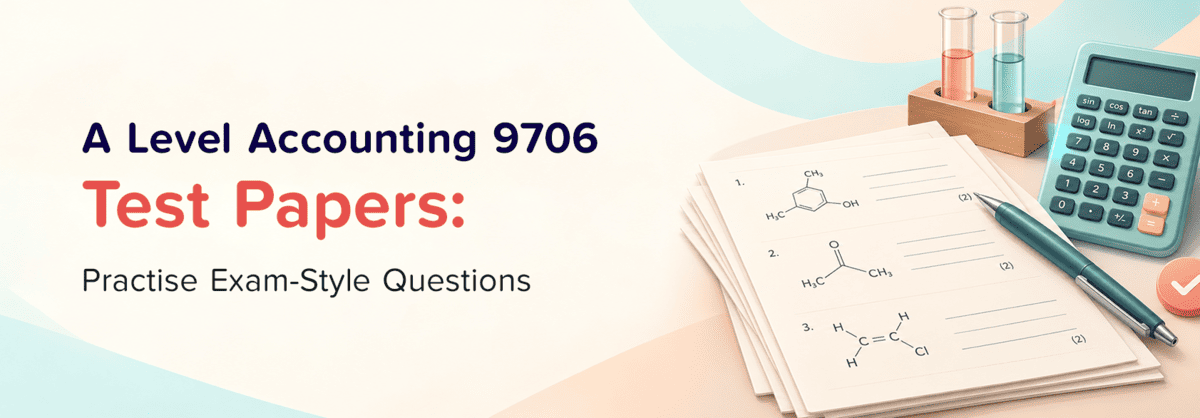
HomeSchool Asia Test Papers provide targeted exam-style practice after you have already learned or revised a Chemistry topic.
They help you move from:
“I understand this Chemistry topic.”
to:
“I can apply it correctly in a question.”
You can select Test Papers through:
Paper Type → Topic → Difficulty Level
This allows you to focus your practice on the Chemistry that actually needs attention instead of repeatedly working through areas you already understand.
For example, you may understand equilibrium theory but need more practice setting up calculations. Or you may remember organic reactions but frequently confuse reagents and conditions.
Test Papers provide grading for the practice completed; they do not generate Diagnostic Reports.
Why Targeted Chemistry Practice Matters
A wrong Chemistry answer can have several different causes.
You may know the topic but:
- Apply the wrong chemical principle.
- Set up a calculation incorrectly.
- Forget an important condition.
- Use an imprecise explanation.
- Misinterpret experimental data.
- Make a numerical error despite correct reasoning.
That means simply completing more random Chemistry questions may not solve the problem.
Suppose you understand organic reaction pathways but repeatedly confuse reagents. Your practice should focus on that weakness rather than restarting the whole topic.
More Chemistry questions are useful when they practise the skill that actually needs improvement.
How to Choose the Right Test Paper
Paper Type
Select the relevant type of practice according to what you want to work on.
The aim is to start with a clear purpose rather than choosing questions without knowing what skill you are testing.
Topic
Choose the Chemistry area that needs attention.
For example, you may want targeted practice in equilibrium, energetics, organic Chemistry, bonding, or quantitative Chemistry.
Difficulty Level
Choose a difficulty that matches your current understanding.
If you are still developing a method, focus first on applying it accurately. Once the Chemistry becomes more secure, move towards questions that require more interpretation or combine several ideas.
What Chemistry Skills Should You Practise?
A Level Chemistry Test Papers should develop more than factual recall.
Chemical Calculations
Can you identify the correct chemical relationship before starting the arithmetic?
For quantitative questions, setting up the Chemistry correctly matters as much as the calculation itself. This may include work involving moles, concentrations, stoichiometry, energetics or equilibria.
Equations and Chemical Representation
Can you write and interpret chemical information accurately?
Check details such as formulae, equation balance, charges and other relevant chemical representations.
Explanation Questions
Knowing the principle is not enough if your written explanation does not connect it clearly to the question.
Practise explaining trends, bonding, energetics, equilibrium, reaction behaviour and other chemical ideas precisely.
Organic Chemistry
Use practice questions to check whether you can identify:
- Reagents
- Conditions
- Products
- Functional-group changes
- Reaction pathways
- Relevant mechanistic reasoning
Data and Experimental Questions
Can you extract useful Chemistry from graphs, tables, observations and experimental results?
These questions often test interpretation as much as recall.
Multi-Step Application
Some questions require several Chemistry ideas to be connected.
A difficult Chemistry question may test several small decisions rather than one large piece of knowledge.
How to Attempt Chemistry Test Papers Effectively
Read the Command Carefully
Look at whether the question asks you to calculate, explain, describe, suggest or deduce.
These commands require different kinds of responses.
Identify the Chemistry First
Before calculating or writing an explanation, decide which chemical principle is relevant.
Do not start manipulating numbers simply because numerical information is provided.
Show Your Working
For quantitative Chemistry, make the stages of your calculation clear.
If your final result is incorrect, visible working makes it easier to identify the first point where the approach went wrong.
Use Precise Chemical Language
Avoid vague explanations.
Try to connect the observation or result directly to the relevant chemical principle.
Check Your Final Answer
Where relevant, review:
- Units
- Significant figures
- Equation balance
- Charges
- Chemical formulae
- Reagents and conditions
- Whether the result is chemically reasonable
Don't Review Only the Grade
A grade tells you how the completed Test Paper went, but it does not automatically tell you what to improve.
Go back through incorrect and uncertain questions.
Ask:
- Was important knowledge missing?
- Did I apply the wrong principle?
- Was the calculation set up incorrectly?
- Was the explanation too vague?
- Did I confuse reagents or conditions?
- Did I misread the experimental information?
- Did an early error affect later parts?
The grade shows how the practice went. Reviewing the Chemistry behind each mistake shows what to improve.
What Type of Chemistry Error Did You Make?
Knowledge Error
A fact, definition, reagent, condition, or relationship was forgotten.
Concept Error
The underlying Chemistry was not understood correctly.
Application Error
You knew the concept but did not apply it appropriately to the question.
Calculation Error
The chemical setup or numerical working was incorrect.
Explanation Error
You understood the idea but expressed it too vaguely or incompletely.
Interpretation Error
You misread data, observations, graphs, or experimental evidence.
Multi-Step Error
A mistake early in the solution affected later reasoning.
What to Do After a Test Paper Mistake
Your next step should depend on the type of error.
If you forgot a definition, formula, reagent, condition, or familiar relationship, use Revision Notes to reinforce it.
If the underlying Chemistry itself does not make sense, return to the relevant Interactive Video.
If the concept is clear but your calculation, explanation or application was weak, correct the exact mistake and practise again.
If you need more questions on the same area, select another targeted Test Paper.
If the reasoning still remains unclear, Tutor Support can provide additional academic guidance.
Test Papers vs Mock Exams
Use Test Papers when you know which Chemistry topic or skill you want to practise.
Use Mock Exams when you are ready to test several Chemistry areas together in a broader assessment.
Targeted practice develops specific skills; broader assessment checks whether those skills work together.
A Practical A Level Chemistry 9701 Test Paper Routine
- Identify the Chemistry topic or skill.
- Select Paper Type, Topic, and Difficulty Level.
- Attempt the questions independently.
- Review the grade.
- Identify incorrect or uncertain questions.
- Classify each error.
- Correct the underlying issue.
- Complete further targeted practice.
- Increase difficulty or move to broader assessment when ready.
Select → Attempt → Review → Correct → Repeat
How HomeSchool Asia Supports Chemistry Practice
HomeSchool Asia combines resources for different stages of Chemistry learning. Interactive Videos support concept learning, while Revision Notes reinforce key knowledge. End-of-Lesson Quizzes check understanding, and after achieving 80% or higher, eligible Instant Explanations can help clarify relevant quiz questions. Test Papers provide targeted practice, Mock Exams support broader assessment, Diagnostic Reports provide broader mastery information, and Tutor Support offers additional academic guidance where needed.
Conclusion
Chemistry practice is most useful when you know exactly what you are trying to improve.
Use A Level Chemistry 9701 Test Papers to target specific topics and difficulty levels, apply chemical knowledge independently, and identify where calculations, explanations, or chemical reasoning break down.
Correct the underlying problem before simply completing more questions, then increase the challenge or move towards broader assessment once your application becomes more secure.
Start Your A-Level Chemistry (9701) Journey!

Premium Plan
- Full 12-month structured resources of all subjects.
- Full access to all Interactive Videos.
- Additional Tutor Credits to access features.
- Diagnostic Report available to all chapters.
- Downloadable Revision Notes available for all topics.
- “Get one Answer a Day” is activated for all subjects.

Custom Plan
- Full 12-month structured resources of chosen subjects.
- Full access to Interactive Videos for the chosen subject.
- Additional Tutor Credits to access features.
- Diagnostic Report available to all chapters.
- Downloadable Revision Notes available for all topics.
- “Get one Answer a Day” is activated for chosen subjects.
Frequently Asked Questions
What are A Level Chemistry 9701 Test Papers?
They are targeted exam-style practice resources for applying Chemistry knowledge independently after learning or revision.
How can Test Papers help with A Level Chemistry revision?
They help you check whether you can apply concepts, calculations and chemical reasoning rather than simply recall information.
Can I choose which Chemistry topic to practise?
Yes. Test Papers can be selected through Paper Type → Topic → Difficulty Level.
What Chemistry skills should I practise?
Focus on calculations, equations, explanations, organic Chemistry, data interpretation, experimental reasoning, and application.
What should I do when I get a Chemistry question wrong?
Identify whether the problem came from knowledge, concept, application, calculation, explanation, or interpretation, then correct that specific issue.
Do Test Papers include Instant Explanations?
No. Instant Explanations are connected to eligible End-of-Lesson Quiz questions within Interactive Video lessons after achieving 80% or higher.
Do Test Papers generate Diagnostic Reports?
No. Test Papers provide grading for the practice completed; they do not generate Diagnostic Reports.
When should I use Mock Exams instead?
Use Mock Exams when you are ready for broader assessment across several Chemistry areas.
What if I still do not understand a Chemistry problem?
Return to the relevant learning resource. If the difficulty remains unresolved, Tutor Support can provide additional academic guidance.