Key Highlights
- Understand the reasoning behind eligible Chemistry quiz questions.
- Access eligible Instant Explanations after achieving 80% or higher.
- Separate conceptual errors from recall and calculation errors.
- Identify where your chemical reasoning first went wrong.
- Return to learning if the underlying Chemistry remains unclear.
- Apply corrected reasoning independently.
- Check whether the same mistake appears again.
Summarize with AI


A wrong answer in A-Level Chemistry does not always mean you misunderstood the topic. You may understand stoichiometry but use the wrong mole ratio, know an organic reaction but forget its condition, or understand an equilibrium principle but apply it incorrectly.
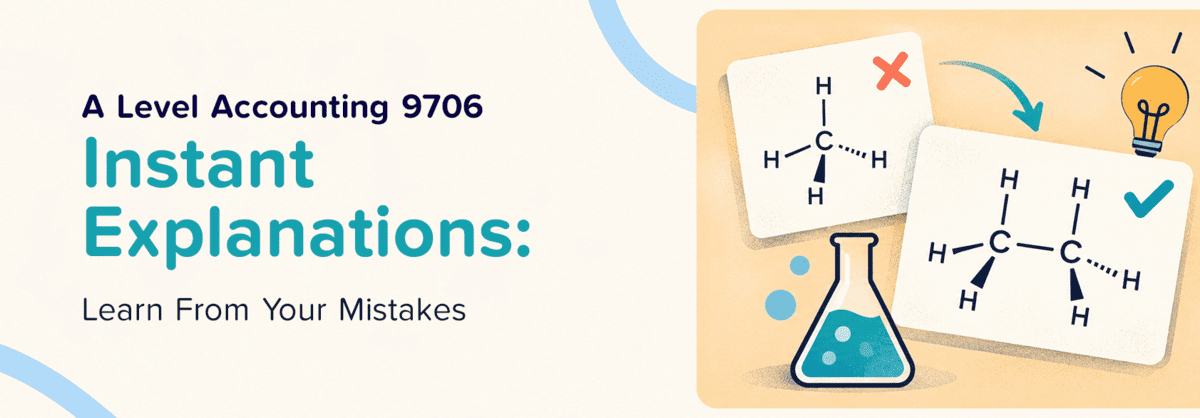
A-Level Chemistry 9701 Instant Explanations can help you examine the reasoning behind eligible End-of-Lesson Quiz questions, identify the specific error, and correct it before moving into further practice.
What Are A-Level Chemistry 9701 Instant Explanations?
Instant Explanations are a clarification tool connected to HomeSchool Asia's Interactive Video learning journey.
The correct flow is:
Interactive Video → End-of-Lesson Quiz → 80%+ → Eligible Instant Explanation
After achieving 80% or higher in an End-of-Lesson Quiz within an Interactive Video lesson, eligible Instant Explanations can help you understand the relevant quiz questions.
Their purpose is not simply to show a correct answer that you can memorise. Instead, they help you examine the Chemistry or reasoning involved in the relevant question.
This is especially important in A-Level Chemistry because the same incorrect answer could result from very different problems.
Why Seeing the Correct Chemistry Answer Is Not Enough
Simply comparing:
Your Answer → Correct Answer
does not necessarily explain the mistake.
Suppose you answer a stoichiometry question incorrectly. Several things could have happened:
- The equation was not balanced correctly.
- The wrong mole ratio was used.
- A quantity was converted incorrectly.
- The final arithmetic was inaccurate.
The topic is still stoichiometry, but the correction required depends on the actual error.
The same applies to organic chemistry. Selecting the wrong product could mean that you misunderstood the reaction, forgot the reagent, confused the condition or misidentified the functional group.
Instead of asking only:
“What is the correct answer?”
ask:
“Where did my chemical reasoning first become incorrect?”
Understanding the cause of an error is more useful than memorising one corrected answer.
What Type of Chemistry Mistake Did You Make?
Concept Error
The underlying chemical principle is unclear.
You may, for example, remember a statement about equilibrium, bonding or energetics without understanding why it applies to the question.
Recall Error
You understand the Chemistry but have forgotten information such as:
- A definition
- A reagent
- A reaction condition
- A formula
- A trend
- A chemical test
This usually requires reinforcement rather than relearning the entire concept.
Calculation Error
You identify the correct Chemistry but make an error in the numerical working.
This can occur in mole, concentration, gas, energetics or other quantitative questions.
Stoichiometry Error
You recognise the reaction but use the relationship incorrectly.
For example, you may use the wrong coefficient from the equation when converting between moles of two substances.
Organic Chemistry Error
You may confuse a functional group, reagent, reaction condition, product, or reaction pathway.
The mistake might be recall, application, or conceptual understanding depending on where the reasoning failed.
Interpretation Error
You misread a graph, table, experimental observation, or analytical information provided in the question.
Application Error
You understand the Chemistry in a familiar example but cannot recognise the same principle when the question is presented differently.
A wrong Chemistry answer does not automatically mean the whole topic is misunderstood.
What Should You Do After Reading an Instant Explanation?
Do not read the explanation and immediately move to another question.
1. Close the Explanation
Remove the support so you are not simply copying it.
2. Explain the Chemistry Yourself
Describe why the correct reasoning works.
If you cannot explain it, return to the part that remains unclear.
3. Retry the Question
Attempt it again without referring to the explanation.
4. Try a Similar Question
Check whether the reasoning transfers when the values, substances, or context changes.
5. Record the Error Pattern
Keep track of specific errors such as:
- Wrong mole ratio
- Forgotten condition
- Incorrect oxidation state
- Equation-balancing error
- Misread data
- Calculation error
Use:
Understand → Retry → Transfer → Check
When You Need to Relearn the Chemistry
Sometimes an explanation reveals that the problem is deeper than one mistake.
You may be able to follow the corrected answer but still not understand why the chemical principle applies.
In that case, return to the relevant Interactive Video.
If you can follow the corrected answer but still cannot explain why the Chemistry works, return to the concept before completing more questions.
Interactive Videos are the concept-learning stage. Instant Explanations clarify reasoning behind eligible quiz questions; they are not a replacement for learning the underlying Chemistry.
When Revision Notes Are the Better Next Step
If the concept itself makes sense but you forgot information, Revision Notes may be more appropriate.
For example, you may need to reinforce:
- A definition
- A reagent
- A reaction condition
- A formula
- A periodic trend
- A chemical equation
If the concept is clear but the information was forgotten, reinforce it rather than relearning the whole topic.
Move From Explanation to Targeted Practice
Once you understand why the mistake occurred, test the corrected reasoning independently.
HomeSchool Asia Test Papers can be selected through:
Paper Type → Topic → Difficulty Level
This allows you to focus practice on the area that needs attention.
Use:
Explanation → Correction → Practice → Review
Test Papers provide grading for the practice completed; they do not generate Diagnostic Reports.
Instant Explanations are not available within Test Papers.
How to Stop Repeating the Same Chemistry Mistakes
A single error may be accidental. A repeated error is something to investigate.
Track patterns such as:
- Mole ratios
- Unit conversions
- Formula selection
- Reagents and conditions
- Oxidation states
- Equation balancing
- Data interpretation
- Organic reaction pathways
Ask:
“Have I made this same type of Chemistry error before?”
If the answer is yes, turn that pattern into a specific revision or practice target rather than simply attempting more unrelated questions.
How HomeSchool Asia Supports Learning From Chemistry Mistakes
HomeSchool Asia combines different resources for different stages of Chemistry learning. Interactive Videos support concept learning, while End-of-Lesson Quizzes check understanding. After achieving 80% or higher, eligible Instant Explanations can clarify relevant quiz questions. Revision Notes reinforce information already learned, Test Papers provide targeted practice, Mock Exams support broader assessment, Diagnostic Reports provide broader mastery information, and Tutor Support offers additional academic guidance where required.
Conclusion
A wrong Chemistry answer becomes useful when you understand why it happened.
Use A-Level Chemistry 9701 Instant Explanations to examine the reasoning behind eligible End-of-Lesson Quiz questions and identify whether the difficulty came from conceptual understanding, recall, stoichiometry, calculation, interpretation or application.
Correct that specific problem, retry the reasoning independently and practise it in another context. The goal is not to remember one corrected answer, but to avoid repeating the same chemical reasoning error.
Start Your A-Level Chemistry (9701) Journey!

Premium Plan
- Full 12-month structured resources of all subjects.
- Full access to all Interactive Videos.
- Additional Tutor Credits to access features.
- Diagnostic Report available to all chapters.
- Downloadable Revision Notes available for all topics.
- “Get one Answer a Day” is activated for all subjects.

Custom Plan
- Full 12-month structured resources of chosen subjects.
- Full access to Interactive Videos for the chosen subject.
- Additional Tutor Credits to access features.
- Diagnostic Report available to all chapters.
- Downloadable Revision Notes available for all topics.
- “Get one Answer a Day” is activated for chosen subjects.
Frequently Asked Questions
What are A-Level Chemistry 9701 Instant Explanations?
They help students understand the reasoning behind eligible End-of-Lesson Quiz questions within Interactive Video lessons.
When do Instant Explanations become available?
After achieving 80% or higher in an End-of-Lesson Quiz within an Interactive Video lesson, for eligible questions.
Are Instant Explanations available for every Chemistry question?
No. They are available only for eligible End-of-Lesson Quiz questions.
Are Instant Explanations available in Test Papers?
No. Instant Explanations are not a Test Paper feature.
Are Instant Explanations available in Mock Exams?
No. They are not a Mock exam feature.
How can Instant Explanations help with Chemistry calculations?
For eligible quiz questions, they can help clarify the reasoning involved so you can examine whether the problem came from Chemistry, the calculation or how the information was applied.
What if I still do not understand the Chemistry concept?
Return to the relevant Interactive Video. Tutor Support can provide additional academic guidance if the difficulty remains unresolved.
What should I do after understanding my mistake?
Retry the reasoning independently, then move into targeted practice to check whether you can apply it elsewhere.
Do Test Papers generate Diagnostic Reports?
No. They provide grading for the practice completed; they do not generate Diagnostic Reports.