Key Highlights
- Identify Chemistry topics that require more attention.
- Separate broader mastery from one practice score.
- Find the type of weakness behind a topic.
- Distinguish recall, conceptual, calculation and application problems.
- Target organic, analytical or practical difficulties more precisely.
- Use Test Papers for focused practice after diagnosis.
- Reassess after correcting the underlying weakness.
Summarize with AI


A low Chemistry result tells you that marks were lost, but it does not tell you what needs fixing. The problem might be equilibrium calculations, forgotten organic reagents, unfamiliar applications or interpreting experimental data.
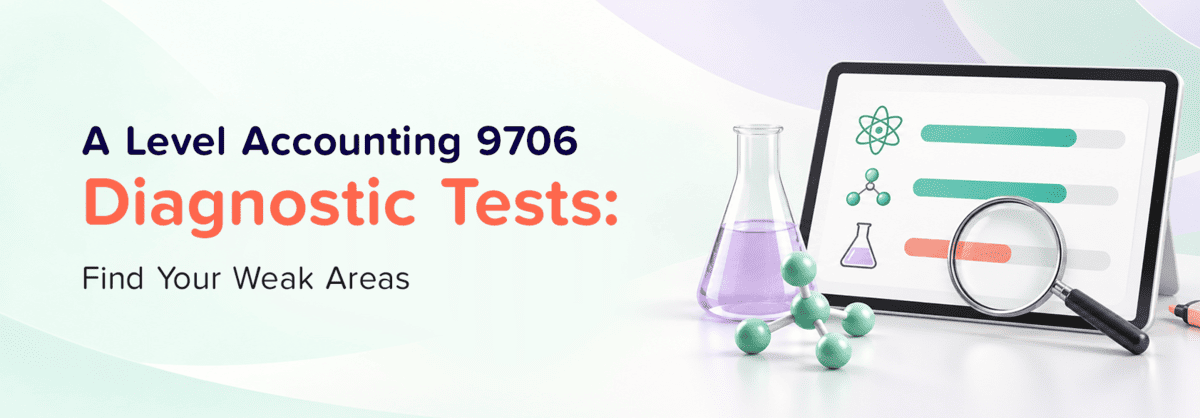
A-Level Chemistry 9701 Diagnostic Tests can help turn a broad weak topic into a more specific revision target, so you can focus your time on what actually needs improvement.
What Is an A-Level Chemistry 9701 Diagnostic Test?
An A-Level Chemistry diagnostic test helps you identify areas where your current Chemistry knowledge or skills require further attention.
Its purpose is not simply to give you another percentage. It should help you answer:
- Which Chemistry area needs work?
- What type of problem am I having?
- Do I need to relearn, revise or practise?
- What should I work on next?
For example, a weak result in equilibria does not automatically mean you do not understand equilibrium. You may understand the theory but struggle with calculations or applying the ideas in unfamiliar situations.
A Diagnostic Report is useful when it changes what you revise next, not when it simply gives you another score.
Why Your Overall Chemistry Score Does Not Tell the Whole Story
Imagine two students receive the same overall result.
Student A understands Chemistry but repeatedly loses marks in stoichiometric and equilibrium calculations.
Student B calculates accurately but struggles to explain chemical behaviour when the question is presented in an unfamiliar context.
Their percentages may look similar, but their revision needs are different.
Student A needs focused quantitative practice. Student B needs more work on chemical reasoning and application.
The useful question is not only “What did I score?” but “Why did I lose marks?”
That is the difference between simply recording performance and using it to improve.
Understanding Your Diagnostic Report
HomeSchool Asia uses the following broader mastery framework:
| Mastery Level | Threshold |
|---|---|
| Inadequate | 80% and below |
| Adequate | 80% and above |
| Complete | 100% |
Inadequate: 80% and below
This area requires further attention.
The next step is to determine whether the weakness involves conceptual understanding, recall, calculations, application, chemical reasoning, data interpretation, or practical skills.
Adequate: 80% and Above
You have reached the Adequate threshold, but further reinforcement or practice may still be useful, particularly with unfamiliar applications.
Complete: 100%
Complete represents full mastery within the HomeSchool Asia mastery framework.
Do not stop at the mastery label. Investigate the Chemistry difficulty behind it.
What Type of Chemistry Weakness Do You Have?
Knowing the weak topic is only the first stage. You also need to know why it is weak.
Concept Weakness
You cannot explain why Chemistry works.
For example, you may remember that equilibrium shifts but not understand why changing conditions affects the position of equilibrium.
Recall Weakness
You understand the concept but forget specific information such as:
- Definitions
- Equations
- Reagents
- Conditions
- Colours
- Organic reactions
In this case, relearning the entire topic may be unnecessary.
Calculation Weakness
The chemical principle makes sense, but the quantitative process causes difficulty.
This can appear in areas such as stoichiometry, energetics, equilibria, electrochemistry and kinetics.
Application Weakness
You remember the content but struggle when it must be applied in an unfamiliar context.
This is different from simple recall.
Organic Pathway Weakness
You may know individual reactions but struggle to connect:
Reactant → Reagent → Conditions → Intermediate → Product
This can make synthesis questions particularly difficult.
Data-Interpretation Weakness
You struggle to use experimental results, spectra, observations, or analytical evidence to reach a chemical conclusion.
Practical-Reasoning Weakness
You may understand the theory but have difficulty with planning, measurements, variables, errors, analysis or evaluation.
A weak topic tells you where the problem appears. Diagnosis should tell you what the problem actually is.
How Diagnostic Information Can Guide Chemistry Revision
Different weaknesses within the same topic require different responses.
Equilibria
Ask whether the problem is:
- Understanding equilibrium theory
- Explaining changes
- Carrying out calculations
- Applying the concept to unfamiliar situations
Energetics
You may understand energy changes but make mistakes with equations, signs or calculations.
Transition Elements
The difficulty may involve recalling colours and observations or explaining the underlying chemical behaviour.
Organic Chemistry
Ask whether you are forgetting reactions, misunderstanding mechanisms or struggling to connect several reactions into a synthesis pathway.
Analytical Techniques
You may know what a technique does but struggle to interpret the evidence it provides.
The goal is to move from:
“I need to revise organic chemistry.”
to something more useful such as:
“I remember individual reactions, but I struggle to connect them in synthesis.”
What to Do After Finding a Weak Topic
| If the problem is… | Next step |
|---|---|
| Forgotten definitions, reactions, or conditions | Revision Notes |
| Chemistry concept does not make sense | Interactive Video |
| Need to check understanding | End-of-Lesson Quiz |
| Eligible quiz question needs clarification after 80%+ | Instant Explanation |
| Need targeted application practice | Test Papers |
| Need broader reassessment later | Mock Exam |
| Difficulty remains unresolved | Tutor Support |
Choose the next resource according to the type of weakness, not simply the topic name.
From Diagnosis to Targeted Chemistry Practice
Once a weak area has been identified, move into focused practice rather than revising everything equally.
HomeSchool Asia Test Papers can be selected through:
Paper Type → Topic → Difficulty Level
Suppose diagnosis identifies equilibria as a weaker area. Before choosing practice, determine whether the issue is theory, calculation, or application.
Then target that specific need.
Use:
Diagnose → Target → Practise → Review
After completing the practice, examine whether the original problem still occurs.
Test Papers provide grading for the practice completed; they do not generate Diagnostic Reports.
When Should You Reassess?
Do not reassess immediately without changing anything.
First:
- Identify the weak topic.
- Diagnose the type of difficulty.
- Relearn or revise where necessary.
- Complete targeted practice.
- Check whether the same problem remains.
- Reassess later.
Use:
Assess → Improve → Reassess
A later Mock Exam can also help you see whether the corrected skill works when different Chemistry topics appear together.
A Practical A-Level Chemistry 9701 Diagnostic Routine
- Complete the relevant assessment.
- Review broader mastery information.
- Identify the Chemistry area requiring attention.
- Determine the type of weakness.
- Choose the appropriate learning or revision resource.
- Complete targeted practice.
- Review recurring mistakes.
- Reassess after improvement.
Assess → Diagnose → Target → Practise → Review → Reassess
How HomeSchool Asia Supports Targeted Chemistry Improvement
HomeSchool Asia Diagnostic Reports provide broader mastery information to help guide revision. Interactive Videos support concept learning, while End-of-Lesson Quizzes check understanding, and eligible Instant Explanations become available after achieving 80% or higher. Revision Notes reinforce familiar knowledge, Test Papers provide targeted practice, Mock Exams support broader assessment, and Tutor Support provides additional academic guidance when a Chemistry difficulty remains unresolved.
Conclusion
Finding the weak topic is only the beginning. You also need to understand why it is weak.
Use A-Level Chemistry 9701 Diagnostic Tests and broader mastery information to identify where attention is needed, then determine whether the problem comes from conceptual understanding, recall, calculations, application, organic synthesis, data interpretation or practical reasoning.
Target that specific difficulty instead of revising everything equally, then reassess after you have worked on it.
Start Your A-Level Chemistry (9701) Journey!

Premium Plan
- Full 12-month structured resources of all subjects.
- Full access to all Interactive Videos.
- Additional Tutor Credits to access features.
- Diagnostic Report available to all chapters.
- Downloadable Revision Notes available for all topics.
- “Get one Answer a Day” is activated for all subjects.

Custom Plan
- Full 12-month structured resources of chosen subjects.
- Full access to Interactive Videos for the chosen subject.
- Additional Tutor Credits to access features.
- Diagnostic Report available to all chapters.
- Downloadable Revision Notes available for all topics.
- “Get one Answer a Day” is activated for chosen subjects.
Frequently Asked Questions
What is an A-Level Chemistry 9701 Diagnostic Test?
It is an assessment used to help identify Chemistry areas requiring further attention and guide more targeted revision.
How can a Diagnostic Test improve my Chemistry revision?
It helps you decide which topics and skills need attention instead of revising every area equally.
What do HomeSchool Asia Diagnostic Report mastery levels mean?
They are Inadequate at 80% and below, Adequate at 80% and above, and Complete at 100%.
Does an Inadequate result mean I do not understand the entire topic?
No. The problem may involve recall, calculations, application, data interpretation or another specific skill.
What if I understand a topic but forget reactions or conditions?
Use Revision Notes to reinforce knowledge you already understand.
What if I understand Chemistry theory but struggle with calculations?
Identify the specific calculation method causing difficulty and move into targeted practice.
How should I practise a weak Chemistry topic?
Use Test Papers selected through Paper Type → Topic → Difficulty Level.
Do Test Papers generate Diagnostic Reports?
No. They provide grading for the practice completed; they do not generate Diagnostic Reports.
When should I reassess a weak topic?
Reassess after targeted revision, relearning, and practice rather than immediately after identifying the weakness.