Summarize with AI


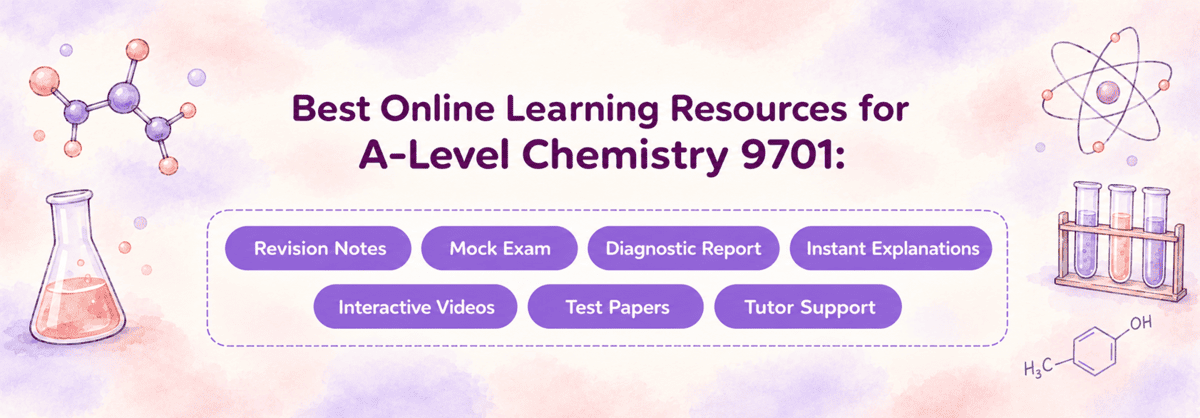
The best online learning resources for A-Level Chemistry 9701 should help you do different things at different stages: learn concepts, review reactions and equations, practise calculations, understand organic mechanisms, develop practical reasoning, answer exam-style questions, test your readiness and identify weak areas. A useful resource mix therefore includes Revision Notes, Interactive Videos, Instant Explanations, Testpapers, Mock Exams, Diagnostic Reports and Tutor Support.
Cambridge International AS & A Level Chemistry (9701) places emphasis on understanding concepts, applying Chemistry in unfamiliar contexts, problem solving and advanced practical skills. That means relying on notes alone is unlikely to be enough. A stronger approach is to move through a clear cycle:
Learn → Understand → Practise → Test → Diagnose → Revise → Get Support
Best Resources for Learning and Practising A-Level Chemistry 9701
A-Level Chemistry Revision Notes and Interactive Videos
Revision Notes are most useful when you need to organise a topic, quickly recover key information, or revisit a concept before practising questions.
For example, good Chemistry notes can help you review:
- Equations and definitions in Stoichiometry
- Trends in Periodicity
- Key ideas in Equilibria and Reaction Kinetics
- Reagents and conditions in Organic Chemistry
- Diagrams and interpretation in Analytical Techniques
HomeSchool Asia provides topic-based A-Level Chemistry 9701 Revision Notes containing definitions, diagrams and explanations across the course.
Interactive Videos become useful when reading alone does not make the process clear. A step-by-step explanation can make concepts such as chemical bonding, equilibrium shifts, electrode processes, or organic reactions easier to follow.
HomeSchool Asia's Chemistry Learning Hub also connects Interactive Videos with End-of-Lesson Quizzes and Diagnostic Reports, so watching can be followed by an immediate check of understanding.
Use this sequence:
Learn → Check Understanding → Review → Practise
If you already understand the concept clearly, move to questions rather than repeatedly watching the lesson.
Chemistry Testpapers, Past-Paper Questions and Mark Schemes
Knowing a definition or reaction is different from being able to apply it in a Cambridge-style question.
Topic Questions and Testpapers are useful between initial learning and complete Past Papers because they let you practise a specific weakness without sitting an entire examination paper.
For example:
- If Equilibria is weak, target equilibrium questions.
- If your organic chemistry is inconsistent, practise reaction pathways, reagents, conditions and synthesis.
- If calculations are costing marks, target Stoichiometry, Energetics or Electrochemistry questions.
HomeSchool Asia's Chemistry Testpapers allow students to generate past-paper questions and filter practice by year, session and paper type, with Mark Schemes included.
A useful progression is:
Learn Topic → Topic Questions → Mixed Testpapers → Review Errors → Past Papers
Do not use a Mark Scheme only to see whether the final answer matches. Check the terminology, calculation working, and reasoning expected.
If you lost a mark because you used the wrong chemical term or omitted a required step, record that error and attempt a similar question later.
Worked Examples and Explanations for Difficult Chemistry Topics
Worked examples are particularly useful when a Chemistry question requires several connected reasoning steps.
This may include:
- stoichiometric calculations
- Hess's Law
- electrode potentials
- equilibrium calculations
- rate equations
- organic mechanisms
- spectral interpretation
The goal is not to memorise the solution. Instead, understand why each step was chosen.
Suppose you can follow a Hess's Law example while looking at the solution but cannot construct the cycle independently in another question. That indicates you still need practice rather than another passive review.
Use this sequence:
Attempt → Check Method → Identify Error → Understand Why → Try a Similar Question
For calculations, first identify the chemical principle, write down the known quantities and determine what the question requires. For organic mechanisms, focus on electron movement and functional-group behaviour rather than memorising arrow positions as a picture.
Worked examples are most valuable when they lead quickly back into independent practice.
Best Resources for Testing Progress and Improving Weak Chemistry Topics
A-Level Chemistry 9701 Mock Exams
After you have worked through individual topics and question sets, Mock Exams help determine whether you can bring that knowledge together under exam-style conditions.
Mock practice can reveal problems that topic practice may hide, including:
- weak time management
- calculation errors under pressure
- incomplete chemical explanations
- confusion between similar reactions
- difficulty switching between physical, inorganic and organic Chemistry
- weak data interpretation
HomeSchool Asia offers time-based A-Level Mock Exams with topic-level testing and Diagnostic Reports.
This exam is most useful once you have already completed substantial learning and practice. Taking full tests repeatedly without addressing the errors between attempts simply gives you more scores.
After each mock, separate your mistakes into categories such as:
Knowledge → Application → Calculation → Terminology → Question Interpretation
That makes the result more useful for your next revision session.
A-Level Chemistry Diagnostic Reports
A Mock Exam tells you how you performed. A useful Diagnostic Report should help you decide what to revise next.
For example, suppose your total Chemistry score looks reasonable, but your results repeatedly show problems with Equilibria and Reaction Kinetics. Revising all topics equally would spend time on areas you may already understand.
A better learning cycle is:
Attempt → Diagnose → Target Weak Topic → Review Concept → Practise Again → Reassess
HomeSchool Asia's Chemistry resources link Mock Exams and Interactive Videos with personalised Diagnostic Reports designed to show topic-level knowledge gaps and mastery levels.
Diagnostic information can help you distinguish between different problems. You may understand equilibrium theory but lose marks on calculations, or know an organic reaction but repeatedly forget its conditions.
Your next learning activity should address that specific gap.
The purpose of diagnosis is therefore not another report. It is Targeted Revision.
A-Level Chemistry Tutor Support
Independent study works well when you can identify a mistake and correct it. Tutor Support becomes more useful when the same problem remains after revision and repeated practice.
For example, additional support may help if:
- you repeatedly draw the wrong organic mechanism
- calculation methods remain unclear
- you cannot explain why an equilibrium shifts
- practical-planning responses consistently miss key details
- your answers use inaccurate chemical terminology
HomeSchool Asia Tutor Support allows students to upload work, ask subject-related questions and receive Cambridge-based evaluations, grading and feedback from Subject Tutors.
Tutor Support should complement rather than replace independent study.
A useful progression is:
Diagnostic Report → Targeted Revision → Practice → Tutor Feedback if Needed → Practise Again
This makes support more focused because you can show the tutor the work or misconception you are actually struggling with.
How to Combine A-Level Chemistry Resources Effectively
You do not need every Chemistry resource at the same time. Choose the resource according to the learning problem you are trying to solve.
A structured pathway can look like:
Revision Notes → Interactive Videos → Testpapers → Past-Paper Practice → Mock Exams → Diagnostic Reports → Targeted Revision → Tutor Support
Learn and Understand
Use Revision Notes and Interactive Videos to understand concepts, reactions, equations, and methods.
Apply
Move to Topic Questions and Testpapers once you think you understand the material. This tests whether you can use Chemistry without being shown the method.
Test
Use Past Papers and Mock Exams to combine topics and work under more realistic examination conditions.
Diagnose
Use Mark Schemes, error review, and Diagnostic Reports to identify why marks are being lost.
Improve
Return only to the topics or skills that need work. If repeated self-study does not correct the problem, use Tutor Support for focused feedback.
This is more effective than collecting disconnected Chemistry resources because each resource has a clear role in the next stage of your learning.
Conclusion
The best online learning resources for A-Level Chemistry 9701 depend on what you need to do next. If you do not understand a concept, review it. If you understand it but cannot apply it, practise questions. If you cannot identify where marks are being lost, test and diagnose your performance.
Use the pathway:
Learn → Practise → Test → Diagnose → Improve
HomeSchool Asia connects Revision Notes, Interactive Videos, Testpapers, Mock Exams, Diagnostic Reports and Tutor Support so you can move from learning Chemistry to identifying and improving the areas that still need work.
Start Your A-Level Chemistry (9701) Journey!

Premium Plan
- Full 12-month structured resources of all subjects.
- Full access to all Interactive Videos.
- Additional Tutor Credits to access features.
- Diagnostic Report available to all chapters.
- Downloadable Revision Notes available for all topics.
- “Get one Answer a Day” is activated for all subjects.

Custom Plan
- Full 12-month structured resources of chosen subjects.
- Full access to Interactive Videos for the chosen subject.
- Additional Tutor Credits to access features.
- Diagnostic Report available to all chapters.
- Downloadable Revision Notes available for all topics.
- “Get one Answer a Day” is activated for chosen subjects.
Frequently Asked Questions About A-Level Chemistry Resources
What are the best online resources for A-Level Chemistry 9701?
A strong combination includes Revision Notes, Interactive Videos, Testpapers, Past Papers, Mark Schemes, Mock Exams, and Diagnostic Reports, with Tutor Support when independent study does not resolve a problem.
Are revision notes enough for A-Level Chemistry?
No. They help you organise and review Chemistry, but you also need to apply concepts through calculations, structured questions, organic reactions, data interpretation, and practical reasoning. Use notes as a foundation before moving into active question practice.
How should I practise A-Level Chemistry calculations?
Review the concept first, then study a worked example and attempt similar questions without looking at the method. Record whether mistakes come from the Chemistry principle, equation choice, units, significant figures or arithmetic.
How should I learn organic Chemistry reaction mechanisms?
Understand the functional groups, reagents, conditions, and movement of electrons rather than memorising diagrams alone. Build reaction pathways by functional group, then practise reproducing mechanisms without referring to your notes.
Should I use topic questions or past papers first?
Use Topic Questions while you are still building individual skills. Once you can apply the main concepts independently, progress to mixed Testpapers and complete Past Papers so you practise deciding which Chemistry knowledge a question requires.
How can I identify my weak Chemistry topics?
Review errors from Testpapers and Mock Exams and group them by topic and question type. Diagnostic Reports can make this easier by highlighting knowledge gaps and helping you focus the next revision session on specific weaknesses.
Are mock exams useful for A-Level Chemistry 9701?
Yes. They help you practise timing, mixed-topic application and exam-style decision-making. They become most valuable when you analyse the results afterwards and use them to direct further revision.
How should I prepare for Chemistry practical skills?
Practise experimental methods, accurate observations and measurements, data processing, error analysis, planning and evaluation. Cambridge places strong emphasis on advanced practical skills and assesses them through its practical assessment structure.