Key Highlights
- Learn difficult Chemistry concepts step by step.
- Connect equations and formulas with the Chemistry they represent.
- Follow calculations from information to final result.
- Understand reaction pathways and organic mechanisms.
- Check learning through End-of-Lesson Quizzes.
- Use eligible Instant Explanations after achieving 80% or higher.
- Move into targeted Test Paper practice once the concept is clear.
Summarize with AI


In A Level Chemistry, remembering a formula or reaction is often not enough. You may also need to explain why it happens, connect several stages of a calculation or recognise the same principle in an unfamiliar situation.
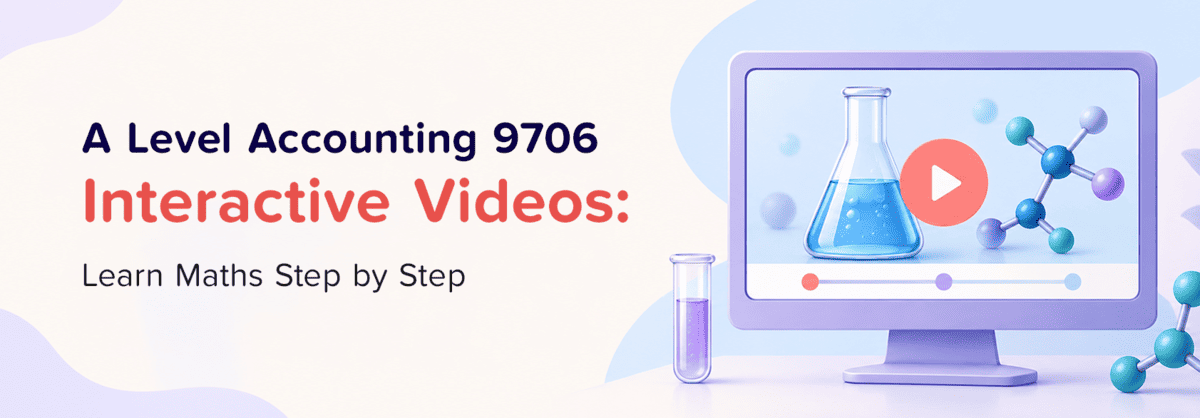
A Level Chemistry 9701 Interactive Videos can help make that reasoning visible before you have to apply it independently.
Why Some A Level Chemistry Concepts Are Difficult to Learn From Notes Alone
Chemistry often requires you to connect several levels of understanding at the same time.
You may observe a change experimentally, explain it using particles, represent it with an equation and then use mathematical relationships to solve a problem.
That is why memorising individual facts can become difficult to apply.
For example, you might remember that changing conditions affects an equilibrium but still struggle to explain why the position of equilibrium changes in a particular situation.
Organic Chemistry creates a similar challenge. Memorising a reaction equation is different from understanding how the functional group changes, which reagent is required, and why a particular mechanism occurs.
What Are A Level Chemistry 9701 Interactive Videos?
HomeSchool Asia Interactive Videos are concept-learning resources designed to help students follow chemical reasoning step by step.
They can support understanding of:
- Chemical concepts and relationships
- Equations and calculations
- Reaction processes
- Molecular and structural ideas
- Organic reaction pathways
- Graphical or experimental information
- Application of Chemistry to questions
The goal is not simply to watch a solution appear.
Interactive Videos should help you understand Chemistry well enough to explain the process and apply it to another question.
Use Interactive Videos when the Chemistry itself is unclear, rather than when you have simply forgotten one equation or definition.
What Does Learning Chemistry Step by Step Mean?
A useful Chemistry explanation should help you understand how the information in a problem leads to the conclusion.
Step 1: Identify the Information
What chemical information, values, observations, or structures are given?
Step 2: Identify the Principle
Which Chemistry concept applies?
This could involve bonding, equilibrium, stoichiometry, energetics, or another principle.
Step 3: Follow the Process
Work through the relevant particles, equations, calculations, or reaction stages.
Step 4: Understand Why Each Step Happens
Do not only copy the sequence.
Ask why a quantity is being calculated, why a reagent is used, or why electrons move in a particular way.
Chemistry Concepts That Benefit From Step-by-Step Learning
Stoichiometry and Calculations
Calculation questions can become confusing when several stages are connected.
A useful process is:
Information → Equation → Mole Relationship → Calculation → Check
For example, you may need to move from concentration and volume to amount of substance before using an equation to determine another quantity.
The important part is understanding why each calculation is required, not simply following arithmetic.
Energetics, Kinetics and Equilibria
These topics often combine chemical principles with graphs, conditions, and explanations.
Step-by-step learning can help you connect what changes with why it changes.
Bonding and Structure
Concepts involving orbitals, bonding, molecular shape and intermolecular forces require you to connect microscopic structure with observable properties.
Seeing those relationships explained in sequence can make individual definitions more meaningful.
Organic Chemistry
Organic Chemistry is especially difficult when reactions are memorised as isolated equations.
A stronger approach is to connect:
Functional Group → Reagent → Conditions → Reaction → Product
Mechanisms add another layer because you also need to understand electron movement and why bonds break or form.
Rather than memorising individual reactions, follow how functional groups, reagents, conditions, and mechanisms connect.
Analytical Chemistry
Step-by-step explanation can also help when you need to interpret chemical information and use evidence to reach a structural conclusion.
How to Use an Interactive Chemistry Video Actively
Watching alone does not prove that you understand Chemistry.
Try using this approach:
Predict → Watch → Explain → Attempt
Before an important step appears, pause and ask:
- What should happen next?
- Which chemical principle applies?
- What product would I expect?
- Which reagent or condition might be required?
- What quantity should I calculate first?
- Why should the reaction proceed in this way?
For mechanisms, try drawing the next step yourself.
For calculations, attempt the next stage before watching the solution.
For trends or equilibria, explain the expected change before hearing the explanation.
Before the explanation continues, ask yourself what should happen next and why.
Use the End-of-Lesson Quiz to Check Understanding
A Chemistry explanation can feel clear while you are watching it.
The more important question is:
Can you apply the concept when the explanation is no longer guiding you?
Interactive Videos include End-of-Lesson Quizzes that provide an immediate checkpoint after learning.
Use:
Learn → Attempt → Check
A difficult quiz question may reveal a problem with:
- Conceptual understanding
- Equation recall
- Calculation setup
- Reagents or conditions
- Mechanism reasoning
- Explaining trends
- Interpreting data
This helps you decide whether you need to revise information, revisit the concept or practise its application.
What Happens After You Achieve 80% or Higher?
After achieving 80% or higher in an End-of-Lesson Quiz within an Interactive Video lesson, eligible Instant Explanations can help students understand the relevant quiz questions.
Use:
80%+ → Eligible Explanation → Understand → Retry
The aim is not to memorise the answer.
Instead, examine why the reasoning works and where your own approach differs.
For example, if a calculation was incorrect, identify whether the problem was the equation, mole relationship, or arithmetic rather than simply copying the final value.
Move From Interactive Videos to Independent Practice
Once the Chemistry makes sense, remove some of the support.
Use Revision Notes later to refresh equations, definitions, reagents, conditions and key relationships you already understand.
Then move into targeted Test Papers selected by:
Paper Type → Topic → Difficulty Level
The process becomes:
Understand → Check → Practise → Review
Test Papers provide grading for the practice completed; they do not generate Diagnostic Reports.
The purpose of practice is to find out whether you can apply Chemistry when the question is no longer presented in the same way as the lesson.
A Practical A Level Chemistry 9701 Interactive Video Routine
- Choose the Chemistry concept that is unclear.
- Watch the Interactive Video actively.
- Predict important steps.
- Explain Chemistry in your own words.
- Complete the End-of-Lesson Quiz.
- Review eligible Instant Explanations after achieving 80% or higher.
- Retry difficult reasoning independently.
- Move into targeted Test Paper practice.
- Return to the concept if the reasoning breaks down again.
Learn → Check → Explain → Practise → Apply
How HomeSchool Asia Supports A Level Chemistry Learning
HomeSchool Asia Interactive Videos support concept learning, while End-of-Lesson Quizzes check whether students can apply the Chemistry independently. Eligible Instant Explanations become available after achieving 80% or higher. Revision Notes reinforce previously learned concepts, Test Papers provide targeted practice, Mock Exams support broader assessment, Diagnostic Reports provide broader mastery information, and Tutor Support offers additional academic guidance where required.
Conclusion
Understanding Chemistry means more than remembering equations, mechanisms or definitions.
Use A Level Chemistry 9701 Interactive Videos to follow complex concepts, calculations and reactions step by step, then check whether you can explain and apply the same Chemistry independently.
Once the concept becomes clear, move from guided learning into targeted practice so you can use the reasoning even when the question, data or chemical context changes.
Start Your A-Level Chemistry (9701) Journey!

Premium Plan
- Full 12-month structured resources of all subjects.
- Full access to all Interactive Videos.
- Additional Tutor Credits to access features.
- Diagnostic Report available to all chapters.
- Downloadable Revision Notes available for all topics.
- “Get one Answer a Day” is activated for all subjects.

Custom Plan
- Full 12-month structured resources of chosen subjects.
- Full access to Interactive Videos for the chosen subject.
- Additional Tutor Credits to access features.
- Diagnostic Report available to all chapters.
- Downloadable Revision Notes available for all topics.
- “Get one Answer a Day” is activated for chosen subjects.
Frequently Asked Questions
What are A Level Chemistry 9701 Interactive Videos?
They are concept-learning resources designed to help students follow chemical concepts, calculations, reactions, and reasoning step by step.
How can Interactive Videos help with difficult Chemistry concepts?
They can show how chemical principles connect with equations, calculations, structures, reactions, and question application.
Which A Level Chemistry topics benefit from video learning?
Examples include stoichiometric calculations, bonding, energetics, equilibria, organic mechanisms and analytical Chemistry.
Do Interactive Videos include End-of-Lesson Quizzes?
Yes. They include End-of-Lesson Quizzes to check understanding after learning.
What should I do after watching an Interactive Video?
Complete the End-of-Lesson Quiz, identify any remaining difficulty, and then try to apply the concept independently.
When are Instant Explanations available?
They are available for eligible questions after achieving 80% or higher in an End-of-Lesson Quiz within an Interactive Video lesson.
Should I use Revision Notes or Interactive Videos?
Use Interactive Videos to understand difficult concepts and Revision Notes to reinforce concepts, equations, and information already learned.
What if a Chemistry concept still does not make sense?
Return to the relevant lesson and identify where your understanding breaks down. Tutor Support can provide additional academic guidance if needed.
What should I do once I understand the concept?
Move into targeted Test Paper practice through Paper Type → Topic → Difficulty Level.