Key Highlights
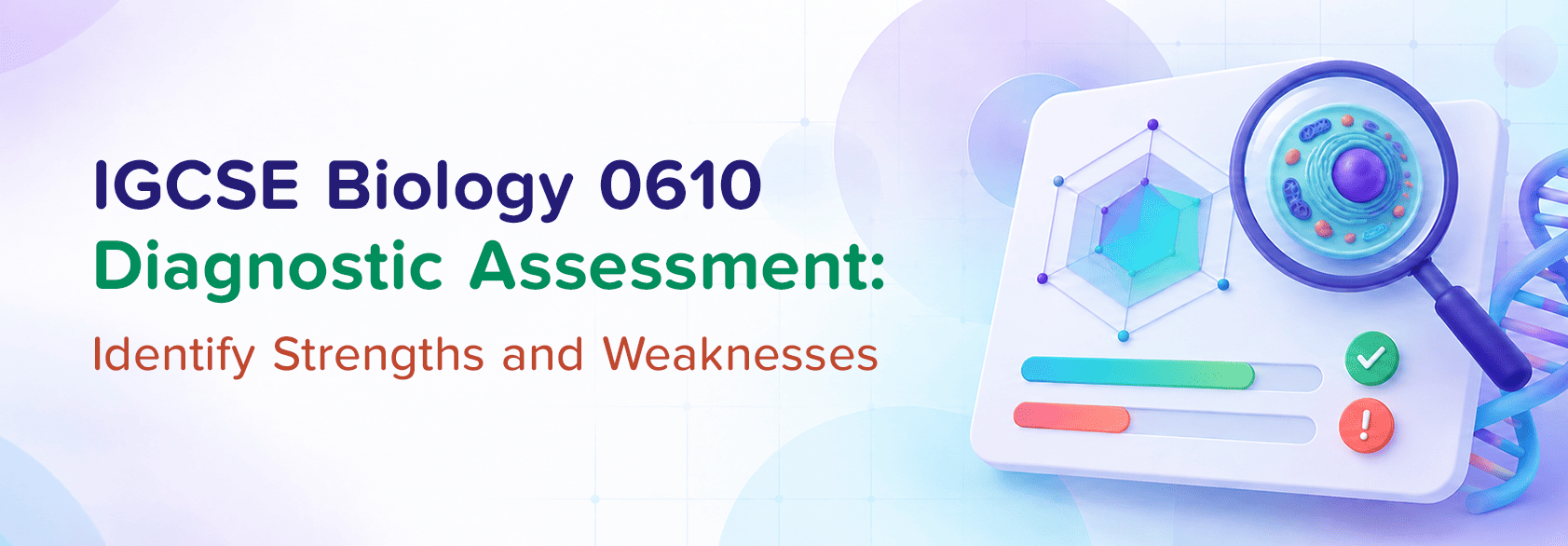
- Understand how an IGCSE Biology 0610 Diagnostic Assessment identifies strengths and weaknesses.
- Learn how Diagnostic Reports classify mastery as Complete, Adequate, or Inadequate.
- Discover how quizzes, Test Papers, end-of-lesson quizzes, Mock Exams and Competency Tests contribute to diagnostic feedback.
- Learn how to use Diagnostic Reports to identify Biology topics that need further revision.
- Understand how Instant Explanations help students understand questions, incorrect answers, and underlying concepts.
- Follow the learning cycle: Assess → Diagnose → Understand → Revise → Practise → Improve.
Summarize with AI


Preparing for your upcoming IGCSE Biology exams requires more than simply completing practice questions and checking your overall score. An IGCSE Biology 0610 Diagnostic Assessment adds another layer by identifying strengths, weaknesses, and levels of mastery. HomeSchool Asia generates Diagnostic Reports from quizzes, Test Paper practice, end-of-lesson quizzes, Mock Exams, and Competency Tests, helping students move from assessment to targeted learning.
What Is an IGCSE Biology 0610 Diagnostic Assessment?
A diagnostic assessment is designed to provide more information than a simple score. Instead of only asking“How many questions did I get right?”, it helps students understand “What do I know, where am I struggling, and what should I work on next?”
On HomeSchool Asia, a Diagnostic Report can be generated after different assessment experiences, including:
- Quizzes
- Test Paper practice
- End-of-lesson quizzes
- Mock Exam practice
- Competency Tests
This allows assessment to become part of the learning process rather than something that happens only at the end of revision.
The process is:
Assess → Diagnose → Understand → Revise → Improve
How HomeSchool Asia's Diagnostic Report Works
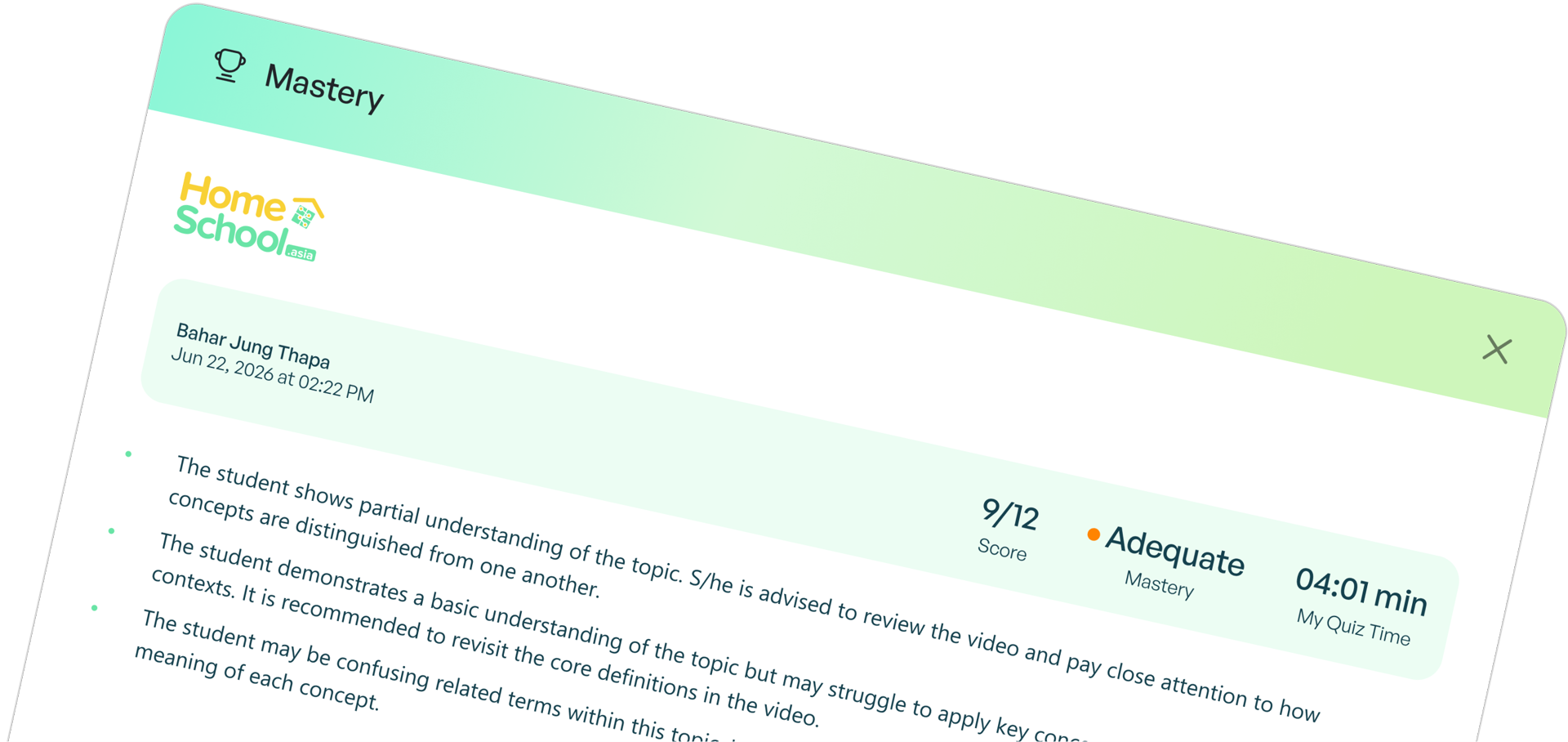
After completing an assessment, students can use the resulting Diagnostic Report to understand their performance across the assessed Biology content.
The report highlights:
- Areas of strength
- Areas of weakness
- Current mastery
- Concepts requiring further attention
Mastery is distributed into three categories:
Complete
Complete indicates that the student has demonstrated the expected level of mastery for the assessed area based on their performance.
This can help students recognise areas where they have demonstrated stronger understanding and may be ready to move forward.
Adequate
Adequate indicates that the student has demonstrated some understanding but may benefit from additional practice or reinforcement.
These areas can become useful revision priorities, particularly when preparing for examination questions.
Inadequate
Inadequate indicates that the assessment suggests the student needs further learning or revision in that area.
Rather than simply moving on after receiving a low score, students can use this information to return to the relevant Biology concepts and strengthen their understanding.
These are HSA mastery indicators, not official Cambridge grades.
What Can an IGCSE Biology Diagnostic Report Tell You?
A useful Diagnostic Report helps turn an assessment result into a learning decision.
Identify Areas of Strength
Students can see which assessed areas demonstrate stronger understanding. This helps them understand what they have already mastered rather than repeatedly revising everything from the beginning.
Identify Areas of Weakness
The report can highlight areas where additional revision or practice may be needed.
For example, a student may perform well overall but still have difficulty with particular Biology concepts. Instead of restarting the entire syllabus, they can focus their revision on the areas identified by the assessment.
Find Knowledge Gaps
A student may recognise a topic from their notes but still struggle to apply it to an examination question.
Diagnostic feedback can help reveal these gaps between recognising information and being able to apply it.
Set Revision Priorities
The purpose of diagnostic feedback is to help answer:
“What should I revise next?”
This makes revision more targeted and gives students a clearer learning pathway.
What Are Instant Explanations?
Assessment can show that a student needs improvement, but understanding why an answer was wrong is equally important.
HomeSchool Asia's Instant Explanations provide an additional layer of support. When students achieve 80% or more correct answers, they can unlock Instant Explanations.
These explanations go beyond simply displaying the correct answer.
What Is the Question Actually Testing?
Instant Explanations help students understand the concept, skill, or knowledge that the question is testing.
This can make it easier to recognise what an examination question is really asking.
Why Don't the Incorrect Answers Work?
Students can understand why incorrect options do not work rather than simply being told that they are wrong.
This helps address misconceptions and improve reasoning.
Why Is the Correct Answer Correct?
The explanation provides clear reasoning behind the correct answer, helping students understand the logic used to reach it.
What Underlying Concept Do You Need to Understand?
The explanation connects the question to the Biology concept that students need to understand.
The learning process becomes:
Answer → Explanation → Understanding
How Diagnostic Assessment Changes Biology Revision
Without diagnostic feedback, revision can easily become:
Revise Everything → Practise → Take Test → Get Score
A diagnostic approach creates a more targeted cycle:
Assess → Identify Weakness → Target Revision → Practise → Reassess
For example, if an assessment indicates that a student has inadequate mastery of a particular Biology concept, they can return to that area, review the relevant learning material and practise similar questions.
The goal is not to assume that one assessment defines a student's ability. Instead, it provides information that can help guide the next learning step.
When Should You Use an IGCSE Biology Diagnostic Assessment?
Diagnostic assessment can be useful at different points in your IGCSE Biology preparation.
Before Revision
Use an assessment to establish your current understanding and identify areas that may require more attention.
During Revision
Assess yourself after studying important topics to check whether your understanding has improved.
After Completing a Chapter
Use assessment to check whether you are ready to move on or need additional practice.
Before Mock Exams
Identify areas that may need further preparation before attempting a full examination.
After Mock Exams
Use your performance to identify topics and concepts that require targeted revision.
The important point is to use the result to make a learning decision.
How to Use Your Diagnostic Report for Targeted Revision
Once you receive your Diagnostic Report, follow these steps.
1. Review Your Mastery
Look through your Complete, Adequate, and Inadequate areas.
2. Identify Priority Topics
Focus first on areas where your understanding requires the most improvement.
3. Review the Relevant Learning Content
Return to the Biology learning material associated with the identified concepts.
4. Practise Again
Complete additional questions to apply what you have learned.
5. Reassess Your Understanding
Take another assessment to check whether your performance has improved.
Follow the cycle:
Assess → Diagnose → Revise → Practise → Reassess
How HomeSchool Asia Connects Assessment With Learning
HomeSchool Asia connects assessment and learning through a wider preparation journey.
Learn — Interactive Videos
Build understanding of Biology concepts through interactive learning.
Reinforce — Revision Notes
Review important concepts, definitions, processes, and key information.
Practise — Test Papers
Apply Biology knowledge through topic and exam-style questions.
Measure — Mock Exams
Evaluate performance under examination conditions.
Diagnose — Diagnostic Reports
Identify strengths, weaknesses, knowledge gaps, and levels of mastery.
Understand — Instant Explanations
Understand what questions are testing, why incorrect answers do not work, why the correct answer works, and which underlying concepts need attention.
The complete learning cycle is:
Learn → Practise → Measure → Diagnose → Understand → Improve
Explore all the resources:
IGCSE Biology 0610 Diagnostic Assessment Checklist
Before using an assessment as part of your revision, check whether it helps you:
- ✓ Measure your current understanding
- ✓ Identify strengths and weaknesses
- ✓ Understand your mastery level
- ✓ Find knowledge gaps
- ✓ Prioritise revision areas
- ✓ Understand difficult questions
- ✓ Learn why incorrect answers do not work
- ✓ Understand the reasoning behind correct answers
- ✓ Connect assessment results with further learning
- ✓ Reassess your progress after revision
Conclusion
An IGCSE Biology 0610 Diagnostic Assessment should do more than give you a score. It should help you understand what you know, what you need to improve, and what you should do next.
With HomeSchool Asia, assessment can form part of a continuous learning cycle:
Assess → Diagnose → Understand → Revise → Practise → Improve
By combining Diagnostic Reports with targeted learning and Instant Explanations, students can make their Biology revision more focused and purposeful.

Start Your IGCSE Biology (0610) Journey!

Premium Plan
- Full 12-month structured resources of all subjects.
- Full access to all Interactive Videos.
- Additional Tutor Credits to access features.
- Diagnostic Report available to all chapters.
- Downloadable Revision Notes available for all topics.
- “Get one Answer a Day” is activated for all subjects.

Custom Plan
- Full 12-month structured resources of chosen subjects.
- Full access to Interactive Videos for the chosen subject.
- Additional Tutor Credits to access features.
- Diagnostic Report available to all chapters.
- Downloadable Revision Notes available for all topics.
- “Get one Answer a Day” is activated for chosen subjects.
Frequently Asked Questions
What is an IGCSE Biology 0610 Diagnostic Assessment?
It is an assessment approach that helps students understand their performance, identify strengths and weaknesses, and recognise areas that may require further learning or revision.
What is the difference between a Biology test and a Diagnostic Assessment?
A test primarily measures performance, while diagnostic assessment adds information that can help students understand where they need to improve and what they should study next.
What do Complete, Adequate, and Inadequate mean?
They are HomeSchool Asia mastery indicators based on assessment performance. They show different levels of demonstrated understanding and are not official Cambridge grades.
When should I take an IGCSE Biology Diagnostic Assessment?
You can use a diagnostic assessment before revision, during revision, after completing chapters, before Mock Exams, or after an assessment to identify areas for further improvement.
What are Instant Explanations?
Instant Explanations are available after achieving 80% or more correct answers and explain what the question is testing, why incorrect answers do not work, why the correct answer works, and which underlying concept needs to be understood.
Can a Diagnostic Report replace revision?
No. A Diagnostic Report helps identify what you should work on. Students still need to review concepts, practise questions, and reassess their understanding.