Key Highlights
- Learn what to look for in an effective IGCSE Biology 0610 Mock Exam.
- Understand why exam-style questions and timed practice matter.
- Discover why a score alone does not fully explain your Biology performance.
- Learn how competency-based feedback can identify areas requiring improvement.
- Understand how Mock Exams can connect students with targeted revision and learning resources.
- See how HomeSchool Asia connects Mock Exams with Interactive Videos, Revision Notes, Test Papers and Diagnostic Reports.
Summarize with AI


What Makes a Good IGCSE Biology 0610 Mock Exam?
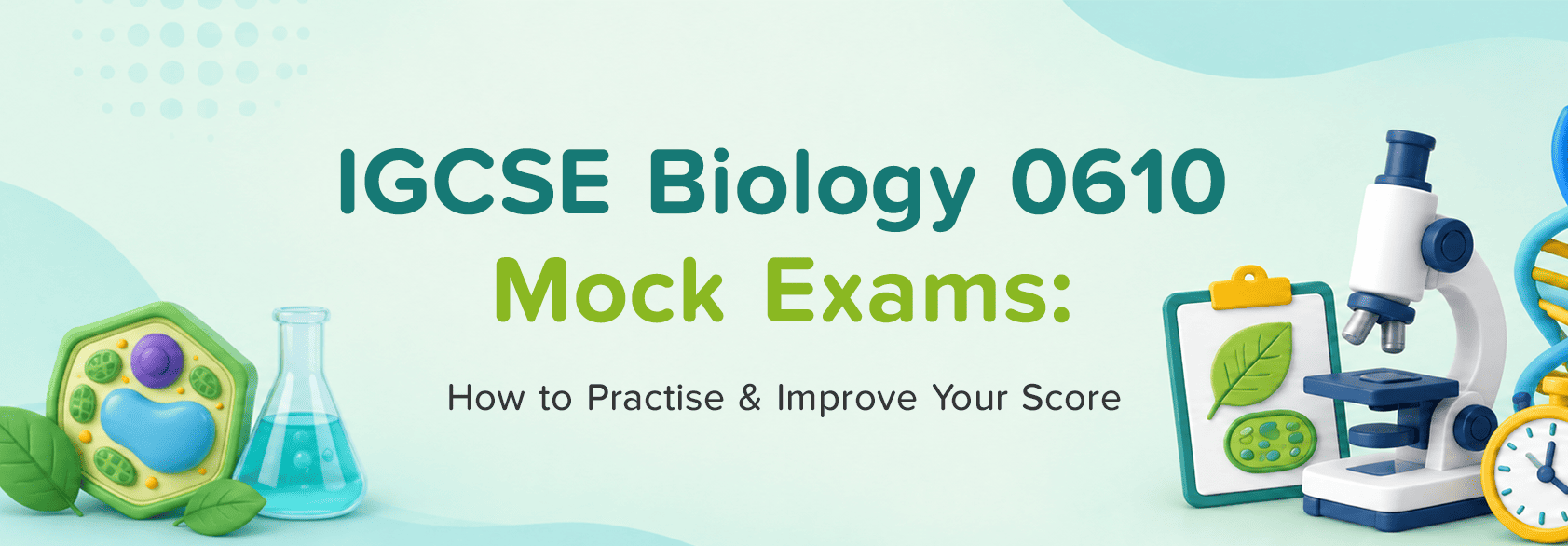
Not every practice test provides the same learning experience. A useful IGCSE Biology 0610 Mock Exam should give you an opportunity to practise applying your knowledge in an examination-style setting while also helping you understand your performance.
Look for a Mock Exam that provides:
- Exam-style Biology questions
- Appropriate topic coverage
- A suitable level of difficulty
- Clear instructions
- Timed assessment
- Meaningful performance results
- Feedback that helps you identify what to improve
The goal is not simply to finish another test. It is to use the assessment to understand where you are now and what you should work on next.
1. Look for Exam-Style Biology Questions
An effective Biology Mock Exam should test more than your ability to recall definitions and facts.
Look for questions that require you to apply Biology knowledge to different situations, such as:
- Biological processes
- Data interpretation
- Diagrams
- Application questions
- Experimental questions
- Calculations where relevant
For example, knowing the definition of an enzyme is different from being able to interpret an experiment involving enzyme activity.
This type of practice helps you become more familiar with applying what you have learned rather than simply recalling information.
2. Look for Timed Assessment
Time management is an important part of examination preparation. A student may understand the Biology concepts but still struggle to complete an examination within the available time.
A timed Mock Exam can help you assess:
- Accuracy
- Speed
- Time management
- Ability to complete questions
- Performance under examination conditions
Try to treat some Mock Exams as genuine assessments. Work within the allocated time, avoid unnecessary interruptions, and review your performance afterwards.
3. Look Beyond the Mock Exam Score
A score tells you how you performed in an assessment, but it does not always explain why you performed that way.
For example, an HSA Mock Exam result may display a score such as 4/20, together with a Low competency indication and the time taken to complete the test.
The score shows the marks achieved in that particular assessment. The additional performance information provides more context about the student's current level of understanding.
This distinction matters because the purpose of assessment is not simply to produce a number. It is to help students make better learning decisions.
4. Look for Competency-Based Feedback
Competency feedback can provide another way of understanding your performance.
Instead of asking only:
“How many questions did I get right?”
you can also consider:
“What does my performance suggest about my current understanding?”
A competency-based result can help you recognise when you may need to revisit a concept before moving on.
The process becomes:
Score → Performance Level → Learning Decision
This makes the Mock Exam part of the learning process rather than an isolated test.
5. Look for Topic and Concept Feedback
A useful assessment should help you identify areas that require further attention.
Depending on the assessment, this may include:
- Weak topics
- Difficult concepts
- Incorrect responses
- Knowledge gaps
- Areas requiring additional practice
For IGCSE Biology, this could help you recognise whether you need to spend more time reviewing areas such as cell biology, enzymes, inheritance, ecology or human physiology.
The important step is what you do with this information afterwards:
Mock Exam → Identify Weakness → Targeted Revision
6. Look for Recommended Learning After the Test
The most useful Mock Exam experience does not necessarily end when you submit your answers.
For example, HSA's Mock Exam results can recommend relevant Video Lessons when the assessment indicates that a student may need to spend more time on particular concepts.
This creates a more connected learning process:
Test → Result → Recommended Learning → Practise Again
Instead of simply telling students that they made mistakes, the assessment can help direct them towards the learning resources they need next.
How HomeSchool Asia Mock Exams Fit Into Your IGCSE Biology Preparation
A Mock Exam works best when it is part of a wider preparation system rather than being used on its own.
Learn — Interactive Videos
Build your understanding of Biology concepts through visual and interactive learning.
Reinforce — Revision Notes
Review important definitions, processes, explanations and key Biology concepts.
Practise — Test Papers
Apply your knowledge through topic-based and examination-style questions.
Measure — Mock Exams
Test your understanding, accuracy and exam readiness under assessment conditions.
Diagnose — Diagnostic Reports
Identify knowledge gaps, weak areas and concepts requiring further attention.
Improve — Targeted Revision
Return to the relevant learning resources, practise again and reassess your progress.
The overall learning cycle is:
Learn → Practise → Measure → Diagnose → Improve
Explore all the resources:
When Should You Take an IGCSE Biology 0610 Mock Exam?
You do not have to wait until the final weeks before your examination to use Mock Exams.
During Revision
Take a Mock Exam to establish a baseline and understand which areas require more attention.
After Completing Major Topics
Use assessment to check whether your learning is translating into exam performance.
Before Final Exams
Complete timed Mock Exams to assess your readiness and practise working under examination conditions.
Using assessments at different stages can help you identify problems earlier rather than discovering them immediately before the final examination.
What to Do After Completing a Biology Mock Exam
Your result should be the starting point for your next revision decision.
1. Check Your Result
Review your score, competency and available performance information.
2. Identify Weak Areas
Look for topics or concepts where your performance needs improvement.
3. Return to Learning Resources
Use relevant Interactive Videos and Revision Notes to strengthen your understanding.
4. Practise Again
Use Test Papers or topic-based questions to apply what you have learned.
5. Reassess
Take another assessment to check whether your performance has improved.
Follow the cycle:
Attempt → Analyse → Revise → Practise → Reassess
IGCSE Biology 0610 Mock Exam Checklist
Before choosing or using a Mock Exam, check whether it provides:
- ✓ Exam-style Biology questions
- ✓ Appropriate topic coverage
- ✓ Timed assessment
- ✓ Clear scoring
- ✓ Competency or performance feedback
- ✓ Identification of weak areas
- ✓ Useful explanations or recommendations
- ✓ Connection to further learning
- ✓ An opportunity to reassess progress
Conclusion
The value of an IGCSE Biology 0610 Mock Exam is not simply the number of questions it contains or the score you receive. A useful Mock Exam should help you practise exam-style questions, measure your performance, understand your competency and identify what you need to improve next.
The most effective assessment journey connects:
Practise → Measure → Diagnose → Learn → Improve → Reassess

Start Your IGCSE Biology (0610) Journey!

Premium Plan
- Full 12-month structured resources of all subjects.
- Full access to all Interactive Videos.
- Additional Tutor Credits to access features.
- Diagnostic Report available to all chapters.
- Downloadable Revision Notes available for all topics.
- “Get one Answer a Day” is activated for all subjects.

Custom Plan
- Full 12-month structured resources of chosen subjects.
- Full access to Interactive Videos for the chosen subject.
- Additional Tutor Credits to access features.
- Diagnostic Report available to all chapters.
- Downloadable Revision Notes available for all topics.
- “Get one Answer a Day” is activated for chosen subjects.
Frequently Asked Questions
What is an IGCSE Biology 0610 Mock Exam?
It is a practice assessment designed to help students test their Biology knowledge, practise examination-style questions and evaluate their exam readiness.
Are IGCSE Biology Mock Exams useful?
Yes. Mock Exams can help students practise applying Biology knowledge, manage their time and identify areas requiring further revision.
When should I take an IGCSE Biology 0610 Mock Exam?
You can use Mock Exams at different stages of preparation, including as a baseline, during revision and before your final examinations.
What should an IGCSE Biology Mock Exam include?
Look for exam-style questions, appropriate topic coverage, timed assessment, scoring and meaningful performance or competency feedback.
Is a Mock Exam score enough to understand my Biology performance?
Not necessarily. A score shows performance in a particular assessment, while competency feedback, mistakes, and topic-level information can provide additional context about what to improve.
What should I do after a Biology Mock Exam?
Review your results, identify weak areas, return to relevant learning resources, practise those areas, and reassess your progress.
Check Result → Identify Weakness → Revise → Practise → Reassess