Key Highlights
- Understand how to build an effective A Level Chemistry 9701 Study Plan based on your exam timeline.
- Follow a practical Last-Minute Exam Checklist covering key concepts, exam questions, practical skills and exam-day preparation.
- Learn how to use Exam Dates and Timetables to organise your revision and final preparation.
- Understand how Grade Boundaries work and why previous thresholds should be used as guidance rather than guaranteed predictions.
- Know what to expect on A Level Chemistry 9701 Results Day, including results, Statements of Results and possible next steps.
- Discover how a structured preparation journey can help you move from understanding Chemistry concepts to exam preparation and Results Day.
Summarize with AI


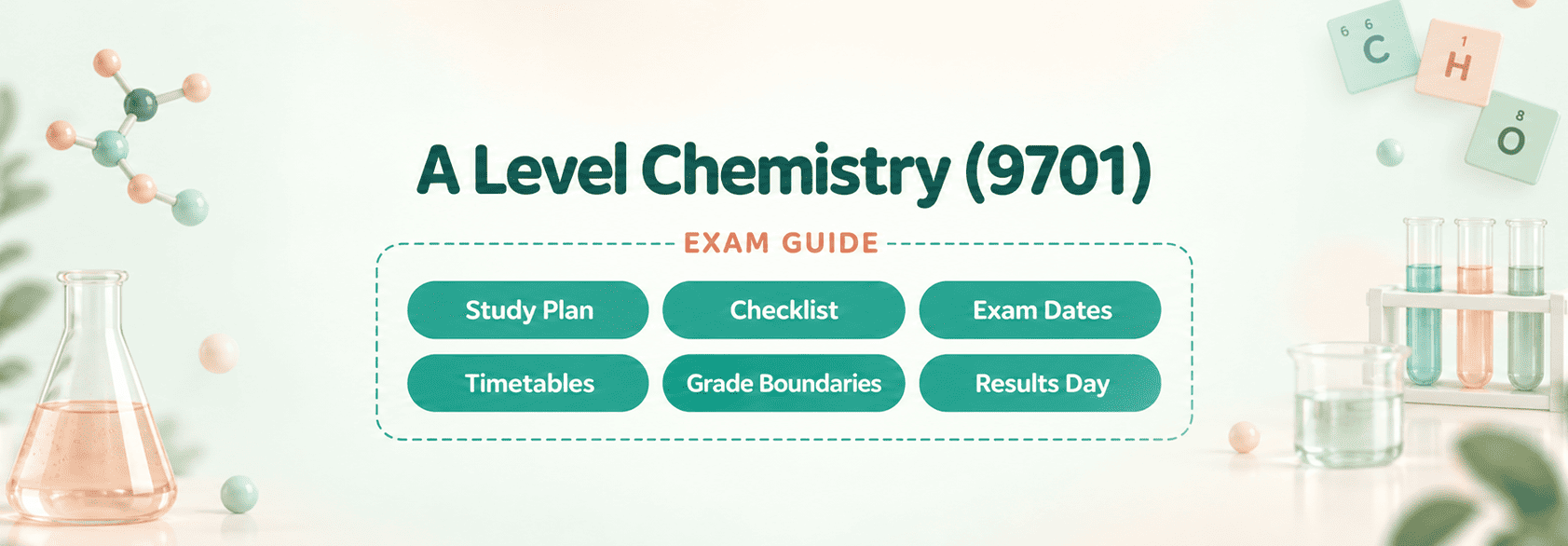
Preparing for Cambridge International A Level Chemistry 9701 requires a structured approach that covers the full examination journey, from creating an effective Study Plan and following a Last-Minute Exam Checklist to tracking Exam Dates and Timetables, understanding Grade Boundaries, and knowing what to expect on Results Day. Each stage helps students organise their preparation, monitor their progress and make informed decisions throughout the A Level Chemistry 9701 examination process.

A Level Chemistry 9701 Study Plan
A strong study plan should change depending on how close students are to their examination.
6+ Months Before Exam
Focus on building foundations:
- Complete syllabus coverage
- Learn Chemistry concepts
- Create Revision Notes
- Practise basic questions
At this stage, understanding is more important than speed.
3–6 Months Before Exam
Focus on application:
- Complete topic questions
- Practise calculations
- Identify weak Chemistry areas
- Review difficult concepts
1–3 Months Before Exam
Focus on exam performance:
- Complete Past Papers
- Study Mark Schemes
- Practise timed questions
- Improve answer structure
Final Month Before Exam
Focus on exam readiness:
- Complete Mock Exams
- Review common mistakes
- Practise practical questions
- Improve time management
A Level Chemistry 9701 Last-Minute Exam Checklist
Before the examination, students should focus on improving accuracy and confidence.
- Review important chemical equations and definitions
- Practise weak Chemistry topics
- Complete timed exam questions
- Review previous mistakes
- Revise practical skills and experimental methods
- Prepare calculator and required materials
- Understand exam instructions
Avoid spending the final days trying to learn the entire syllabus again.
Final preparation should focus on strengthening existing knowledge.
A Level Chemistry 9701 Exam Dates and Timetable
Cambridge International examination dates depend on the examination series.
Students may sit examinations during Cambridge examination sessions such as:
- March
- June
- November
The exact timetable depends on:
- Examination series
- Region
- School or examination centre
Students should confirm their final examination dates through:
- Cambridge official timetable documents
- Their school
- Their exams officer
A timetable should not only tell students when exams happen. It should help them organise their final revision schedule.
A Level Chemistry 9701 Grade Boundaries
Cambridge uses grade thresholds to determine the marks required for each grade.
Grade boundaries can change between examination series because:
- Exam difficulty varies
- Question demands differ
- Cambridge maintains consistent standards across sessions
Students should use previous grade boundaries as guidance, not as guaranteed predictions.
A better approach is to focus on maximising marks by:
- Understanding concepts
- Practising questions
- Reviewing mistakes
- Improving weak areas
A Level Chemistry 9701 Results Day
Results Day is the final stage of the examination journey.
Students should understand:
- When results are released
- How results are received
- What grades mean
- What steps to take afterwards
Cambridge results are provided through schools and examination centres.
Students should review:
- Final grade
- Statement of Results
- Any required next steps
If results are lower than expected, students should speak with their school or exams officer to understand available options.
Get Ready for A Level Chemistry 9701

Explore Revision Notes, Interactive Videos, Test Papers, Mock Exams, Diagnostic Reports and Tutor Support for your Chemistry preparation.
Resources to Support A Level Chemistry 9701 Preparation
HomeSchool Asia supports students through a complete Chemistry learning journey.
Learn — Interactive Videos
Build understanding of complex Chemistry concepts through visual explanations.
Reinforce — Revision Notes
Review:
- Key definitions
- Chemical equations
- Important concepts
- Reaction pathways
Practise — Test Papers
Develop:
- Exam application
- Calculation skills
- Structured answers
Measure — Mock Exams
Evaluate:
- Exam readiness
- Time management
- Performance under pressure
Improve — Diagnostic Reports
Identify:
- Weak Topics
- Knowledge Gaps
- Areas requiring targeted revision
Support — Tutor Support
Receive additional guidance for difficult concepts and exam preparation.
The complete learning cycle is:
Learn → Practise → Analyse → Improve
Conclusion
Preparing for Cambridge International A Level Chemistry 9701 requires a combination of understanding, practice and continuous improvement.
Successful preparation comes from:
- Understanding Chemistry concepts
- Applying knowledge through exam questions
- Reviewing mistakes
- Improving weak areas
From your first revision session to Results Day, having a structured preparation plan helps you approach the examination with confidence.
Explore structured A Level Chemistry 9701 preparation resources with HomeSchool Asia.
Frequently Asked Questions
What is A Level Chemistry 9701?
A Level Chemistry 9701 is a Cambridge International qualification that develops students’ understanding of chemical principles, practical skills and problem-solving ability across Physical, Inorganic and Organic Chemistry.
How difficult is A Level Chemistry 9701?
A Level Chemistry requires strong conceptual understanding and consistent practice. Students need to apply Chemistry knowledge rather than only memorise information.
How should I revise for A Level Chemistry?
A strong revision process follows:
Learn → Practise → Analyse → Improve
Students should combine Interactive Videos, Revision Notes, Test Papers, Past Papers and Mock Exams.
How many papers are there in Chemistry 9701?
The number of papers depends on whether students complete AS Level or the full A Level route. Cambridge assessment includes multiple-choice, structured questions and practical assessment components.
Are past papers enough for Chemistry preparation?
Past papers are important, but they should be combined with concept learning, revision and mistake analysis.
How can I get an A* in A Level Chemistry 9701?
Students aiming for higher grades should focus on:
• Strong conceptual understanding
• Regular exam practice
• Reviewing mistakes
• Improving weak topics
How important are Chemistry practical skills?
Practical skills are an important part of Cambridge Chemistry assessment. Students should understand experimental methods, data analysis and evaluation techniques.