Key Highlights
- Understand how Diagnostic Tests help identify weak areas in IGCSE Additional Mathematics 0606.
- Learn the difference between Diagnostic Tests, Mock Exams and Topic Practice.
- Discover how Diagnostic Reports can highlight strengths, weaknesses and knowledge gaps.
- Understand mastery levels such as Complete, Adequate and Inadequate.
- Learn how to turn diagnostic results into targeted Mathematics revision.
- Follow a continuous cycle of assessment, practice and improvement.
Summarize with AI


How do you know which IGCSE Additional Mathematics 0606 topics you actually need to revise? An overall test score can show how you performed, but it does not always explain where your strengths and weaknesses are. Diagnostic Tests help students understand their performance at a deeper level by identifying areas that may require further learning or practice. This allows you to move from simply taking a test to creating a more targeted revision plan.
The process is simple:
Test → Analyse → Identify Weak Areas → Target Revision → Practise → Reassess
What Is an IGCSE Additional Mathematics 0606 Diagnostic Test?
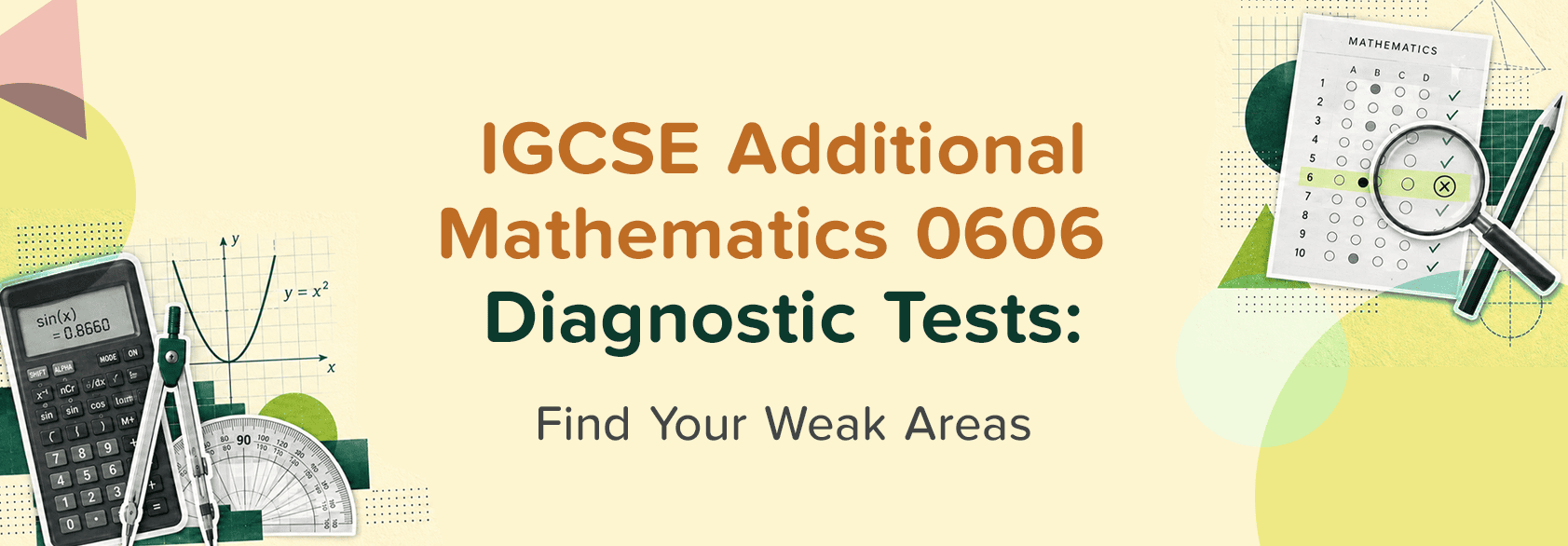
A Diagnostic Test is designed to help you understand which areas of Mathematics you have mastered and which areas need further attention.
A traditional test might tell you that you achieved a particular score. A diagnostic assessment goes a step further by helping you understand what that performance means for your learning.
For example, you may perform well overall but still have difficulty with a particular area such as differentiation, functions or trigonometry.
Instead of revising every topic equally, diagnostic insights can help you focus your time where it is most needed.
Think of the process as:
Score → Insight → Action
The important question is not only “How did I perform?”, but also:
“What should I revise next?”
How Diagnostic Tests Help You Find Weak Mathematics Topics
Diagnostic assessment can help you identify different aspects of your Mathematics performance.
Areas of Strength
A report can highlight topics where your performance demonstrates stronger understanding.
These areas may require less immediate revision, allowing you to spend more time on topics where you need additional practice.
Weak Areas
Diagnostic results can highlight topics where your performance suggests that further revision or practice may be useful.
For example, if you repeatedly struggle with a particular mathematical method, that area can become a priority in your revision plan.
Knowledge Gaps
Sometimes the issue is not simply making a calculation error. You may not fully understand the underlying concept or know when to apply a particular method.
Identifying these gaps early gives you an opportunity to return to the relevant learning material.
Repeated Mistakes
If similar errors appear across multiple questions or assessments, they may indicate a pattern that needs attention.
The goal is to recognise the pattern and address its underlying cause.
The process becomes:
Identify → Target → Practise → Improve
Understanding Your Diagnostic Report
A Diagnostic Report can organise performance into different mastery levels to help you understand where you currently stand.
| Mastery Level | What It Indicates |
|---|---|
| Complete | Strong demonstrated understanding of the assessed area |
| Adequate | Understanding is present but may benefit from further reinforcement |
| Inadequate | Further learning and practice are recommended |
These categories should be treated as learning guidance, rather than as predictions of your final examination grade.
For example, an area marked Inadequate does not mean you will perform poorly in the final examination. It indicates that the area deserves additional attention based on your current assessment performance.
The purpose is to help you decide where to focus your next revision session.
How HomeSchool Asia Generates Diagnostic Insights
HomeSchool Asia connects assessment with performance analysis across different learning activities.
Depending on the assessment, students may receive diagnostic insights after completing activities such as:
- Quizzes
- Test Paper practice
- End-of-lesson quizzes
- Mock Exam practice
- Competency Tests
The resulting Diagnostic Report can help highlight areas of strength and weakness based on your performance.
This means assessment is not simply about receiving a final score. The information can help you understand what to work on next.
For example:
Assessment → Diagnostic Report → Weak Area → Targeted Revision

Diagnostic Test vs Mock Exam vs Topic Practice
These three forms of assessment serve different purposes.
| Assessment | Main Purpose |
|---|---|
| Diagnostic Test | Identify strengths, weaknesses and areas requiring attention |
| Mock Exam | Practise complete examination performance under exam conditions |
| Topic Practice | Strengthen a specific Mathematics topic or skill |
A student can use all three during their preparation.
For example:
Diagnostic Test → Identify Weak Topic → Topic Practice → Mock Exam → Reassess
A Mock Exam may show that your overall performance needs improvement. A Diagnostic Report can help you understand which areas contributed to that performance, while Topic Practice allows you to work directly on those areas.
What Should You Do After Finding a Weak Topic?
Finding a weak area is only useful if you act on it.
Follow these four steps.
Step 1 — Identify the Topic
Start by reviewing your Diagnostic Report and identifying the areas that require further attention.
Do not immediately start revising everything.
Prioritise the topics where your assessment indicates that more learning or practice is needed.
Step 2 — Review the Concept
Return to the relevant learning material.
You can use:
- Interactive Videos
- Revision Notes
Focus on understanding the mathematical concept and the method behind the questions.
Step 3 — Practise the Topic
Once you have reviewed the concept, move into targeted practice.
Use Learning Test Papers to generate questions according to factors such as:
- Paper type
- Topic
- Difficulty level
This allows you to practise questions that match your current learning objectives and assessment needs.
Step 4 — Reassess
After targeted revision and practice, assess your understanding again.
The aim is to see whether your performance has improved and whether the topic still requires further attention.
The cycle becomes:
Diagnose → Learn → Practise → Reassess
Example: Turning a Weak Area Into a Revision Plan
Imagine your Diagnostic Report identifies Differentiation as an area requiring improvement.
Instead of revising the entire IGCSE Additional Mathematics syllabus again, you could create a targeted learning path:
- Review the relevant differentiation concepts.
- Watch the relevant Interactive Video.
- Review supporting Revision Notes.
- Generate targeted Test Paper questions.
- Practise questions at an appropriate difficulty level.
- Review mistakes and identify anything that remains unclear.
- Reassess your performance.
This creates a focused revision cycle:
Differentiation → Review → Practise → Analyse → Reassess
The same approach can be applied to other areas where your Diagnostic Report indicates that further work is needed.
When Should You Use a Diagnostic Test?
Diagnostic assessment can be useful at different stages of your IGCSE Additional Mathematics preparation.
Early Preparation
Use assessment to understand your current starting point and identify topics that may require additional attention.
During Revision
Use diagnostic insights to adjust your revision plan as you progress through the syllabus.
Before Mock Exams
Identify remaining weak areas before moving into full examination practice.
Before Final Exams
Use your latest performance information to prioritise final revision.
There is no single testing schedule that works for every student. The important point is to use assessment information to make your revision more targeted.
How HomeSchool Asia Supports Targeted IGCSE Additional Mathematics 0606 Revision
HomeSchool Asia connects assessment with learning and practice through a continuous preparation cycle.
Assess — Diagnostic Tests
Identify areas of strength, weakness and knowledge gaps.
Understand — Interactive Videos
Build understanding of mathematical concepts and methods.
Reinforce — Revision Notes
Review important concepts, methods and formulas.
Practise — Learning Test Papers
Generate targeted questions based on your learning and assessment needs.
Measure — Mock Exams
Practise applying your Mathematics knowledge under examination conditions.
Analyse — Diagnostic Reports
Review performance and identify areas requiring further attention.
The complete learning journey is:
Assess → Learn → Practise → Measure → Improve
Explore our Additional Mathematics resources:
IGCSE Additional Mathematics 0606 Diagnostic Assessment Checklist
Before reviewing your Diagnostic Report:
- ✓ Complete the assessment independently
- ✓ Review your overall performance
- ✓ Identify strong and weak areas
- ✓ Check your mastery levels
- ✓ Look for knowledge gaps
- ✓ Identify repeated mistakes
- ✓ Select relevant learning resources
- ✓ Practise weak topics
- ✓ Reassess your understanding

Conclusion
A Diagnostic Test should do more than tell you whether you performed well or poorly. It should help you understand what you know, what you are struggling with and what you should revise next.
Use your results to create a targeted learning cycle:
Test → Diagnose → Target → Practise → Reassess
By connecting assessment with focused revision and practice, you can spend less time revising topics you already understand and more time working on the areas that need attention.
Start Your IGCSE Additional Mathematics (0606) Journey!

Premium Plan
- Full 12-month structured resources of all subjects.
- Full access to all Interactive Videos.
- Additional Tutor Credits to access features.
- Diagnostic Report available to all chapters.
- Downloadable Revision Notes available for all topics.
- “Get one Answer a Day” is activated for all subjects.

Custom Plan
- Full 12-month structured resources of chosen subjects.
- Full access to Interactive Videos for the chosen subject.
- Additional Tutor Credits to access features.
- Diagnostic Report available to all chapters.
- Downloadable Revision Notes available for all topics.
- “Get one Answer a Day” is activated for chosen subjects.
Frequently Asked Questions
What is a Diagnostic Test in IGCSE Additional Mathematics?
A Diagnostic Test helps identify areas of strength, weakness and potential knowledge gaps based on your assessment performance.
How can I find my weak topics in Additional Mathematics 0606?
Use Diagnostic Reports to review your performance and identify areas that require further learning or practice. You can then use targeted resources to work on those topics.
Is a Diagnostic Test the same as a Mock Exam?
No. A Diagnostic Test focuses on understanding strengths and weaknesses, while a Mock Exam is primarily used to practise complete examination performance under timed conditions.
What does “Inadequate” mean in a Diagnostic Report?
It indicates that your current performance in an assessed area suggests that further learning or practice may be beneficial. It does not represent a prediction of your final examination grade.
Should I revise the whole syllabus if I have weak topics?
Not necessarily. Diagnostic insights can help you prioritise specific areas that require attention, allowing you to make your revision more targeted.
How often should I take a Diagnostic Test?
The appropriate frequency depends on your preparation stage and learning needs. Use diagnostic assessment when you need to understand your current performance and decide which areas require further work.