Key Highlights
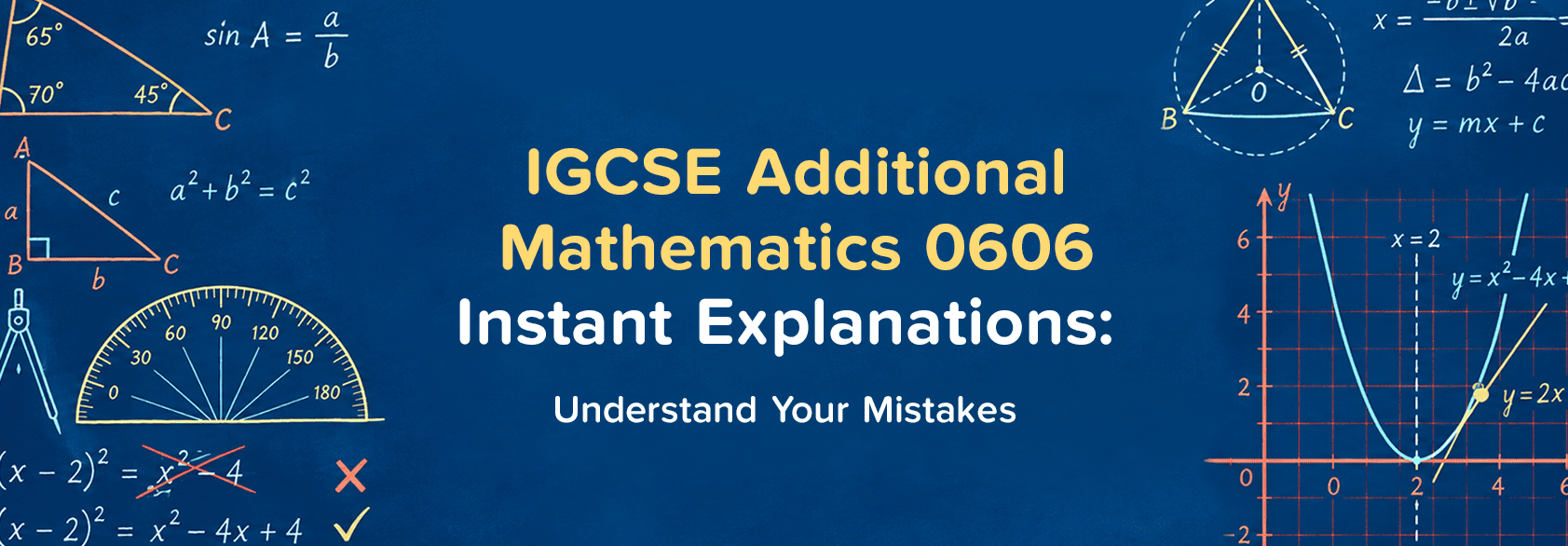
- Understand how Instant Explanations help you learn from mistakes in IGCSE Additional Mathematics 0606.
- Discover what a question is actually testing and why an incorrect answer does not work.
- Learn how explanations connect individual questions with the underlying mathematical concept.
- Understand how End-of-Lesson Quizzes and Instant Explanations work together.
- See how Instant Explanations differ from Mock Exams, Test Papers and Diagnostic Reports.
- Learn how to use explanations to improve your approach to similar Mathematics questions.
Summarize with AI


Getting an IGCSE Additional Mathematics 0606 question wrong does not always mean you need to memorise the correct answer. The more useful question is: why was the answer wrong? Instant Explanations help students understand what a question is testing, why an incorrect answer does not work, why the correct answer works and which underlying concept needs to be understood. Available within End-of-Lesson Quizzes in Interactive Video lessons, they turn mistakes into opportunities to strengthen mathematical understanding.
What Are IGCSE Additional Mathematics 0606 Instant Explanations?
When you get a Mathematics question wrong, simply seeing the correct answer may not explain what went wrong in your approach.
You may have:
- Chosen the wrong mathematical method
- Misinterpreted the question
- Applied a formula incorrectly
- Made a calculation error
- Missed an important step
- Misunderstood the underlying concept
Instant Explanations are designed to help you understand the reasoning behind the question and answer.
Rather than stopping at:
“Your answer is incorrect.”
the explanation helps you understand:
What is the question testing? → Why doesn't my answer work? → Why does the correct answer work? → What concept do I need to understand?
This makes the process more about learning than simply checking answers.
How Instant Explanations Work
Instant Explanations are part of the learning experience within Interactive Video lessons.
Step 1 — Learn Through an Interactive Video
Start by learning a Mathematics concept through the relevant Interactive Video. The lesson provides the conceptual foundation before you test your understanding.
Step 2 — Complete the End-of-Lesson Quiz
After the lesson, complete the End-of-Lesson Quiz to check how well you understand the concept. The questions give you an opportunity to apply what you have just learned.
Step 3 — Review the Instant Explanation
When an explanation is available, review it after answering the question. Instead of only checking whether your answer was correct, focus on understanding the reasoning behind the result.
Step 4 — Apply What You Learned
Return to the concept and try to apply the method to similar questions.
The learning process becomes:
Learn → Check → Understand → Apply
Step 5 — Achieve 80% and Review Your Answers
Complete the End-of-Lesson Quiz and aim for 80% or higher to unlock Instant Explanations. Once unlocked, review the explanations to understand what the question was testing, why an incorrect answer does not work, why the correct answer works, and which underlying concept you need to understand.
What Does an Instant Explanation Tell You?
Instant Explanations focus on helping you understand the reasoning behind a question.
What the Question Is Actually Testing
A question may appear to test one skill while actually requiring you to recognise a particular mathematical concept or method.
The explanation helps identify what you were expected to understand or apply.
For example, a question involving an equation may require more than simply carrying out calculations. You may first need to recognise which mathematical method is appropriate. Understanding this helps you approach similar questions more effectively.
Why Incorrect Answers Don't Work
An incorrect answer can result from different types of mistakes. You may have used an inappropriate method, misunderstood the information given or made an error during the calculation.
Instant Explanations help you understand why the incorrect approach does not lead to the required result, rather than simply telling you that it is wrong.
Why the Correct Answer Works
The correct answer is supported by a mathematical method and reasoning. Understanding that reasoning helps you recognise how the solution was reached rather than simply memorising the final result.
The Underlying Concept
A question is connected to a wider mathematical idea. The explanation helps connect the individual question with the concept you need to understand so that you can apply it again in another context.
Why Understanding Your Mistakes Matters in Additional Mathematics
Additional Mathematics questions often require students to select an appropriate method and apply it correctly.
That means an incorrect answer can reveal more than a simple calculation mistake.
For example, you might know a differentiation formula but struggle to recognise when it should be used. Or you might understand the method but make an algebraic error while working through the solution.
Reviewing mistakes helps you ask:
- Did I understand the question?
- Did I choose the correct method?
- Did I apply the method correctly?
- Where did my working go wrong?
- What concept should I review?
The goal is:
Mistake → Explanation → Understanding → Better Application
Example of Learning From a Mathematics Mistake
Imagine you answer a differentiation question incorrectly. Simply seeing the correct answer tells you the result, but it may not explain why your approach failed.
An Instant Explanation can help you understand:
- What the question is testing — the mathematical concept or skill involved.
- Why your approach does not work — the error in the method or reasoning.
- Why the correct method works — the mathematical reasoning behind the solution.
- What you need to understand — the underlying concept you should revisit.
You can then return to the relevant learning material and practise a similar question.
The objective is not simply to correct one answer. It is to help you recognise the correct approach when you encounter a similar problem again.
Instant Explanations vs Other HomeSchool Asia Learning Tools
Different resources support different parts of the learning process.
| Resource | Main Purpose |
|---|---|
| Interactive Videos | Learn mathematical concepts |
| End-of-Lesson Quizzes | Check understanding after a lesson |
| Instant Explanations | Understand why answers are correct or incorrect |
| Test Papers | Practise targeted questions |
| Mock Exams | Practise complete examination performance |
| Diagnostic Reports | Identify broader strengths and weaknesses |
These resources work together rather than replacing one another.
For example, you might first learn differentiation through an Interactive Video, check your understanding through the End-of-Lesson Quiz, use an Instant Explanation to understand a mistake and then practise the concept further using Test Papers.
When Are Instant Explanations Available?
Instant Explanations are available for End-of-Lesson Quizzes within Interactive Video lessons when students achieve 80% or higher.
The intended learning flow is:
Interactive Video → End-of-Lesson Quiz → 80% Score → Instant Explanation
Instant Explanations are specifically designed to help students understand the reasoning behind a specific question.
This is different from the broader Diagnostic Report system.
| Feature | Purpose |
|---|---|
| End-of-Lesson Quiz | Checks understanding after an Interactive Video |
| 80% Threshold | Unlocks Instant Explanations |
| Instant Explanations | Explains the reasoning behind specific questions |
| Diagnostic Reports | Provides broader insights into strengths, weaknesses and mastery |
How Instant Explanations Fit Into IGCSE Additional Mathematics 0606 Preparation
Instant Explanations form one part of a wider learning journey on HomeSchool Asia.
Learn — Interactive Videos
Build your understanding of Mathematics concepts and methods.
Check — End-of-Lesson Quizzes
Test your understanding immediately after learning a concept.
Understand — Instant Explanations
Review why an answer works or does not work and understand the underlying concept.
Practise — Learning Test Papers
Apply your knowledge through targeted questions.
Measure — Mock Exams
Practise applying your Mathematics knowledge under examination conditions.
Diagnose — Diagnostic Reports
Identify broader strengths, weaknesses and areas requiring further attention.
The complete learning journey is:
Learn → Check → Understand → Practise → Measure → Improve
Explore our Additional Mathematics resources:
How to Make the Most of Instant Explanations
Don't Just Read the Correct Answer
Focus on the reasoning behind the answer. Ask yourself: “Why does this method work?”
Identify Your Mistake
Try to identify exactly where your approach went wrong. Was it your method, calculation, interpretation or understanding?
Revisit the Concept
If the explanation reveals a gap in your understanding, return to the relevant Interactive Video or Revision Notes.
Try a Similar Question
Use targeted Test Papers to practise applying the same concept again.
Check Whether the Mistake Repeats
If you continue making the same type of mistake, it may indicate that the underlying concept needs more revision.
The process becomes:
Review → Understand → Practise → Reassess
IGCSE Additional Mathematics 0606 Mistake Review Checklist
After getting a question wrong:
- ✓ Identify the question you got wrong
- ✓ Understand what the question was testing
- ✓ Review why your answer did not work
- ✓ Understand why the correct answer works
- ✓ Identify the underlying concept
- ✓ Revisit the relevant lesson if necessary
- ✓ Practise a similar question
- ✓ Check whether you can apply the method independently
Conclusion
Getting a question wrong is not the end of the learning process. The more important step is understanding why the answer was wrong and what concept or method you need to improve.
Instant Explanations help turn an incorrect answer into a learning opportunity by connecting the question, the mistake, the correct reasoning and the underlying concept.
The process is:
Answer → Understand the Mistake → Learn the Concept → Apply the Method → Improve
Start Your IGCSE Additional Mathematics (0606) Journey!

Premium Plan
- Full 12-month structured resources of all subjects.
- Full access to all Interactive Videos.
- Additional Tutor Credits to access features.
- Diagnostic Report available to all chapters.
- Downloadable Revision Notes available for all topics.
- “Get one Answer a Day” is activated for all subjects.

Custom Plan
- Full 12-month structured resources of chosen subjects.
- Full access to Interactive Videos for the chosen subject.
- Additional Tutor Credits to access features.
- Diagnostic Report available to all chapters.
- Downloadable Revision Notes available for all topics.
- “Get one Answer a Day” is activated for chosen subjects.
Frequently Asked Questions
What are Instant Explanations in IGCSE Additional Mathematics?
Instant Explanations help students understand what a question is testing, why an incorrect answer does not work, why the correct answer works and which underlying concept they need to understand.
When are Instant Explanations available?
Instant Explanations are available for End-of-Lesson Quizzes within Interactive Video lessons. Students who achieve 80% or higher in the End-of-Lesson Quiz can unlock the Instant Explanation for the relevant questions.
Do Instant Explanations replace Revision Notes?
No. Instant Explanations provide question-specific reasoning, while Revision Notes support broader review of mathematical concepts, methods and formulas.
Are Instant Explanations available for Mock Exams?
Instant Explanations are specifically associated with End-of-Lesson Quizzes within Interactive Video lessons. They should not be presented as a general feature of Mock Exams.
How can Instant Explanations help me improve?
They help you understand mistakes, connect individual questions with underlying concepts and recognise how to approach similar questions.
What should I do after reading an Instant Explanation?
If necessary, revisit the relevant concept, practise similar questions and check whether you can apply the method independently.