Key Highlights
- Discover the key IGCSE Additional Mathematics 0606 resources needed to move from understanding concepts to solving questions independently.
- Learn how Interactive Videos and Revision Notes work together to build and reinforce mathematical understanding.
- Use Testpapers to practise topical past-paper questions, with Mark Schemes to review your working and identify errors.
- Understand how Mock Exams and Diagnostic Reports help measure exam readiness and identify weak topics.
- Learn when Tutor Support can help you overcome recurring mistakes and difficult mathematical concepts.
- Follow a structured learning pathway: Learn → Review → Practise → Test → Diagnose → Improve.
Summarize with AI


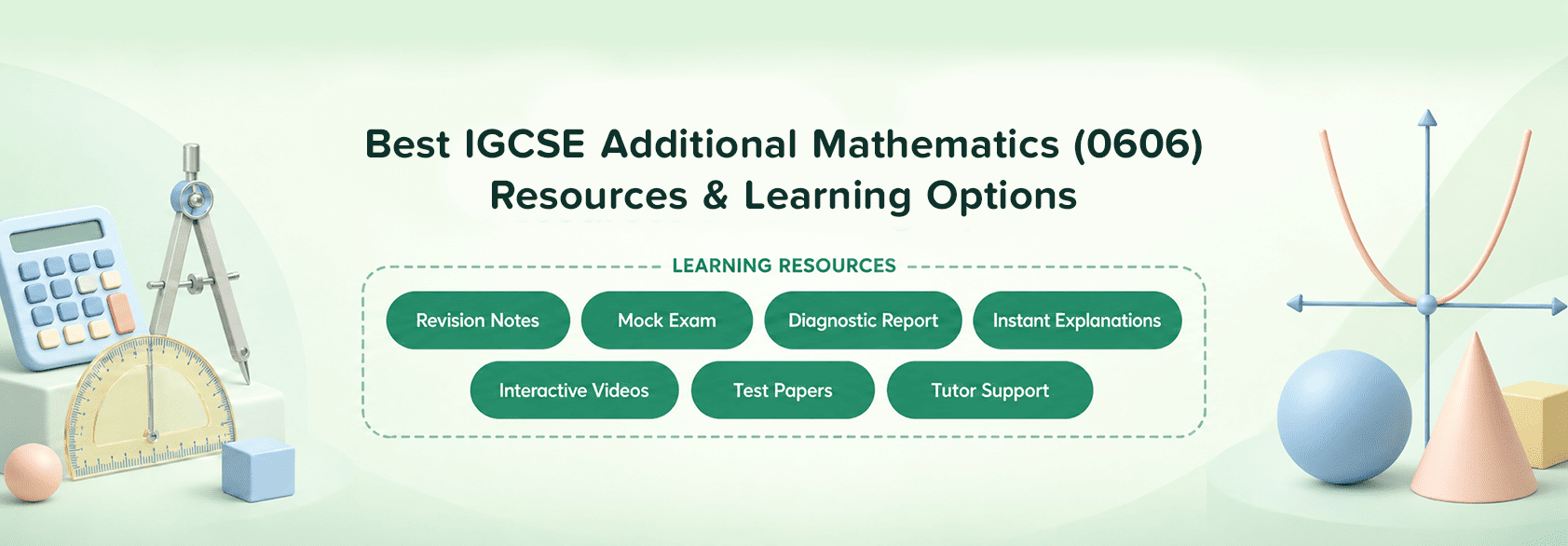
The best IGCSE Additional Mathematics 0606 resources should help you move from learning a mathematical concept to solving questions independently. A useful learning process begins with Interactive Videos to understand the method, followed by Revision Notes to review and reinforce what you have learned. You can then use Testpapers to generate topical past-paper questions, before moving to Mock Exams, Diagnostic Reports, targeted revision and Tutor Support when needed.
This matters in Additional Mathematics because knowing a formula is not the same as knowing when and how to apply it. Cambridge IGCSE Additional Mathematics 0606 develops mathematical fluency, reasoning and problem-solving skills both with and without a calculator.
A structured resource pathway can therefore look like this:
Interactive Videos → Revision Notes → Testpapers → Mock Exams → Diagnostic Reports → Targeted Revision → Tutor Support
Best Resources for Learning and Practising IGCSE Additional Mathematics 0606
1. Interactive Videos for Learning Additional Mathematics Concepts
Interactive Videos should be the starting point when learning a new Additional Mathematics topic.
Additional Mathematics contains methods that are often easier to understand when you can follow the reasoning step by step rather than only reading a formula or finished solution.
For example, when learning Calculus, knowing the differentiation rule is only the beginning. You also need to see how the form of a question determines which method to use, how each line of working follows from the previous one, and how the final result should be presented.
The same applies across areas such as:
- Functions
- Quadratic Functions
- Logarithmic and Exponential Functions
- Coordinate Geometry
- Trigonometry
- Vectors
- Differentiation
- Integration
HomeSchool Asia provides Interactive Videos across all 14 Additional Mathematics topic areas, with End-of-Lesson Quizzes and Diagnostic Reports connected to the learning experience.
This creates a useful first learning cycle:
Watch → Understand → Check Understanding → Identify Gaps
An End-of-Lesson Quiz is particularly useful because it checks whether you understood what you just learned instead of assuming that completing a video means you have mastered the topic.
If the result shows that you are still unclear about a concept, return to the relevant part of the lesson before moving into independent question practice.
2. Revision Notes for Reviewing and Reinforcing What You Learned
Once you have learned a topic through an Interactive Video, Revision Notes help you reinforce and revisit the method.
They are useful when you need to quickly recover:
- A formula
- Mathematical notation
- A rule or identity
- The steps used in a method
- An important condition
- A concept you learned earlier
For example, after completing an Interactive Video on Trigonometry, your Revision Notes can become a quicker reference when you later need to review identities, relationships or methods before practising questions.
The same approach works for Functions, Series, Vectors and Calculus.
HomeSchool Asia provides teacher-made Additional Mathematics Revision Notes alongside its Interactive Videos and other learning resources.
The relationship should therefore be:
Interactive Video → Revision Notes → Practice
Revision Notes are not intended to replace learning or question practice. Their value is in helping you consolidate what you have already studied and quickly revisit it when a question exposes a gap.
Instead of repeatedly watching an entire lesson whenever you forget one step, you can return to your notes, review the method and then attempt the question again.
3. Testpapers for Topical Past-Paper Question Practice
After learning the method and reviewing it, the next question is simple:
Can you apply it yourself?
This is where Testpapers become important.
On HomeSchool Asia, Testpapers allow you to generate past-paper questions and filter them by year, session and paper type, with Mark Schemes included. This means you can use Testpapers for targeted or topical past-paper practice instead of treating topical questions as a separate learning resource.
For example, if you have just studied Differentiation, you can move from:
Interactive Video → Revision Notes → Differentiation past-paper questions through Testpapers
If Trigonometry remains weak, you can generate more relevant practice rather than immediately sitting an entire paper containing topics you may already understand.
This makes Testpapers particularly useful for:
- Strengthening individual topics
- Applying methods independently
- Practising mathematical working
- Recognising different question formats
- Finding repeated errors
- Preparing gradually for full exam papers
The progression should be:
Learn Topic → Review Topic → Generate Topical Past-Paper Questions → Attempt Independently → Check Mark Scheme → Review Errors
Mark Schemes should not only be used to see whether your final answer is correct.
Look at where the marks come from. Cambridge's current Additional Mathematics assessment gives marks for appropriate mathematical working where relevant, so clearly showing your method matters.
If your answer is wrong, identify whether the problem came from the concept, your algebra, the method you selected or a calculation error. Then return to the relevant learning resource before generating another set of questions.
Best Resources for Testing Progress and Improving Weak Topics
4. IGCSE Additional Mathematics 0606 Mock Exams
Testpapers are useful for targeted practice. Mock Exams test something different: whether you can combine your knowledge across different topics under exam-style conditions.
A Mock Exam removes the topic label.
You may move from a Functions problem to Trigonometry, then Calculus or Vectors. You need to recognise what the question is testing and select the appropriate method yourself.
Mock Exams can help you practise:
- Time management
- Mixed-topic problem solving
- Mathematical working
- Method selection
- Non-calculator fluency
- Calculator accuracy
- Exam stamina
For the 2025–2027 Cambridge 0606 syllabus, candidates take two papers. Both are 2 hours and worth 50% of the qualification. Paper 1 is non-calculator, while Paper 2 requires a scientific calculator.
That means your preparation should develop both independent numerical and algebraic fluency and accurate calculator use.
HomeSchool Asia provides time-based Additional Mathematics Mock Exams with a personalised Diagnostic Report after attempts.
Do not move straight from watching a lesson to repeatedly taking Mock Exams.
Build your skills through:
Interactive Videos → Revision Notes → Test Papers → Mock Exams
That gives you enough topic-level practice before you begin testing everything together.
5. Diagnostic Reports for Finding Your Weak Additional Maths Topics
A Mock Exam gives you a result.
A Diagnostic Report should help you decide what to do with that result.
Imagine you achieve a reasonable overall mark, but your topic-level performance shows that most of your mistakes come from Trigonometry and Calculus.
Your next step should not be to restart every Additional Mathematics chapter.
Instead:
Identify Weak Topic → Return to Interactive Video → Review Revision Notes → Generate Targeted Testpaper → Reassess
HomeSchool Asia's Diagnostic Reports track topic-level progress and help identify knowledge gaps and mastery levels. The current platform categorises progress into Inadequate Mastery, Adequate Mastery and Complete Mastery.
The important part is connecting diagnosis back to learning.
For example, a weakness in Calculus could mean several different things:
- You do not understand the differentiation method.
- Your algebra breaks down during the calculation.
- You know the method but cannot recognise when to use it.
- You make repeated accuracy errors.
Each problem requires a slightly different response.
Diagnostic information helps make your revision more targeted rather than simply telling you to “do more Maths”.
6. Additional Mathematics Tutor Support
Sometimes you have already watched the lesson, reviewed the notes and attempted several questions, but the same mistake keeps appearing.
That is when Tutor Support can become useful.
You may need additional feedback if:
- You repeatedly make the same algebraic error.
- You cannot see why a Calculus method is incorrect.
- You know a trigonometric identity but cannot decide when to use it.
- You keep losing method marks.
- You cannot identify which step caused your final answer to become incorrect.
HomeSchool Asia provides Tutor Support where students can receive exam-style evaluations and feedback from Subject Tutors.
Tutor Support should come into the learning cycle where independent practice is no longer solving the problem.
A useful pathway is:
Diagnostic Report → Targeted Revision → Testpaper Practice → Tutor Support if Needed → Independent Practice Again
The objective is not to have a tutor solve each question for you. It is to identify the misconception or incorrect step so that you can return to solving similar problems independently.
How to Combine IGCSE Additional Mathematics Resources Effectively
The most useful Additional Mathematics resources are not separate tools to use randomly. Each one should solve a different learning need.
Learn with Interactive Videos
Start here when learning a new concept or mathematical method.
Follow the explanation, understand the reasoning, and complete the End-of-Lesson Quiz to check your initial understanding.
Reinforce with Revision Notes
After learning the topic, use Revision Notes to consolidate key methods, formulae and mathematical ideas.
They also become your quick-reference resource later in revision.
Practise with Testpapers
Generate topical past-paper questions through Testpapers and apply the method independently.
Use the Mark Scheme afterwards to review both your final answer and your mathematical working.
Test with Mock Exams
Once your individual topics are stronger, move to mixed-topic Mock Exams under timed conditions.
Diagnose Your Weaknesses
Use Diagnostic Reports to find the topics or skills that are still holding back your performance.
Then return to the appropriate Interactive Video, Revision Notes, and Testpaper practice.
Get Support Where Needed
If the same misconception remains after targeted revision, use Tutor Support for feedback and then return to independent questions.
Interactive Videos → Revision Notes → Testpapers → Mock Exams → Diagnostic Reports → Targeted Revision → Tutor Support
Conclusion
The best IGCSE Additional Mathematics 0606 resources are most effective when you use them in the right order. Begin with Interactive Videos to learn the concept, use Revision Notes to reinforce it, and then practise topical past-paper questions through Testpapers.
From there, use Mock Exams to test your overall readiness and Diagnostic Reports to decide what needs more work. If a difficulty remains after targeted revision, Tutor Support can provide additional feedback.
Think of your Additional Mathematics preparation as one connected process:
Learn → Review → Practise → Test → Diagnose → Improve.
Frequently Asked Questions
What are the best resources for IGCSE Additional Mathematics 0606?
A structured combination includes Interactive Videos for learning, Revision Notes for reinforcement, Test Papers for topical past-paper practice, Mock Exams for exam readiness, Diagnostic Reports for identifying weak areas, and Tutor Support when additional feedback is needed.
Should I use Interactive Videos or Revision Notes first?
For HomeSchool Asia's learning pathway, start with Interactive Videos to learn and understand the concept. Use Revision Notes afterwards to consolidate the method and as a quick reference while revising.
Are Revision Notes enough for Additional Mathematics?
No. Revision Notes help you remember and revisit concepts, but Mathematics requires independent application. After reviewing your notes, move to topical past-paper questions through Testpapers to check whether you can actually use the method.
How should I practise Calculus for Additional Mathematics?
Start with the Interactive Video to understand the method, use Revision Notes to reinforce the rules, and then generate relevant past-paper questions through Testpapers. Review errors before progressing to mixed-topic Mock Exams.
How can I improve my non-calculator skills?
Practise algebraic manipulation, exact values and mathematical working without relying on a calculator. This is particularly important because Paper 1 of the current 0606 syllabus is non-calculator.
Should I use topical questions or full past papers first?
Start with topical past-paper questions generated through Testpapers while strengthening individual topics. Move towards complete papers and Mock Exams once you can apply methods independently across several topics.
How can I identify my weakest Additional Maths topics?
Use results from your quizzes, Testpapers, and Mock Exams alongside Diagnostic Reports. Look beyond the overall score and identify which topics or mathematical methods repeatedly produce errors.