Key Highlights
- Use diagnostic assessment to understand your broader Accounting mastery.
- Identify areas that require further attention.
- Separate conceptual difficulties from procedure, application or calculation problems.
- Review Inadequate, Adequate and Complete mastery levels.
- Use mastery information to prioritise your revision.
- Relearn unclear concepts rather than simply doing more questions.
- Reassess after working on weaker areas.
Summarize with AI


A score can tell you how you performed, but it does not always tell you what should receive your attention next. In A Level Accounting 9706, a lower result may come from misunderstanding an accounting concept, forgetting a procedure, selecting the wrong treatment or making repeated calculation errors.
Diagnostic assessment helps you move beyond the result and think more carefully about what needs to happen next. By reviewing your broader mastery, identifying the type of difficulty and choosing an appropriate response, you can make your revision more focused.
Assess → Diagnose → Target → Improve → Reassess
What Are A Level Accounting 9706 Diagnostic Tests?
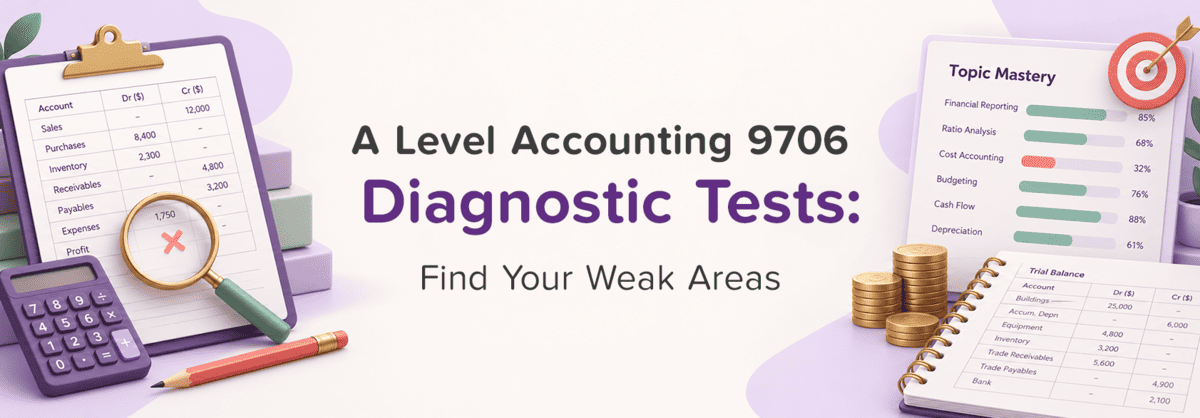
A Level Accounting 9706 Diagnostic Tests help students evaluate their current understanding and use the resulting mastery information to decide where further attention may be needed.
The purpose is not simply to produce another score. Instead, diagnostic assessment should help answer a more useful question:
What does my current performance mean for what I should revise next?
For example, two students may achieve similar results but have very different problems. One may not understand an accounting principle, while another understands the concept but repeatedly makes errors when applying it to calculations.
Those difficulties require different responses.
That is why diagnostic-led revision should follow:
Assessment → Mastery Insight → Identify Weak Area → Target Revision → Reassess
Why a Score Alone May Not Tell You What to Revise
An Accounting result can hide several different types of difficulty. Before labelling a topic as simply “weak”, identify what actually went wrong.
The Concept May Be Unclear
You may not fully understand the underlying accounting principle.
If you cannot explain why a particular treatment or procedure is used, the difficulty is likely deeper than forgotten detail. More question practice alone may not solve it.
The Procedure May Be Forgotten
You may understand the concept but forget the correct sequence of steps when solving a problem.
In this case, you may need reinforcement rather than relearning the entire topic.
The Application May Be Wrong
Sometimes you understand the theory but cannot recognise which accounting treatment applies to the situation in the question.
This is an application problem rather than purely a knowledge problem.
The Calculation May Break Down
You might select the correct method but make errors when transferring figures, carrying out calculations or completing later stages of the working.
That means your revision should focus on accurate application and practice.
The Interpretation May Be Weak
You may be able to calculate a result but struggle to explain what the Accounting information means.
Here, the challenge is moving from calculation to interpretation.
Understanding the type of difficulty gives you a much clearer revision direction.
Understanding Your Diagnostic Report Mastery Levels
HomeSchool Asia uses three Diagnostic Report mastery levels:
| Mastery Level | Threshold |
|---|---|
| Inadequate | 80% and below |
| Adequate | 80% and above |
| Complete | 100% |
These levels should be used as a starting point for deciding what to do next rather than simply as another result to collect.
Inadequate : 80% and Below
An Inadequate result indicates that the area requires further attention.
Do not immediately assume that you need to restart the entire topic. First ask:
- Do I understand the accounting concept?
- Have I forgotten a procedure?
- Am I selecting the wrong treatment?
- Are my calculations inaccurate?
- Can I interpret the resulting information?
Once you know what is causing the difficulty, you can choose a more appropriate response.
Adequate : 80% and Above
Adequate means that the 80% threshold has been reached.
This does not mean you should never revisit the topic. Continue reinforcing and applying it as part of your wider Accounting preparation.
Complete : 100%
Complete represents 100% within the Diagnostic Report mastery framework.
A Complete area may need less immediate attention than an Inadequate area, but it can still be kept active through occasional review and practice.
How to Find the Cause of a Weak Accounting Area
Once diagnostic information highlights an area requiring attention, use a simple process.
Step 1 : Identify the Topic
Start with the specific Accounting area that needs further work.
Avoid vague conclusions such as:
“I'm bad at Accounting.”
Instead:
“This particular topic needs more attention.”
Step 2 : Identify What Went Wrong
Classify the difficulty.
Was it:
- Knowledge
- Procedure
- Calculation
- Application
- Interpretation
This helps you avoid using the wrong revision strategy.
Step 3 : Ask Whether You Understand the Logic
Can you explain why the accounting treatment works?
If not, you may need to relearn the concept rather than simply memorise the steps again.
Step 4 : Choose the Correct Response
Use:
Identify → Classify → Respond
The next action should match the type of weakness.
What to Do With an Inadequate Mastery Area
An Inadequate area should lead to a specific learning action.
If You Don't Understand the Concept
Return to the relevant Interactive Video and work through the concept again.
Focus on understanding the Accounting reasoning rather than memorising a procedure.
If You Understand It but Forgot the Details
Use Revision Notes to refresh terminology, procedures, relationships and calculations.
If You Want to Check Your Understanding
Complete the End-of-Lesson Quiz after the relevant Interactive Video lesson.
If You Achieve 80% or Higher
Eligible Instant Explanations can help you understand relevant End-of-Lesson Quiz questions after you achieve 80% or higher.
Use them to consider what the question was testing and whether your reasoning matched the concept.
If You Understand the Topic but Need Practice
Use Test Papers for targeted question practice by selecting:
Paper Type → Topic → Difficulty Level
If the Difficulty Remains
Use Tutor Support for additional academic guidance with the concept or problem.
The important point is that an Inadequate result should trigger the right type of response, not simply more random revision.
How to Use Diagnostic Results to Plan Your Accounting Revision
Instead of giving every Accounting topic the same amount of time, organise your next revision cycle around mastery.
Priority 1 : Inadequate Areas
Give these areas the most immediate attention.
For each one, determine whether you need:
- Relearning
- Revision
- Practice
- Additional guidance
Priority 2 : Adequate Areas
Maintain these through reinforcement and question practice.
They may not need the same immediate attention as an Inadequate area, but continued application can help keep the knowledge active.
Priority 3 : Complete Areas
Use occasional review to maintain them rather than repeatedly allocating the same revision time.
This creates a more purposeful approach:
Mastery Level → Priority → Action
Diagnostic Insight and Test Paper Grading
These two forms of information should not be treated as the same thing.
Test Papers provide grading for the practice completed. They do not generate Diagnostic Reports.
A Test Paper grade tells you how you performed on that particular practice.
A Diagnostic Report provides broader mastery information through the Inadequate, Adequate and Complete levels.
Once you identify an area requiring attention, Test Papers can then be useful for targeted application practice.
What Should You Do After Improving a Weak Area?
Revision should not stop as soon as you finish another study session.
You need to check whether the original difficulty has actually changed.
Reassess
Use an appropriate assessment to review your understanding again.
Review the Original Error
Ask whether the same issue remains.
If your original problem was calculation accuracy, are the calculations now more consistent?
If the concept itself was unclear, can you now explain the Accounting logic independently?
Decide Whether More Work Is Needed
If the difficulty remains, adjust your approach rather than repeating exactly the same activity.
Use:
Diagnose → Improve → Reassess
A Practical A Level Accounting 9706 Diagnostic Revision Routine
A diagnostic-led revision session can follow this process:
- Complete the relevant assessment.
- Review your mastery information.
- Identify areas requiring attention.
- Classify the difficulty.
- Relearn or revise the topic.
- Complete targeted practice.
- Review how you performed.
- Reassess when appropriate.
The complete cycle is:
Assess → Diagnose → Target → Learn or Revise → Practise → Reassess
This prevents diagnostic assessment from becoming something you check once and then ignore.
How HomeSchool Asia Supports Diagnostic-Led Revision
HomeSchool Asia allows students to use mastery information to guide what happens next. Interactive Videos can support relearning, while Revision Notes reinforce concepts already understood. End-of-Lesson Quizzes check understanding, with eligible Instant Explanations available after achieving 80% or higher. Test Papers provide targeted practice and grading, while Mock Exams support broader assessment. If a concept remains difficult after independent study, Tutor Support can provide additional academic guidance.
Conclusion
An A Level Accounting 9706 Diagnostic Test is useful when the result changes what you do next. The three mastery levels, Inadequate at 80% and below, Adequate at 80% and above, and Complete at 100%, provide a way to interpret broader mastery.
Don't stop at labelling a topic as weak. Identify whether the difficulty involves understanding, procedure, application, calculation or interpretation. Then choose the appropriate revision response and reassess after working on it.
Identify the weak area → Understand why it is weak → Target your revision → Reassess.
Start Your A-Level Accounting (9706) Journey!

Premium Plan
- Full 12-month structured resources of all subjects.
- Full access to all Interactive Videos.
- Additional Tutor Credits to access features.
- Diagnostic Report available to all chapters.
- Downloadable Revision Notes available for all topics.
- “Get one Answer a Day” is activated for all subjects.

Custom Plan
- Full 12-month structured resources of chosen subjects.
- Full access to Interactive Videos for the chosen subject.
- Additional Tutor Credits to access features.
- Diagnostic Report available to all chapters.
- Downloadable Revision Notes available for all topics.
- “Get one Answer a Day” is activated for chosen subjects.
Frequently Asked Questions
What is an A Level Accounting 9706 Diagnostic Test?
It is an assessment used to help understand current Accounting mastery and identify areas that may require further attention.
How can Diagnostic Tests help me find weak Accounting areas?
They provide broader mastery information that can help you identify which areas deserve further review and then investigate why those areas are difficult.
What are the Diagnostic Report mastery levels?
- Inadequate: 80% and below
- Adequate: 80% and above
- Complete: 100%
What does Inadequate mastery mean?
It indicates that the area requires further attention. Determine whether the difficulty involves understanding, procedure, application, calculation or interpretation before deciding what to do next.
What should I do after receiving an Inadequate result?
Identify the cause first. Relearn unclear concepts, use Revision Notes for forgotten details or move into targeted question practice when the underlying concept is understood.
What should I do after reaching Adequate mastery?
Continue reinforcing and applying the topic through appropriate revision and practice.
What does Complete mastery mean?
Complete represents 100% within the Diagnostic Report mastery framework.
Do Test Papers generate Diagnostic Reports?
No. Test Papers provide grading for the practice completed; they do not generate Diagnostic Reports.
Can Instant Explanations help me understand a weak topic?
Instant Explanations can help you understand eligible End-of-Lesson Quiz questions after achieving 80% or higher within an Interactive Video lesson. If the wider Accounting concept remains unclear, return to the relevant learning material.