Key Highlights
- Understand the Cambridge IGCSE Physics 0625 exam structure, including Core and Extended paper routes and practical assessment options.
- Learn how to create an effective IGCSE Physics revision plan combining concept learning, question practice and timed exam preparation.
- Discover how to use Revision Notes, Topic Questions, Past Papers and Mock Exams to improve Physics problem-solving skills.
- Understand how IGCSE Physics 0625 exam dates, administrative zones and timetables affect your final exam preparation.
- Learn how Cambridge grade thresholds, results day and performance reports work after completing your Physics examinations.
- Follow a complete IGCSE Physics 0625 preparation journey from syllabus planning to Results Day and future learning decisions.
Summarize with AI


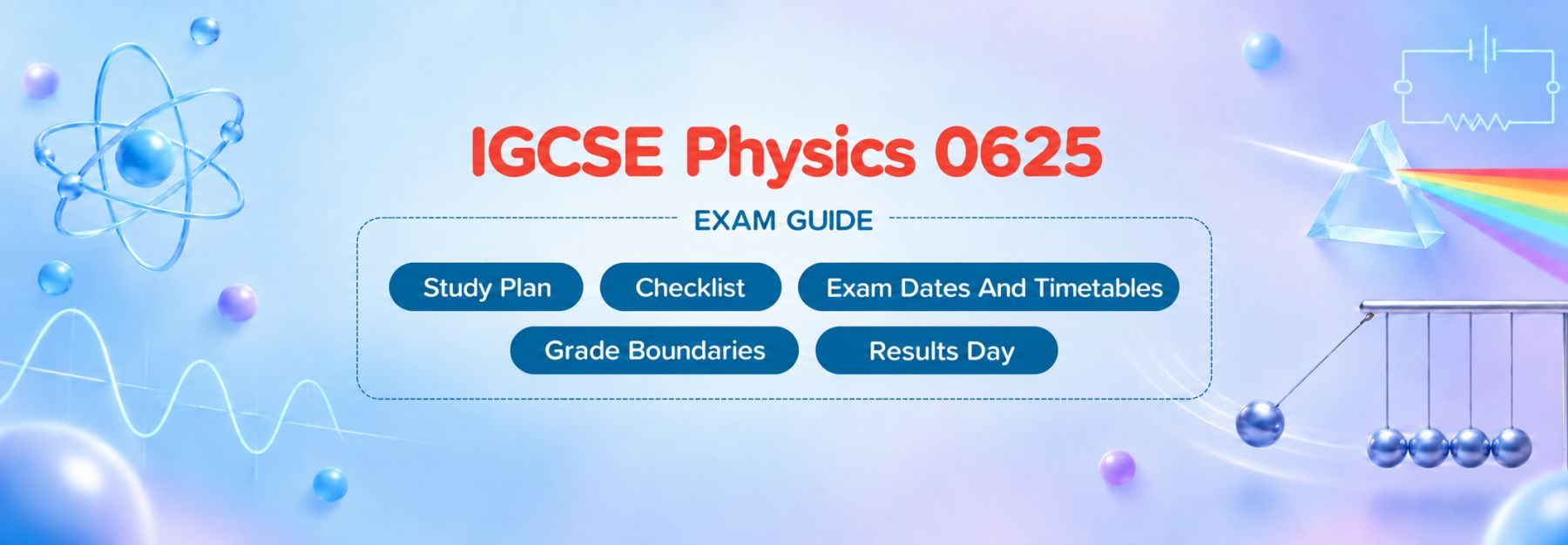
Preparing for Cambridge IGCSE Physics 0625 involves more than revising the syllabus. You need to know which Core or Extended papers you are taking, build an exam-focused study plan, practise under timed conditions, complete a final checklist, confirm the correct Cambridge timetable for your administrative zone, understand how grade thresholds work and know what to expect on results day. This exam guide brings those stages together so you can see the complete journey before, during and after your examination series.
The current Physics 0625 syllabus applies to examinations in 2026, 2027 and 2028. Cambridge offers the qualification in the June and November series, with a March series available in India.
Understand Your IGCSE Physics 0625 Exam Papers First
Before planning revision, confirm which papers you are actually taking. All Physics 0625 candidates take three papers, but the combination depends on whether you are entered for Core or Extended.
| Route | Papers | Assessment |
|---|---|---|
| Core | Paper 1 + Paper 3 + Paper 5 or 6 | Core Multiple Choice, Core Theory and practical skills |
| Extended | Paper 2 + Paper 4 + Paper 5 or 6 | Extended Multiple Choice, Extended Theory and practical skills |
Paper 5 is the Practical Test, while Paper 6 is Alternative to Practical. Both assess experimental skills and carry the same 20% weighting. Core candidates are eligible for grades C–G, while Extended candidates can access the full A*–G range.
Your school or examination centre should confirm your exact component combination. Knowing it early prevents you from spending revision time on the wrong paper format.
How to Prepare for IGCSE Physics 0625 Exams
A useful Physics exam-preparation process moves from understanding individual topics to applying them across complete papers.
Start with this sequence:
Syllabus Check → Diagnose Weak Topics → Topic Revision → Exam-Style Questions → Past Papers → Mock Exams → Error Review
First, compare your current knowledge with the syllabus and identify the areas that need the most work. Your study plan should include theory, calculations and practical skills, rather than treating practical preparation as something to leave until the end.
After reviewing a topic, move into exam-style questions. Use mark schemes to check not only whether your answer was correct, but whether your explanation, units, calculations and working matched what the question required.
As the exam approaches, move from topic questions to complete Past Papers and Mock Exams under timed conditions. Keep an error log and return to repeated mistakes instead of simply attempting more papers.
Get Ready for Your IGCSE Physics 0625 Exams
Find Revision Notes, Mock Exams, Interactive Videos, Test Papers and more to support every stage of your exam preparation.
IGCSE Physics Last-Minute Exam Checklist
Your final days should focus on checking readiness, not trying to relearn the entire syllabus.
Before each Physics paper, confirm:
- Your correct paper and component
- Exam date and AM/PM session
- Examination venue and centre instructions
- Correct administrative-zone timetable
- Calculator and permitted equipment
- Important equations, definitions and units
- Common errors from your past-paper practice
- Graph, data-handling and practical skills
- Any weak areas that can still be reviewed with targeted questions
Avoid spending your final revision session repeatedly reviewing topics you already know well. Use recent Mock Exams, Past Papers or Diagnostic Reports to decide which concepts genuinely need attention.
Paper 5 and Paper 6 require practical thinking, so your final preparation should also include measurements, variables, tables, graphs, sources of error and improvements to experimental procedures.
IGCSE Physics Exam Dates and Timetables
There is no single worldwide IGCSE Physics 0625 exam timetable.
Cambridge assigns international centres to one of six administrative zones, with a separate timetable also published for UK centres. Your Physics exam date can therefore depend on your examination series, administrative zone and component. Cambridge explicitly advises centres to use the correct zone timetable and notes that a final timetable may occasionally be revised after publication.
When checking your timetable, confirm:
- Exam series: June, November or applicable March series
- Administrative zone
- Syllabus code: 0625
- Paper/component
- AM or PM session
- Your school's exact reporting and start time
Candidates should rely on their examination centre for detailed start and finish arrangements. Cambridge currently publishes final zone-specific June and November timetables on its official timetable page.
How IGCSE Physics Grade Boundaries Work
Students usually search for IGCSE Physics grade boundaries, but Cambridge officially calls them grade thresholds.
A grade threshold is the minimum number of marks required for a particular grade in a paper or overall subject. Cambridge sets thresholds only after an examination has been taken and marked. They can change from one series to another because papers may differ slightly in difficulty.
This means there is no permanent statement such as “you always need 80% for an A*”.
Cambridge publishes both component thresholds and thresholds for valid combinations of components. Where component weightings apply, marks are weighted before the final syllabus grade is compared with the relevant overall threshold. Grade A* is awarded at syllabus level rather than as a component grade.
Previous thresholds can help you understand historical performance, but they should not be used to predict the exact grade boundary for a future examination.
IGCSE Physics Results Day
Cambridge normally releases June-series IGCSE results in August and November-series results in January. March-series candidates have a separate results schedule. Exact release dates should always be checked for the examination series you actually took.
For example, Cambridge released June 2026 IGCSE and O Level results on 18 August 2026. Your school or examination centre normally tells you when and how you can access your results; some candidates may receive secure online access.
Once you receive your Physics result:
- Check your final syllabus grade.
- Speak to your school or centre if anything is unclear.
- Consider your next academic step before reacting to one individual component.
- If there is a genuine concern about marking, ask your centre about Cambridge's Enquiries About Results process.
Cambridge states that enquiries are submitted through the centre via Cambridge International Direct. Final certificates are issued later than results; for international centres Cambridge expects June-series certificates by the end of October and November-series certificates by the end of March.
How the Full IGCSE Physics Exam Journey Fits Together
The stages of exam preparation should work together rather than becoming separate tasks.
Plan → Revise → Practise → Final Checklist → Confirm Timetable → Sit Exam → Check Grade Thresholds → Results Day
Your study plan determines which topics need attention. Past Papers and Mock Exams show whether you can apply that knowledge under examination conditions.
Your last-minute checklist then helps you prepare for the correct paper and avoid practical mistakes before the examination. The official timetable confirms when and where you need to sit each component.
After the exam series, Cambridge's grade thresholdsexplain how marks relate to syllabus grades for that particular session. Results day then gives you the final outcome and, where necessary, access to formal post-results procedures.
Use this master guide as the overview, then move into the dedicated cluster guide whenever you need detailed information about one stage.
Frequently Asked Questions
Which papers do I take for IGCSE Physics 0625?
Core candidates take Paper 1, Paper 3 and either Paper 5 or 6. Extended candidates take Paper 2, Paper 4 and either Paper 5 or 6. Confirm your exact component entry with your school or examination centre.
How early should I start preparing for IGCSE Physics?
There is no single ideal starting point. Begin early enough to identify weak topics, revise them and complete topic questions before moving into full Past Papers and Mock Exams. The more knowledge gaps you currently have, the more preparation time you should allow.
How should I prepare for Physics 0625 exams?
Check your required papers, identify weak topics, revise concepts, practise exam-style questions and then progress to timed Past Papers and Mock Exams. Review mistakes after every paper and target repeated weaknesses instead of simply completing more tests.
When are IGCSE Physics 0625 exams?
Physics 0625 is available in June and November, with March availability in India. Exact component dates vary by Cambridge administrative zone, so use the official timetable for your own centre rather than relying on a date found for another country or zone.
Are IGCSE Physics grade boundaries fixed?
No. Cambridge sets grade thresholds after each examination series. They may rise or fall depending on the difficulty of the examination, so previous thresholds provide context but cannot guarantee the marks required in your series.
When are Cambridge IGCSE results released?
June-series IGCSE results are normally released in August, while November-series results are normally released in January. Always check Cambridge's current results page for the exact date applying to your examination series.
What is the difference between Paper 5 and Paper 6?
Paper 5 is the Practical Test, where candidates carry out experimental work. Paper 6 is Alternative to Practical, which assesses the same experimental skills through written questions rather than a practical examination. Both are worth 20% of the qualification.
Where can I find Physics 0625 exam-preparation resources?
HomeSchool Asia's IGCSE Physics resources can support topic revision, question practice, Mock Exams and weak-topic diagnosis. Use the relevant resource alongside this exam guide based on your current stage of preparation.