Key Highlights
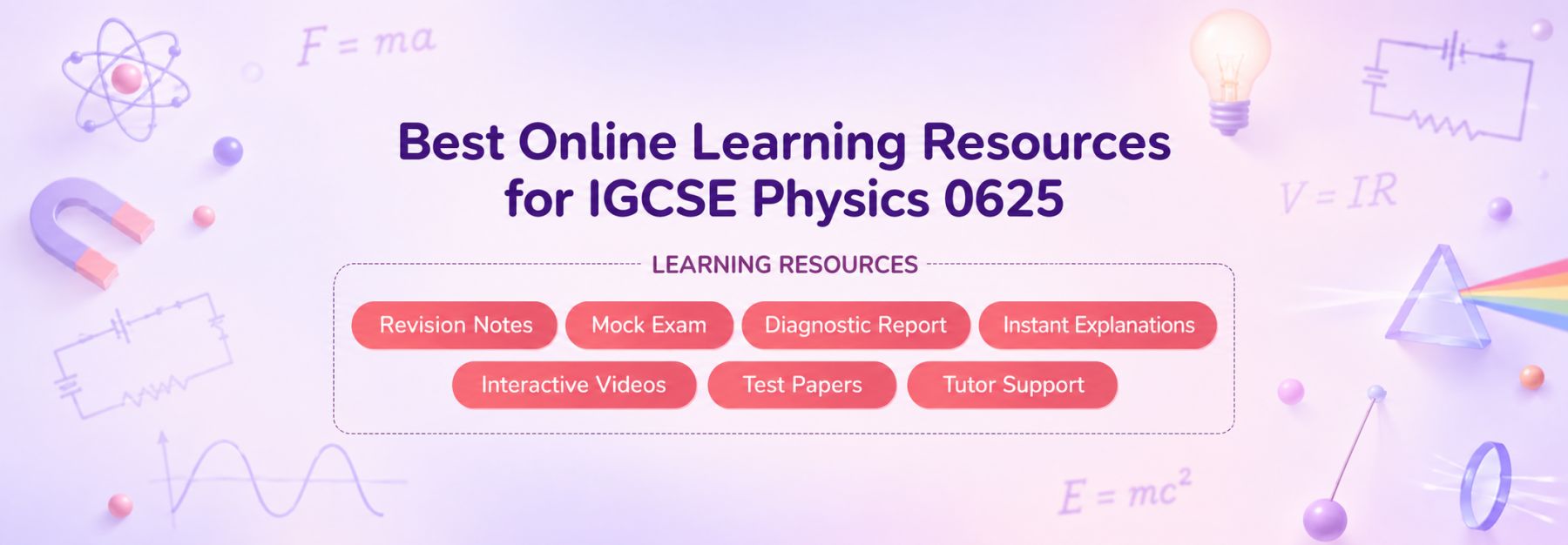
- Discover the best IGCSE Physics 0625 learning resources including Revision Notes, Interactive Videos, Test Papers, Mock Exams and Diagnostic Reports.
- Learn how to combine different resources to build a complete Physics preparation pathway from understanding concepts to improving exam performance.
- Understand how Topic Questions, Test Papers and Past Papers help develop problem-solving skills and exam application.
- Learn how Mock Exams and Diagnostic Reports identify weak Physics topics, knowledge gaps and areas for targeted revision.
- Explore how Instant Explanations and Tutor Support help students overcome difficult concepts and improve understanding.
- Follow a structured Learn → Practise → Test → Diagnose → Improve approach for effective IGCSE Physics 0625 preparation.
Summarize with AI


The best online learning resources for IGCSE Physics 0625 should work together to help you learn concepts, revise topics, practise questions, test your exam readiness, identify weak areas and get additional support when you need it. A useful combination includes Revision Notes, Interactive Videos, Instant Explanations, Test Papers, Mock Exams, Diagnostic Reports and Tutor Support rather than relying on one resource for every stage of preparation.
The Cambridge IGCSE Physics 0625 syllabus for 2026–2028 includes Core and Extended content across Motion, Forces and Energy, Thermal Physics, Waves, Electricity and Magnetism, Nuclear Physics and Space Physics, alongside practical skills. The key is to match the resource to what you are trying to do: learn → understand → practice → test → diagnose → revise → get support.
Resources for Learning and Practising IGCSE Physics 0625
IGCSE Physics Revision Notes and Interactive Videos
Revision Notes are most useful when you need to revisit a topic quickly, organise what you need to know or recover a definition, equation or concept before practising questions.
For example, if you are revising Motion, Forces and Energy, you may need to review acceleration, momentum, energy transfers and pressure separately rather than rereading an entire textbook chapter. HomeSchool Asia's IGCSE Physics Revision Notes are organised across the six main Physics 0625 chapters and include topic-level definitions, diagrams and explanations.
IGCSE Physics 0625 Revision Notes
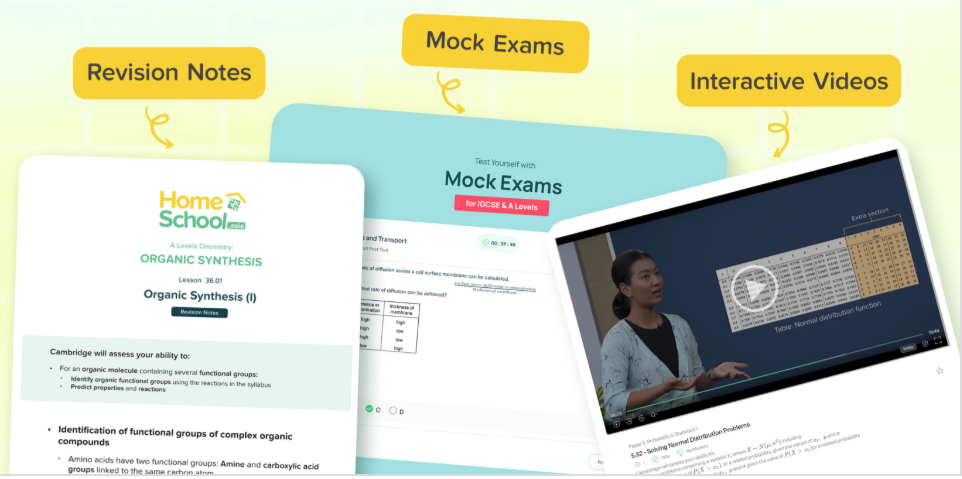
Interactive Videos serve a different purpose. They can help when a concept is easier to understand visually, such as wave behaviour, forces, circuits or electromagnetic effects. HomeSchool Asia's Interactive Videos also include End-of-Lesson Quizzes, allowing you to check whether you understood the lesson rather than simply watching it.
A useful sequence is:
Read or Watch → Check Understanding → Review Mistakes → Practise
Use Revision Notes when you need a concise reference. Use Interactive Videos when you need a concept explained or visualised more clearly. Neither should replace question practice.
IGCSE Physics 0625 Video Lessons
IGCSE Physics Test Papers and Exam-Style Questions
Understanding a Physics idea does not automatically mean you can apply it in an unfamiliar question. Test Papers, Topic Questions and exam-style questions help you move from recognition to independent problem solving.
After learning a topic such as Waves, for example, practise questions that require you to interpret diagrams, perform calculations and decide which principle applies without being told the method first.
HomeSchool Asia's Testpaper feature allows students to generate Objective or Subjective Testpapers, choose chapters or topics, select difficulty levels and practise different question types. Subjective Testpapers can include open-ended, multiple-choice and practical questions.
A useful progression is:
Learn Topic → Practise Topic Questions → Complete Mixed Test Papers → Review Mistakes
When you receive your Diagnostic Report, do not focus only on the final score. Ask why each error happened:
- Did you forget a Physics concept?
- Did you choose the wrong equation?
- Did you make a calculation or unit error?
- Did you misunderstand the question?
- Was your written explanation incomplete?
Official Cambridge Past Papers and Mark Schemes become especially useful once you have enough topic knowledge to attempt mixed questions under realistic conditions.
IGCSE Physics Test Papers Guide
Instant Explanations for Difficult Physics Concepts
Immediate explanations can be useful when you repeatedly answer a question incorrectly but cannot work out why. The goal should be to understand the reasoning behind the correct answer, not simply reveal it.
HomeSchool Asia has an Instant Explanations feature connected to End-of-Lesson Quizzes. For IGCSE Physics 0625, students can instead use quiz and competency feedback to identify the area of difficulty and then return to the relevant Revision Notes, Interactive Video or Topic Questions. If the misconception remains, HomeSchool Asia's Academic Support allows students to submit subject-related questions or completed work for feedback from Subject Experts.
The important learning relationship is:
Incorrect Answer → Identify Why → Review Concept → Attempt Again
Simply seeing a correct answer without correcting the underlying misunderstanding is unlikely to improve the next attempt.
Best Resources for Testing Progress and Improving Weak Topics
IGCSE Physics Mock Exams
Once you have studied and practised individual topics, Mock Exams help answer a different question: can you apply your knowledge across several topics under exam-style conditions?
They are useful for practising:
- Time management
- Mixed-topic questions
- Calculation accuracy
- Paper familiarity
- Moving between easier and harder questions
- Applying knowledge without knowing the topic in advance
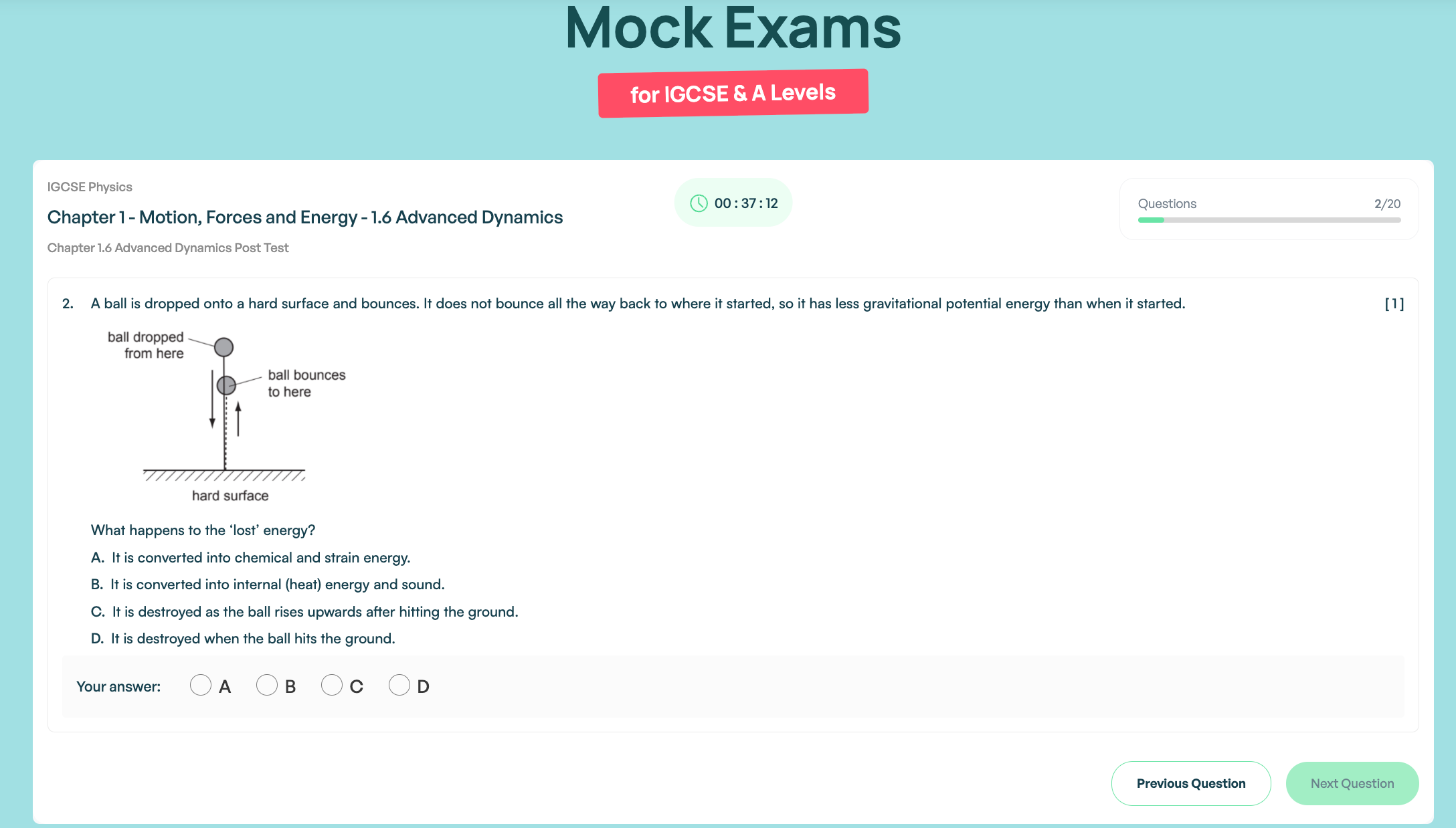
Cambridge IGCSE Physics candidates take three papers. Core candidates take Paper 1, Paper 3 and either Paper 5 or Paper 6, while Extended candidates take Paper 2, Paper 4 and either Paper 5 or Paper 6. Papers 5 and 6 assess practical skills through the Practical Test or Alternative to Practical route.
HomeSchool Asia provides IGCSE Physics 0625 Mock Exams alongside Diagnostic Reports, allowing exam-style practice to lead into analysis of your performance.
Use Mock Exams after substantial topic-based practice. Taking full tests too early can show that you are struggling, but it may not help if you have not yet built the underlying knowledge.
IGCSE Physics Diagnostic Reports
A score tells you how you performed. A useful Diagnostic Report should help you decide what to study next.
Imagine you complete an assessment and achieve an acceptable overall score, but your results repeatedly show difficulty with Electricity and Magnetism. Revising all six Physics chapters equally would ignore the most useful information from your assessment.
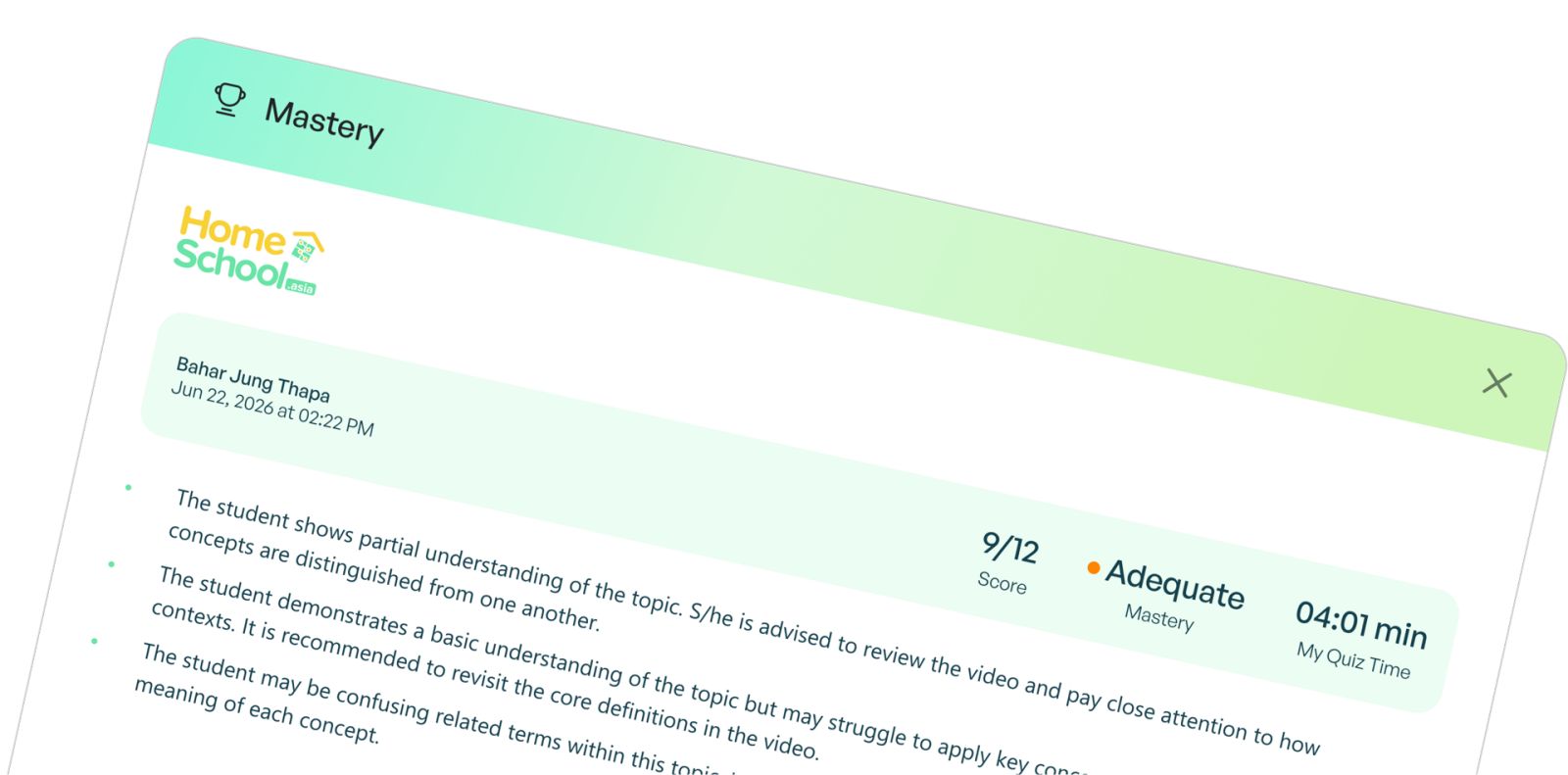
Diagnostic assessment should support:
- Weak-topic identification
- Knowledge-gap detection
- Error analysis
- Topic performance review
- Progress tracking
- Targeted revision
HomeSchool Asia's Competency Evaluator uses Pre-Tests and Post-Tests and generates Diagnostic Reports after completion. Multiple reports for the same topic can also be compared over time.
The learning cycle should be:
Attempt → Diagnose → Target Weak Topics → Practise Again → Measure Improvement
A Diagnostic Report only becomes useful when you act on it. If Waves is weak, return specifically to Waves Revision Notes or Videos, complete another set of questions and then reassess.
IGCSE Physics Tutor Support
Independent learning is useful when you can identify an error and correct it yourself. Tutor Support becomes more valuable when the same misunderstanding remains after concept review and repeated practice.
For example, if your Diagnostic Reports repeatedly show difficulty with circuit calculations, first revisit the relevant notes and questions. If you still cannot identify why your method is failing, subject-specific feedback can help isolate the misconception.
HomeSchool Asia's Academic Support allows students to submit assignments or subject-related questions for Cambridge-based evaluation by Subject Experts. This is currently asynchronous assignment and question support rather than one-to-one live tutoring.
Tutor support should therefore complement independent learning:
Diagnostic Report → Targeted Revision → Practice → Subject Expert Feedback if Needed → Practise Again
You do not need tutor support for every topic. Use it where self-study is no longer resolving the problem.
How to Combine IGCSE Physics Resources Effectively
You do not need to use every resource at the same time. Choose the resource according to the stage of learning you are in.
A structured IGCSE Physics pathway can look like this:
Revision Notes → Interactive Videos → Test Papers → Mock Exams → Diagnostic Reports → Targeted Revision → Tutor Support
Start with Revision Notes or Interactive Videos when you are learning or revisiting a concept. Move into Topic Questions and Test Papers once you think you understand it.
Use Mock Exams when you are ready to test several topics together under more realistic conditions. Then use Diagnostic Reports and error review to decide where your next revision session should focus.
HomeSchool Asia's Learning Hub brings Revision Notes, Interactive Videos, Test Papers, Competency Tests and Tutor Support into the same learning environment, which can make it easier to move from learning into practice and feedback without treating each resource as a separate activity.
The goal is not to collect more IGCSE Physics resources. It is to build a repeatable process:
Learn → Practise → Test → Diagnose → Revise → Get Support
Conclusion
The best online learning resources for IGCSE Physics 0625 are not necessarily the largest collection of notes, videos or questions. You need the right resource at the right stage of your preparation.
Use Revision Notes and Interactive Videos to understand concepts, Test Papers to apply them, Mock Exams to test your readiness and Diagnostic Reports to decide what needs more work. Then use targeted revision and Subject Expert support where necessary.
Explore the learning resources on HomeSchool Asia to build a study process based on what you understand, what you can apply and what still needs improvement.
Start Your IGCSE Physics (0625) Journey!

Premium Plan
- Full 12-month structured resources of all subjects.
- Full access to all Interactive Videos.
- Additional Tutor Credits to access features.
- Diagnostic Report available to all chapters.
- Downloadable Revision Notes available for all topics.
- “Get one Answer a Day” is activated for all subjects.

Custom Plan
- Full 12-month structured resources of chosen subjects.
- Full access to Interactive Videos for the chosen subject.
- Additional Tutor Credits to access features.
- Diagnostic Report available to all chapters.
- Downloadable Revision Notes available for all topics.
- “Get one Answer a Day” is activated for chosen subjects.
Frequently Asked Questions About IGCSE Physics Resources
What are the best online resources for IGCSE Physics 0625?
A useful combination includes Revision Notes, Interactive Videos, Topic Questions, Test Papers, Past Papers, Mock Exams and Diagnostic Reports, with Subject Expert support when independent revision does not resolve a difficulty.
Are revision notes enough for IGCSE Physics?
No. Revision Notes help you review knowledge, but Physics also requires application and problem solving. After reviewing a topic, practise questions that require calculations, explanations, graph interpretation and use of the underlying concepts.
Should I use topic questions or past papers first?
Use Topic Questions first when you are still learning or strengthening individual areas. Move towards mixed Test Papers and complete Past Papers once you can handle the main concepts independently.
How can I identify my weak Physics topics?
Use Topic Tests, Mock Exams or Diagnostic Assessments and review where errors occur. Diagnostic Reports can help organise performance by topic so you can focus revision on specific knowledge gaps rather than repeating everything.
Are mock exams useful for IGCSE Physics 0625?
Yes. Mock Exams help you practise timing, mixed-topic application and exam-style decision-making. They are most useful after you have already completed topic learning and question practice.
What should I do if I keep getting the same Physics topic wrong?
Return to the underlying concept, review a worked explanation or Interactive Video, then attempt new questions on the same skill. If the problem continues, use Subject Expert support to identify the misconception before doing more practice.
Where can I find IGCSE Physics 0625 learning resources?
HomeSchool Asia provides Revision Notes, Interactive Videos, Test Papers, Competency Assessments, Mock Exams and Academic Support through its Learning Hub.