Key Highlights
- Discover the key online learning resources available for Cambridge A-Level Biology 9700.
- Understand when to use Interactive Videos, Revision Notes, Test Papers and Mock Exams.
- Learn how End-of-Lesson Quizzes and Instant Explanations support learning after an Interactive Video.
- See how Diagnostic Reports identify strengths, weaknesses, and areas requiring targeted revision.
- Understand how Tutor Support can provide additional help with difficult Biology concepts.
- Follow a complete Biology learning pathway from understanding concepts to exam preparation.
Summarize with AI


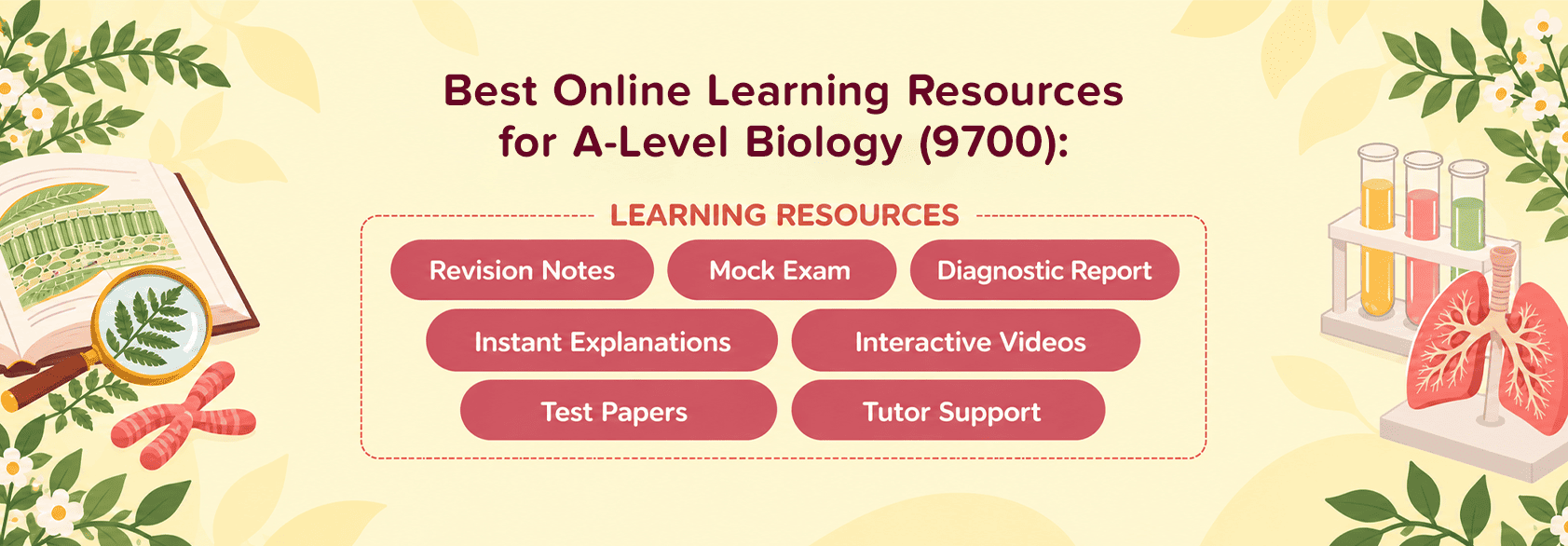
Preparing for Cambridge International A-Level Biology 9700 involves more than reading revision notes or completing past papers. Different stages of preparation require different resources: you may need an Interactive Video to understand a difficult concept, Revision Notes to reinforce it, Test Papers to practise it, and Mock Exams to assess your overall readiness.
A structured learning journey can therefore follow:
Learn → Check → Understand → Practise → Measure → Diagnose → Improve
HomeSchool Asia brings these stages together through Interactive Videos, End-of-Lesson Quizzes, Instant Explanations, Revision Notes, Test Papers, Mock Exams, Diagnostic Reports and Tutor Support.
What Makes a Good Online Learning Resource for A-Level Biology 9700?
A useful A-Level Biology resource should support students throughout different stages of their preparation rather than simply provide information.
For example, a student learning photosynthesis may first need a clear explanation of the process. After learning it, they may need to review key terms and equations, test their understanding, practise exam-style questions and identify areas they still find difficult.
This means effective preparation can involve several types of resources:
- Concept learning to understand difficult Biology topics
- Revision to reinforce important information
- Quizzes to check understanding
- Question practice to apply knowledge
- Mock Exams to practise examination conditions
- Diagnostic Reports to identify strengths and weaknesses
- Tutor Support when additional guidance is needed
The objective is not to find one resource that does everything, but to use the right resource at the right stage.
1. Interactive Videos — Learn Difficult Biology Concepts
Interactive Videos are designed to help students build an understanding of Biology concepts through structured lessons.
They can support learning across the A-Level Biology 9700 syllabus, including areas such as:
- Cell Biology
- Biological Molecules
- Enzymes
- Cell Membranes and Transport
- Photosynthesis
- Respiration
- Genetics
- Protein Synthesis
- Homeostasis
- Immunity
- Ecology
- Evolution
Interactive learning can be particularly useful when a student needs to understand how a biological process works, rather than simply memorise a definition.
For example, when learning photosynthesis, students need to understand the relationship between the stages of the process, not only remember isolated facts.
2. Revision Notes — Reinforce Key Biology Knowledge
Once students understand a topic, Revision Notes can help them review and consolidate the information.
They can be used to revisit:
- Key definitions
- Biological processes
- Important terminology
- Structures and functions
- Scientific concepts
- Important relationships between concepts
Revision Notes are particularly useful when students need a concise way to review previously learned material.
The distinction is simple:
Interactive Videos → Learn
Revision Notes → Reinforce and Review
However, revision notes should work alongside active practice rather than replace it.
3. End-of-Lesson Quizzes — Check Your Understanding
After learning through an Interactive Video, students can use the End-of-Lesson Quiz to check whether they can apply what they have just learned.
The learning flow is:
Interactive Video → End-of-Lesson Quiz
This provides an opportunity to move from passive learning to active recall and application.
For example, after learning about enzymes, a student may need to answer questions involving enzyme activity, factors affecting enzymes or how experimental results should be interpreted.
The purpose is not simply to see whether an answer is correct. It is to identify whether the student can use the concept independently.
4. Instant Explanations — Understand Your Mistakes
Instant Explanations provide additional support within the End-of-Lesson Quiz experience.
They become available when a student achieves 80% or higher in an End-of-Lesson Quiz within an Interactive Video lesson.
The learning pathway is:
Interactive Video → End-of-Lesson Quiz → 80%+ → Instant Explanation
Once unlocked, Instant Explanations help students understand:
- What the question is actually testing
- Why an incorrect answer does not work
- Why the correct answer works
- The underlying Biology concept they need to understand
This makes the quiz more than a simple score.
For example, if a student chooses an incorrect answer about gas exchange, the explanation can help them understand the underlying concept and why the alternative does not fit.
Important: Instant Explanations are specifically available for End-of-Lesson Quizzes within Interactive Video lessons. They are not a general explanation feature for every assessment or Mock Exam.
5. Learning Test Papers — Practise Targeted Biology Questions
Once students have learned and reviewed a topic, they need opportunities to apply their knowledge.
Learning Test Papers provide targeted question practice rather than requiring students to immediately complete an entire examination.
Students can generate topical Biology questions according to their learning and assessment needs.
Choose by Paper Type
Students can select the relevant paper type for the assessment practice they want to complete.
Choose by Topic
Students can focus on a specific Biology topic, such as genetics, respiration, or homeostasis.
Choose by Difficulty
Students can select an appropriate difficulty level based on their current learning objectives.
The process is:
Choose → Generate → Practise → Review
This makes Learning Test Papers particularly useful when students have identified a topic they need to practise further.
6. Mock Exams — Practise Under Exam Conditions
Mock Exams serve a different purpose from topical Test Papers.
Learning Test Papers allow students to focus on particular topics, while these Exams allow them to practise handling a broader examination experience.
These Exams can help students practise:
- Completing full papers
- Managing examination time
- Handling different question types
- Applying knowledge across topics
- Working under timed conditions
- Reviewing overall performance
Students should use these Exams as part of their wider preparation rather than relying on them as their only form of revision.
A useful progression is:
Learn Topics → Practise Topics → Complete Mock Exams → Analyse Performance
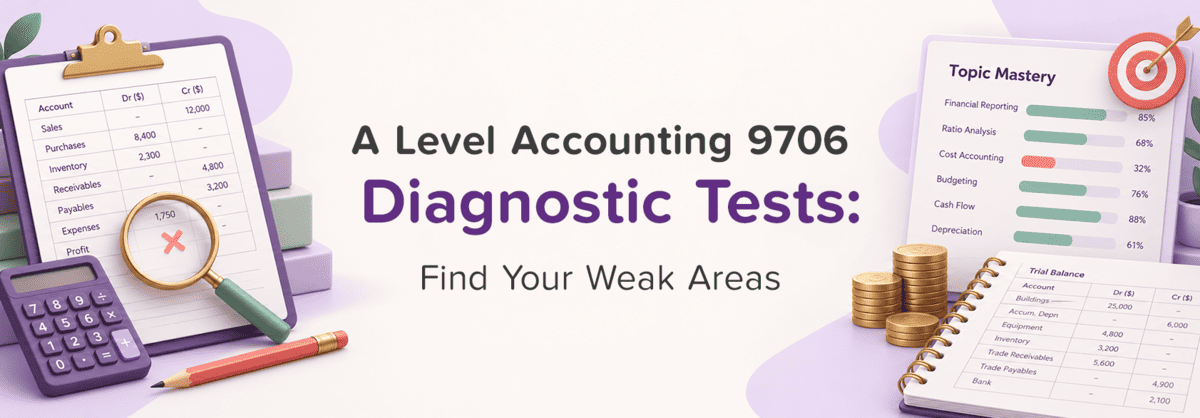
7. Diagnostic Reports — Identify Strengths and Weaknesses
Completing an assessment is only one part of the learning process. Students also need to understand what their performance tells them.
Diagnostic Reports provide broader insights into performance following supported assessment activities such as:
- Quizzes
- Learning Test Paper practice
- End-of-Lesson Quizzes
- Mock Exams
- Competency Tests
The reports can highlight areas of:
- Strength
- Weakness
- Mastery
- Further learning need
Performance can be represented through mastery levels such as:
Complete → Adequate → Inadequate
This allows students to move from simply seeing a result to identifying what they should work on next.
The improvement cycle becomes:
Attempt → Diagnose → Target Weak Topic → Revise → Practise Again
8. Tutor Support — Get Help With Difficult Biology Topics
Independent learning does not always mean learning without support.
Some Biology concepts may remain difficult even after watching a lesson, reviewing notes and practising questions. This is where Tutor Support can provide additional guidance.
Students may seek support when they:
- Cannot understand a particular Biology concept
- Continue making similar mistakes
- Need additional clarification
- Want guidance with difficult examination topics
- Need help connecting different areas of the syllabus
Tutor Support complements independent learning by providing an additional layer of academic assistance.
Which A-Level Biology 9700 Resource Should You Use?
Different resources are useful for different stages of preparation.
| Resource | Best For | When to Use |
|---|---|---|
| Interactive Videos | Learning difficult concepts | Before practice |
| Revision Notes | Reviewing Biology knowledge | During revision |
| End-of-Lesson Quizzes | Checking understanding | After Interactive Videos |
| Instant Explanations | Understanding quiz reasoning | After achieving 80%+ |
| Learning Test Papers | Targeted topical past paper practice | After learning a topic |
| Mock Exams | Full exam practice | Closer to examinations |
| Diagnostic Reports | Identifying strengths and weaknesses | After assessments |
| Tutor Support | Additional academic help | When further guidance is needed |
The important point is that these resources are not interchangeable. Each supports a different stage of the learning process.
How to Build Your A-Level Biology 9700 Learning Journey
A structured approach can connect these resources into one continuous learning cycle.
Step 1 — Learn
Interactive Videos: Build your understanding of Biology concepts.
Step 2 — Reinforce
Revision Notes: Review important information and terminology.
Step 3 — Check
End-of-Lesson Quiz: Test whether you can apply what you have learned.
Step 4 — Understand
Instant Explanations: After achieving 80% or higher, use the explanations to understand the reasoning behind the End-of-Lesson Quiz questions.
Step 5 — Practise
Learning Test Papers: Generate targeted questions based on paper type, topic and difficulty.
Step 6 — Measure
Mock Exams: Practise broader examination performance under timed conditions.
Step 7 — Diagnose
Diagnostic Reports: Identify strengths, weaknesses and areas requiring further attention.
Step 8 — Improve
Targeted Revision + Tutor Support: Return to difficult areas and continue practising.
The complete pathway is:
Learn → Check → Understand → Practise → Measure → Diagnose → Improve
How HomeSchool Asia Supports A-Level Biology 9700 Students
HomeSchool Asia connects different stages of A-Level Biology preparation within one learning journey.
Learn
Interactive Videos
Understand concepts across the Biology 9700 syllabus.
Reinforce
Revision Notes
Review key Biology knowledge.
Check
End-of-Lesson Quizzes
Test your understanding after an Interactive Video.
Understand
Instant Explanations
After achieving 80% or higher, understand what quiz questions are testing and why answers work or do not work.
Practise
Learning Test Papers
Generate targeted Biology questions according to your practice needs.
Measure
Mock Exams
Experience broader examination practice.
Diagnose
Diagnostic Reports
Identify strengths, weaknesses, and mastery areas.
Support
Tutor Support
Get additional help with difficult Biology topics.
Instead of using a different resource for every stage of preparation, students can follow a connected pathway:
Learn → Check → Understand → Practise → Measure → Diagnose → Improve
Start Your A-Level Biology 9700 Preparation
Whether you are learning a difficult Biology concept, reviewing your notes, practising topical questions, or preparing for full examinations, the right resource can support each stage of your preparation.
Start by identifying what you need right now:
- Need to understand? Start with Interactive Videos.
- Need to review? Use Revision Notes.
- Need to practise? Generate Learning Test Papers.
- Need to assess your readiness? Complete a Mock Exam.
- Need to understand your performance? Review your Diagnostic Report.
- Need additional help? Use Tutor Support.
Conclusion
Effective A-Level Biology 9700 preparation requires more than one type of resource. Students need opportunities to learn concepts, reinforce knowledge, apply what they have learned, assess their performance, and identify areas for improvement.
A structured learning journey can follow:
Learn → Check → Understand → Practise → Measure → Diagnose → Improve
With Interactive Videos, Revision Notes, End-of-Lesson Quizzes, Instant Explanations, Learning Test Papers, Mock Exams, Diagnostic Reports and Tutor Support, students can choose resources according to where they are in their Biology preparation.
Explore structured A-Level Biology 9700 learning resources with HomeSchool Asia.
Start Your A-Level Biology (9700) Journey!

Premium Plan
- Full 12-month structured resources of all subjects.
- Full access to all Interactive Videos.
- Additional Tutor Credits to access features.
- Diagnostic Report available to all chapters.
- Downloadable Revision Notes available for all topics.
- “Get one Answer a Day” is activated for all subjects.

Custom Plan
- Full 12-month structured resources of chosen subjects.
- Full access to Interactive Videos for the chosen subject.
- Additional Tutor Credits to access features.
- Diagnostic Report available to all chapters.
- Downloadable Revision Notes available for all topics.
- “Get one Answer a Day” is activated for chosen subjects.
Frequently Asked Questions
What are the best online resources for A-Level Biology 9700?
A complete preparation strategy can combine Interactive Videos, Revision Notes, End-of-Lesson Quizzes, Learning Test Papers, Mock Exams, Diagnostic Reports and Tutor Support. Each resource serves a different stage of learning and examination preparation.
Are A-Level Biology 9700 Revision Notes enough?
Revision Notes are useful for reviewing and reinforcing knowledge, but they should be combined with active question practice, assessment and mistake analysis.
Are Interactive Videos available for the whole Biology 9700 syllabus?
HomeSchool Asia's Interactive Videos are structured across the A-Level Biology 9700 syllabus, allowing students to learn concepts throughout their course.
What are A-Level Biology 9700 Learning Test Papers?
Learning Test Papers provide targeted question practice. Students can generate questions according to factors such as paper type, topic, and difficulty level, allowing practice to match their learning and assessment needs.
What is the difference between Learning Test Papers and Mock Exams?
Learning Test Papers are designed for targeted practice, allowing students to focus on specific topics and difficulty levels. Mock Exams provide broader examination practice under timed conditions.
What is an A-Level Biology 9700 Diagnostic Report?
A Diagnostic Report provides broader insights into a student's assessment performance, helping identify areas of strength, weakness, and mastery that may require further attention.
When do Instant Explanations become available?
Instant Explanations become available within End-of-Lesson Quizzes in Interactive Video lessons after achieving 80% or higher. They help students understand what a question is testing, why an incorrect answer does not work, why the correct answer works, and which underlying concept they need to understand.
Are Instant Explanations available for Mock Exams?
No. Instant Explanations are specifically part of the End-of-Lesson Quiz experience within Interactive Video lessons. They should not be presented as a general feature of Mock Exams or other assessments.
Can I get Tutor Support for difficult Biology topics?
Yes. Tutor Support is designed to provide additional academic guidance when students need help understanding difficult concepts, resolving confusion or preparing for examination topics.