Key Highlights
- Identify mathematical areas that need more attention.
- Separate broader mastery from one practice grade.
- Look beyond the topic name to the type of error.
- Use mastery levels to guide your next step.
- Relearn unclear methods rather than repeatedly practising them.
- Use targeted Test Papers after identifying a weakness.
- Reassess after meaningful improvement.
Summarize with AI


Knowing that you lost marks in Maths is not enough. To improve efficiently, you need to know whether those marks were lost because you misunderstood the concept, forgot a formula, chose the wrong method, or made an accuracy error.
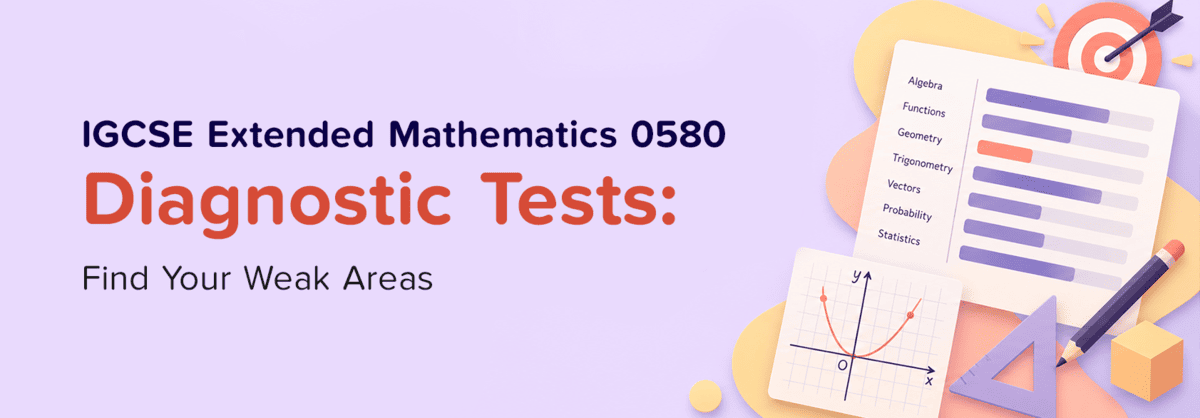
IGCSE Extended Mathematics 0580 Diagnostic Tests and broader mastery information can help you identify where your Mathematics needs attention and make your revision more targeted.
Assess → Diagnose → Target → Practise → Review → Reassess
What Is an IGCSE Maths Diagnostic Test?
A Maths diagnostic test helps you understand where your current knowledge and skills are strong enough and where further work may be needed.
The purpose is not simply to produce another score.
Useful diagnostic information should help you answer:
- Which mathematical areas need attention?
- What kind of difficulty am I having?
- Do I need to revise, relearn or practise?
- What should I work on next?
For example, a low result in trigonometry does not automatically mean you need to relearn all of trigonometry. You may understand the concept but repeatedly choose the wrong relationship or make calculator errors.
Diagnosis helps make that distinction.
Why Your Overall Maths Score Does Not Tell the Whole Story
Imagine two students both receive the same overall result.
Student A understands the methods but regularly loses marks through algebraic sign errors.
Student B calculates accurately once a method is chosen but struggles to recognise which method a question requires.
Their overall scores may look similar, but their revision needs are completely different.
Student A needs greater accuracy. Student B needs more practice with method selection.
The useful question is not only “What did I score?” but “Why did I lose marks?”
This is why broader mastery information becomes more useful when combined with an understanding of the mistakes behind the result.
Understanding Your Diagnostic Report
HomeSchool Asia uses the following broader mastery framework:
| Mastery Level | Threshold |
|---|---|
| Inadequate | 80% and below |
| Adequate | 80% and above |
| Complete | 100% |
Inadequate — 80% and Below
This area requires further attention.
Do not immediately assume the whole topic must be relearned. First determine whether the difficulty involves understanding, formula recall, method selection, accuracy, application, or multi-step reasoning.
Adequate — 80% and Above
You have reached the Adequate threshold, but that does not mean revision should automatically stop. You may still need reinforcement or more application practice.
Complete — 100%
Complete represents 100% mastery within the HSA mastery framework.
A mastery level should guide what you do next, not simply become another score to record.
What Kind of Maths Weakness Do You Have?
Before deciding how to improve a weak area, identify what kind of weakness it actually is.
Concept Weakness
You do not understand why the mathematical method works.
For example, you may remember a formula but not understand the relationship it represents.
Recall Weakness
You understand the method but forget a formula, rule, or mathematical relationship.
This often requires reinforcement rather than complete relearning.
Method-Selection Weakness
You know several methods but struggle to recognise which one a question requires.
This commonly appears when questions are mixed rather than organised by topic.
Accuracy Weakness
Your method is correct, but algebraic manipulation, signs, arithmetic, or calculator input produces the wrong answer.
Multi-Step Reasoning Weakness
You understand individual stages but struggle to connect them across a longer problem.
Interpretation Weakness
You misread graphs, diagrams, coordinates, transformations, or question wording.
Application Weakness
You can solve familiar examples but struggle when the same Mathematics appears in a different context.
How Diagnostic Information Can Guide Topic Revision
Diagnostic information becomes useful when it helps you narrow down the actual problem.
For example:
- Number: Is the issue ratio, percentage, standard form, or numerical accuracy?
- Algebra and Graphs: Is the problem manipulation, equations, signs, or interpreting graphs?
- Coordinate Geometry: Do you struggle with gradient, line equations, or relationships between lines?
- Geometry: Can you identify which geometrical property applies?
- Mensuration: Do you know the formula but struggle to select the correct dimensions?
- Trigonometry: Is the difficulty relationship selection, substitution, or application?
- Transformations and Vectors: Is the challenge visual interpretation or mathematical notation?
- Probability: Can you organise information across several events?
- Statistics: Can you interpret results as well as calculate them?
Instead of saying:
“I need to revise Geometry.”
you can reach a more useful conclusion such as:
“I know the geometrical properties, but I struggle to recognise which one justifies the next step.”
That tells you what to work on.
What to Do After Finding a Weak Area
Match the resource to the type of problem.
| If the problem is… | Next Step |
|---|---|
| Forgotten formula or rule | Revision Notes |
| Method does not make sense | Interactive Video |
| Need to check understanding | End-of-Lesson Quiz |
| Eligible quiz question needs clarification after 80%+ | Instant Explanation |
| Need more targeted practice | Test Papers |
| Need broader reassessment later | Mock Exam |
| Still cannot understand the problem | Tutor Support |
If you understand the method but cannot remember the rule or formula, Revision Notes can help reinforce it.
If the method itself does not make sense, return to the relevant Interactive Video before attempting more practice.
After achieving 80% or higher in an End-of-Lesson Quiz within an Interactive Video lesson, eligible Instant Explanations can help you understand the relevant quiz questions.
From Diagnosis to Targeted Maths Practice
Once you identify the weakness, practise that specific area instead of revising everything equally.
HomeSchool Asia Test Papers can be selected through:
Paper Type → Topic → Difficulty Level
For example, if your Diagnostic Report suggests a weakness in algebra, first determine whether the problem is manipulation, equations, signs, or application. Then practise questions that target that specific need.
Use:
Diagnose → Target → Practise → Review → Repeat
After practice, check whether the same type of error continues.
Test Papers provide grading for the practice completed; they do not generate Diagnostic Reports.
Example: Diagnosing a Trigonometry Weakness
Suppose your results suggest that trigonometry needs attention.
Instead of simply completing more trigonometry questions, investigate the problem.
Ask:
- Do I recognise when trigonometry is required?
- Do I remember the relevant relationship?
- Can I identify the correct sides?
- Do I substitute values correctly?
- Is my calculator input accurate?
- Can I use trigonometry within a multi-step problem?
If the relationship itself does not make sense, relearn it.
If you understand it but forget the formula, revise it.
If the method is clear but application remains difficult, complete targeted practice.
The topic may be the same, but the solution depends on why you are losing marks.
When Should You Reassess?
Do not reassess immediately without changing anything.
First:
- Identify the weakness.
- Revise or relearn the relevant area.
- Complete targeted practice.
- Check whether the same error persists.
- Reassess after improvement.
Use:
Assess → Improve → Reassess
A later Mock Exam can also help you see whether the improved skill still works when different topics are mixed together.
Diagnostic Tests vs Test Paper Grades
A Test Paper grade and a Diagnostic Report serve different purposes.
A Test Paper grade tells you how you performed on that particular practice. Diagnostic Reports provide broader mastery information.
One should not be treated as automatically producing the other.
A Practical IGCSE Extended Maths Diagnostic Routine
- Complete the relevant assessment.
- Review broader mastery information.
- Identify the area needing the most attention.
- Determine the type of difficulty.
- Choose the appropriate learning or revision resource.
- Complete targeted practice.
- Review repeated errors.
- Reassess after improvement.
Assess → Diagnose → Target → Practise → Review → Reassess
How HomeSchool Asia Supports Targeted Maths Improvement
HomeSchool Asia Diagnostic Reports provide broader mastery information that can guide the next stage of revision. Revision Notes reinforce familiar rules and formulas, while Interactive Videos support relearning and End-of-Lesson Quizzes check understanding. Eligible Instant Explanations are available after achieving 80% or higher. Test Papers provide targeted practice, Mock Exams support broader assessment, and Tutor Support offers additional guidance when a mathematical difficulty remains unresolved.
Conclusion
Finding a weak topic is only the first step. The more useful question is why that topic is weak.
Use IGCSE Extended Mathematics 0580 Diagnostic Tests and broader mastery information to identify where attention is needed, then determine whether the difficulty comes from understanding, recall, method selection, accuracy, or application.
Target that specific problem, practise it, and reassess after improvement.
Start Your IGCSE Extended Maths (0580) Journey!

Premium Plan
- Full 12-month structured resources of all subjects.
- Full access to all Interactive Videos.
- Additional Tutor Credits to access features.
- Diagnostic Report available to all chapters.
- Downloadable Revision Notes available for all topics.
- “Get one Answer a Day” is activated for all subjects.

Custom Plan
- Full 12-month structured resources of chosen subjects.
- Full access to Interactive Videos for the chosen subject.
- Additional Tutor Credits to access features.
- Diagnostic Report available to all chapters.
- Downloadable Revision Notes available for all topics.
- “Get one Answer a Day” is activated for chosen subjects.
Frequently Asked Questions
What is an IGCSE Extended Mathematics 0580 Diagnostic Test?
It is an assessment used to help identify mathematical areas that may require further attention and support more targeted revision.
How can a Diagnostic Test help my Maths revision?
It helps you focus on specific weaknesses instead of revising every area equally.
What do the Diagnostic Report mastery levels mean?
HomeSchool Asia uses Inadequate at 80% and below, Adequate at 80% and above, and Complete at 100%.
Does an Inadequate result mean I do not understand the whole topic?
No. Investigate whether the issue is conceptual understanding, recall, method selection, accuracy, interpretation, or application.
What should I do if I forget formulas?
Use Revision Notes to reinforce formulas and rules that you already understand.
What if I know the formula but cannot choose the correct method?
Focus on method selection by practising how to identify what the question gives you, what it asks for, and which relationship connects them.
How should I practise a weak Maths topic?
Use targeted Test Papers through Paper Type → Topic → Difficulty Level.
Do Test Papers generate Diagnostic Reports?
No. Test Papers provide grading for the practice completed; they do not generate Diagnostic Reports.
When should I reassess a weak area?
Reassess after targeted revision, relearning, and practice rather than immediately after identifying the weakness.