IGCSE Biology (0610) is an internationally recognised qualification offered by Cambridge Assessment International Education (CAIE). It provides a comprehensive introduction to the study of living organisms, their structures, functions, and interactions.
The course is designed to build a strong foundation in scientific literacy, critical thinking, and practical skills, making it a stepping stone to advanced studies such as A-Levels or IB Diploma biology. Students can choose between the Core curriculum (grades C to G) and the Extended curriculum (grades A* to G).
IGCSE Biology 0610 Specification and Assessment Objectives Explained
The Cambridge IGCSE Biology (0610) syllabus is meticulously designed to balance fundamental biological knowledge with essential scientific methodologies. Understanding the three primary Assessment Objectives (AOs) is crucial for scoring highly :
- AO1: Knowledge with Understanding: Your ability to recall scientific facts, terminology, definitions, and concepts.
- AO2: Handling Information and Problem Solving:Your capacity to translate data from tables, graphs, and diagrams, identify patterns, and apply your knowledge to unfamiliar novel situations.
- AO3: Experimental Skills and Investigations:Your competency in planning, executing, and evaluating laboratory experiments.
Core Syllabus Content
The Cambridge 0610 specification divides biological sciences into 21 distinct units. These range from cellular-level mechanics to complex ecological interactions, requiring a mix of rote learning, structural identification, and data interpretation:
| S.N. | Chapter Name |
|---|---|
| 1 | Characteristics and classification of living organisms |
| 2 | Organisation of the organism |
| 3 | Movement into and out of cells |
| 4 | Biological molecules |
| 5 | Enzymes |
| 6 | Plant nutrition |
| 7 | Human nutrition |
| 8 | Transport in plants |
| 9 | Transport in animals |
| 10 | Diseases and immunity |
| 11 | Gas exchange in humans |
| 12 | Respiration |
| 13 | Excretion in humans |
| 14 | Coordination and response |
| 15 | Drugs |
| 16 | Reproduction |
| 17 | Inheritance |
| 18 | Variation and selection |
| 19 | Organisms and their environment |
| 20 | Human influences on ecosystems |
| 21 | Biotechnology and genetic modification |
- Characteristics and Classification of Living Organisms:
Master the 7 life processes (MRS GREN) and understand binomial nomenclature. Focus on classifying organisms into the five kingdoms using features like cell walls, and look closely at the dichotomous keys used to identify unfamiliar species. - Organisation of the Organism:
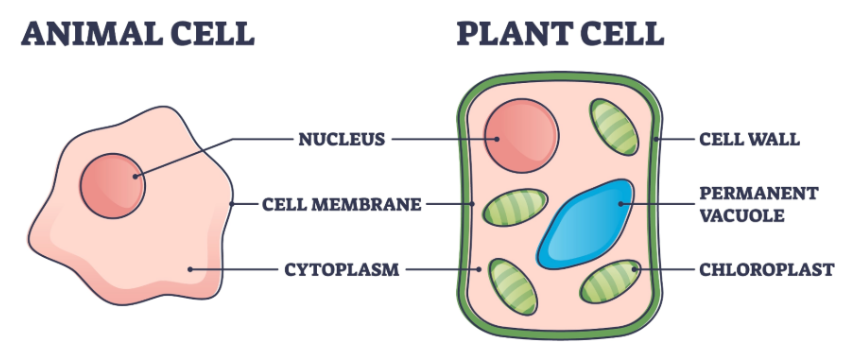
Understand cell structure by comparing plant and animal cells under light microscopes. Learn the functions of specialised cells (e.g., ciliated cells, root hair cells) and how cells group into tissues, organs, and organ systems. - Movement Into and Out of Cells:
Master the physical mechanics of transport: diffusion (passive movement down a concentration gradient), osmosis (water movement across a partially permeable membrane), and active transport (energy-requiring movement against a gradient using protein carriers). - Biological Molecules:
Focus on the chemical tests used to identify essential nutrients. Learn the base subunits, structural roles, and chemical components (C, H, O, N, P) of carbohydrates, proteins, lipids, and nucleic acids (DNA). - Enzymes:
Learn how enzymes function as biological catalysts using the Lock-and-Key mechanism. You must be able to explain how changes in temperature and pH alter the active site shape, leading to denaturation. - Plant Nutrition:
Study chloroplast anatomy, leaf cross-sections, and how limiting factors like light intensity and CO2 concentration affect growth. - Human Nutrition:
Cover the balanced diet requirements and the main stages of food processing: ingestion, digestion (mechanical and chemical), absorption (focused on villi structure), assimilation, and egestion. - Transport in Plants:
Study how the vascular bundle works. Xylem vessels transport water and mineral ions via transpiration pull, while phloem tubes move sucrose and amino acids through translocation. - Transport in Animals:
Master the human double circulatory system. Focus on cardiac anatomy, the structural differences between arteries, veins, and capillaries, and the components of blood. - Diseases and Immunity:
Learn about pathogen transmission and the body's defence systems. Differentiate between non-specific defences (phagocytosis) and specific immune responses (antibody production by lymphocytes), alongside active versus passive immunity. - Gas Exchange in Humans:
Study the anatomy of the respiratory system (trachea, bronchi, bronchioles, alveoli). Understand the mechanics of ventilation (the action of intercostal muscles and the diaphragm) and how the alveoli are optimized for gas diffusion. - Respiration:
Compare aerobic respiration (complete glucose breakdown yielding high energy) with anaerobic respiration (incomplete breakdown yielding lactic acid in muscles, or ethanol and CO2 in yeast fermentation). - Excretion in Humans:
Understand how the body removes toxic waste products and substances in excess. Focus on the role of the lungs, CO2, the liver (urea production via deamination), and the kidneys (filtration and reabsorption within nephrons). - Coordination and Response:
Examine how organisms detect and respond to stimuli. This includes the human nervous system (reflex arcs, synapses, and eye accommodation) alongside endocrine control (hormones like adrenaline and insulin) and plant tropisms. - Drugs:
Evaluate the effects of medicinal drugs (like antibiotics, noting the critical issue of bacterial resistance) and misuse of substances (such as alcohol and tobacco) on human health and performance. - Reproduction:
Compare the evolutionary benefits of asexual versus sexual reproduction. Study the structural anatomy of flowering plants and human reproductive systems, alongside the hormonal control of the menstrual cycle. - Inheritance:
Master genetics terminology (alleles, homozygous, heterozygous, genotype, phenotype). Practice drawing monohybrid cross-diagrams, determining test crosses, and understanding co-dominance and sex-linked traits. - Variation and Selection:
Differentiate between continuous and discontinuous variation. Study how mutation leads to genetic variation, and explore how natural selection drives evolutionary adaptation, alongside the mechanics of selective breeding. - Organisms and Their Environment:
Map energy flow through ecosystems via food chains, food webs, and trophic pyramids. Study the carbon and nitrogen cycles, alongside population growth curves (lag, exponential, stationary, and death phases). - Human Influences on Ecosystems:
Evaluate human impacts on the biosphere, including habitat destruction, deforestation, pollution (eutrophication and greenhouse gases), and the modern conservation strategies needed to protect endangered species. - Biotechnology and Genetic Modification:
Explore why microorganisms are used in biotechnology (e.g., yeast in breadmaking, anaerobic fermenters for penicillin). Study genetic engineering steps, particularly using restriction enzymes and ligase to insert human genes into bacterial plasmids.
High-Yield Biological Systems: Plants vs. Humans
To navigate the 21 topics efficiently, smart revision links them into major anatomical systems. You must master the functional parallels and structural contrasts between plant systems (such as Topic 6: Plant Nutrition, Topic 8: Transport in Plants, and Topic 16: Plant Reproduction) and human systems (Topic 7: Human Nutrition, Topic 9: Transport in Animals, and Topic 11-13: Gas Exchange, Respiration, and Excretion).
For instance, you should regularly practice comparing xylem and phloem translocation mechanisms in flora directly with the double-circulatory cardiac mechanics found in fauna.
Microbiology, Genetics, and Modern Biotechnology
The final section of the syllabus shifts away from macroscopic anatomy into molecular and environmental systems. Topics 17 (Inheritance) and 18 (Variation and Selection) require a strong grasp of DNA base sequences, monohybrid cross-diagrams, and natural selection. This directly bridges into Topic 21 (Biotechnology and Genetic Modification), where you must understand how bacterial plasmids and restriction enzymes are utilized to manufacture human insulin or genetically modified crops.
Practical Skills & Experimental Assessment
Mastering Paper 6: Alternative to Practical Strategies
Paper 6 does not test your memory of biological facts; it tests your performance as a scientist. To maximise marks, you must follow rigid structural rules. When calculating percentage changes, always display your formula step-by-step. When identifying variables, explicitly state the Independent Variable (what you alter), the Dependent Variable (what you measure), and at least two Control Variables (what you keep the same to ensure a fair test).
Scientific Drawing and Graphing Rules for IGCSE
Examiners use strict criteria for visual marks. Biological drawings must be executed with a sharp HB pencil using clear, single, unbroken lines—no artistic shading allowed.
When building graphs, your independent variable always belongs on the x-axis, and your dependent variable belongs on the y-axis. Ensure your data points occupy more than 50% of the grid provided, and connect your plotted points with clean, straight ruled lines or a smooth curve of best fit.

Standard Food Tests and Experimental Procedures to Memorise
You are guaranteed to see the core biochemical food tests appear across Paper 1/2, Paper 4, and Paper 6. Memorise this definitive experimental matrix:
| Nutrient | Testing Reagent | Negative Result Colour | Positive Result Colour | Required Condition |
|---|---|---|---|---|
| Starch | Iodine Solution | Yellow-Brown | Blue-Black | Room Temperature |
| Reducing Sugars | Benedict's Solution | Blue | Green/Yellow/Brick-Red | Heat in a Water Bath |
| Proteins | Biuret Reagent | Blue | Violet/Purple | Room Temperature |
| Fats/Lipids | Ethanol Emulsion Test | Clear/Colourless | Cloudy/Milky Emulsion | Mix with ethanol, pour into water |
| Vitamin C | DCPIP | Blue | Decolourised (Colourless) | Add sample drop by drop |
Conclusion
Mastering IGCSE Biology 0610 requires an equal mix of structured keyword memorization and practical, analytical logic. Do not study topics in isolation. Link micro-cellular actions, such as osmosis and active transport, directly to macro-level systems, such as root hair absorption in plants or villi absorption in the human gut. Before stepping into your exam hall, ensure you have practiced at least 5 years of past Paper 2/4/6 series under timed conditions.
Read the questions carefully—pay close attention to command words like "State", "Describe", or "Explain", as they dictate exactly how deep your answer needs to be. For comprehensive support, expert guidance, and step-by-step past paper video breakdowns, leverage the student tools available at HomeSchool.asia to convert your biology preparation into a guaranteed A*.
Frequently Asked Questions
Is the IGCSE Biology 0610 Syllabus Hard to Pass?
The Core tier is highly passable with simple recall. However, scoring an A* on the Extended tier requires mastering a strict set of scientific keywords. Cambridge examiners use unyielding mark schemes; if a student writes that an enzyme "dies" or "stops working" instead of stating that the active site denatures, they lose the marks. At HomeSchool.asia, we explicitly train students to match these examiner requirements.
What is the Hardest Topic in the Whole Biology Syllabus?
Official examiner reports consistently point to Topic 14 (Coordination and Response) and Topic 17 (Inheritance)as the toughest modules.
- Topic 14 involves extensive memorisation of complex physiological pathways such as reflex arcs, homeostatic feedback loops, and eye accommodation.
- Topic 17 requires a shift from descriptive biology to mathematical probability, forcing students to map out error-free genetic crosses and Punnett squares.
How Do I Download Free IGCSE Biology Study Materials?
You can download syllabus-aligned Revision Notes, Past Paper directories, and topical question banks directly from the student dashboard at HomeSchool.asia. All resources are fully updated for the current 2026–2028 Cambridge exam cycle, so you never waste time studying outdated specifications
What is the Difference Between Biology 0610 and 0970?
The course material, learning objectives, and exam papers are 100% identical. The only variance is how the final grade is printed on your certificate:
- 0610 uses the traditional international alphanumeric scale (A* to G).
- 0970 uses the UK-aligned numerical grading scale (9 to 1).
Because the exam papers are identical, 0610 and 0970 past papers are completely interchangeable for practice.