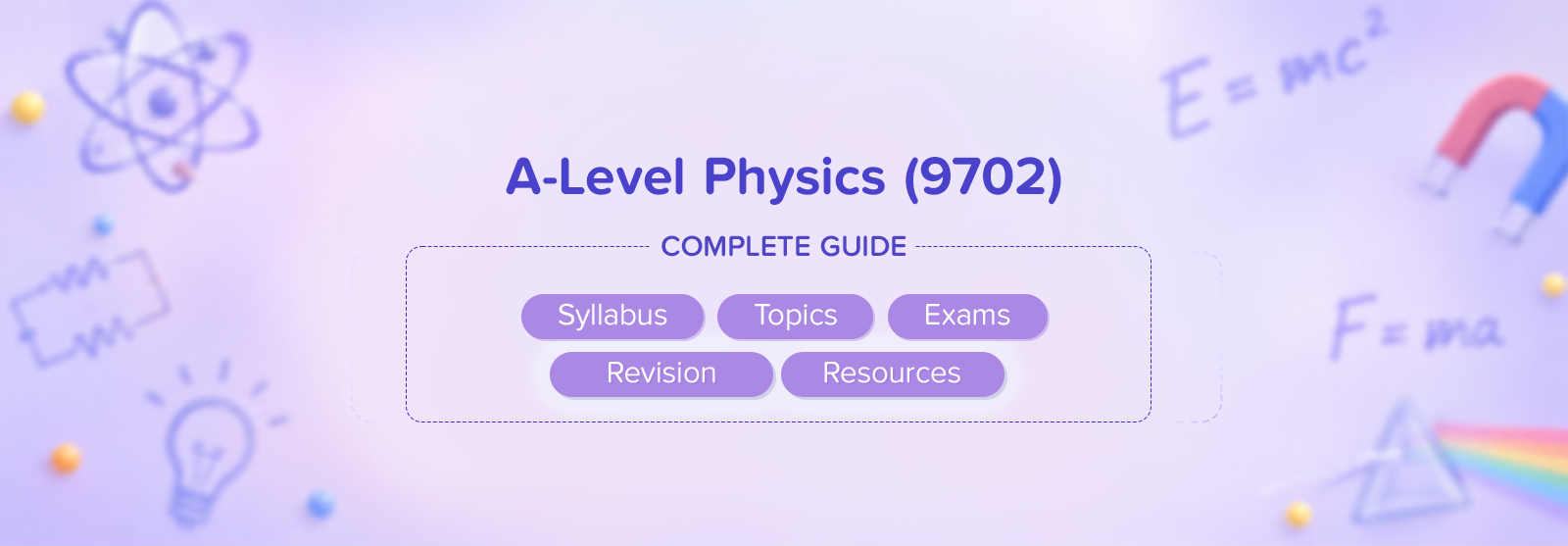
If you are studying A-Level Physics 9702, the first thing to get clear is exactly what you need to learn, which papers apply to you, and how the syllabus is assessed. The 2025–2027 Physics 9702 syllabus contains 25 main topic areas across AS and A Level, covering mechanics, waves, electricity, fields, thermal physics, quantum physics, nuclear physics and more, alongside practical skills that are assessed separately.
This guide brings the whole course structure into one place. You will find a clear overview of the Physics 9702 syllabus, key terms, exam papers, practical assessment, data and formulae provided in the exam, revision strategies, study resources and the latest syllabus changes.
A-Level Physics 9702 Syllabus Overview
The A-Level Physics 9702 syllabus covers a wide range of topics across mechanics, waves, electricity, thermal physics, fields, quantum physics, nuclear physics, medical physics and astronomy.
Students completing AS Level study the foundational topics first, while the full A Level extends these concepts into more advanced areas such as gravitational fields, thermodynamics, oscillations, capacitance, magnetic fields and quantum physics.
The syllabus also places strong emphasis on practical skills, including measurement, data analysis, planning experiments and evaluating results.
For a complete breakdown of the syllabus, topic groups and learning objectives, explore our A-Level Physics 9702 Syllabus & Specification Guide.
Key A-Level Physics 9702 Terms You Should Know
Physics 9702 introduces many terms that students need to understand accurately before they can apply them in calculations, explanations and exam questions.
Important terms include:
- Displacement, velocity and acceleration
- Force, momentum and impulse
- Work, energy and power
- Stress, strain and Young modulus
- Wavelength, frequency and phase difference
- Current, potential difference and resistance
- Electric and gravitational field strength
- Capacitance and time constant
- Simple harmonic motion and resonance
- Photon energy and photoelectric effect
- Binding energy and radioactive decay
Understanding these terms is especially important because Physics questions often test whether students can connect definitions with equations, graphs and physical situations.
For clear definitions organised by topic, explore our A-Level Physics 9702 Glossary.
How to Prepare for A-Level Chemistry 9701 Exams
Preparing for A-Level Chemistry 9701 requires more than reviewing the syllabus. Students need to practise applying concepts, work through structured and practical questions, review common mistakes and become familiar with Cambridge exam expectations.
A strong exam-preparation approach should include:
- Reviewing weak Chemistry topics before full-paper practice
- Completing topic-based and past-paper questions
- Using mark schemes to understand how answers are assessed
- Practising calculations, equations and data-based questions
- Preparing for practical and planning questions
- Completing timed mock exams
- Reviewing mistakes and revisiting weak areas
For a step-by-step preparation strategy, including past papers, practical skills, mock exams and exam techniques, explore our A-Level Chemistry 9701 Exam Preparation Guide.
How to Revise for A-Level Physics 9702
Effective Physics revision should combine concept review with active problem-solving rather than relying only on rereading notes.
A useful revision approach includes:
- Checking the syllabus and identifying weak topics
- Reviewing concepts and equations before practising questions
- Completing topic-based questions
- Practising calculations and written explanations
- Reviewing diagrams, graphs and experimental data
- Recording common mistakes
- Progressing to mixed-topic questions
- Completing timed past papers
- Using mark schemes and examiner reports
- Revisiting weak topics through spaced practice
Students should also practise explaining why a physical relationship works, not only how to substitute values into an equation.
For a detailed revision strategy, study plan and topic-by-topic approach, explore our How to Study A-Level Physics 9702 Guide.
What Data and Formulae Are Provided in Physics 9702 Exams?
Cambridge provides candidates with a Data and Formulae resource containing selected physical constants, equations and mathematical relationships that may be required during Physics 9702 examinations.
This can include information connected with areas such as:
- Mechanics
- Waves
- Electricity
- Fields
- Thermal physics
- Quantum physics
- Nuclear physics
However, having access to a formula does not remove the need to understand the underlying physics. Students still need to identify the correct relationship, rearrange equations accurately, use appropriate units and recognise when a formula applies.
It is therefore useful to practise with the official data and formulae sheet before the examination.
For a detailed explanation of the equations provided, what students should know and how to use the sheet effectively, explore our A-Level Physics 9702 Formula Sheet Guide.
A-Level Physics 9702 Study Resources
Different Physics resources support different stages of learning and exam preparation. Students should use resources according to whether they need to understand a concept, practise a topic or prepare under examination conditions.
Useful resources can include:
- Official syllabus documents
- Revision notes
- Interactive video lessons
- Topic-based questions
- Past papers
- Mark schemes
- Examiner reports
- Formula sheets
- Practical-skills resources
- Mock exams
- Diagnostic reports
- Tutor support
For example, revision notes can help organise concepts, while topic questions test understanding. Past papers and mock exams are more useful once students are ready to apply several topics under timed conditions.
For a detailed comparison of available resources and how to use them effectively, explore our Best A-Level Physics 9702 Learning Resources Guide.
Has the Physics 9702 Syllabus Changed?
Cambridge periodically updates syllabus documents to reflect changes in content, assessment information, wording, or administrative guidance.
Students should always use the Physics 9702 syllabus that matches their examination year rather than relying on an older syllabus or revision resource. Even when Cambridge reports no significant changes affecting teaching, smaller updates to wording, assessment information, or syllabus documentation may still appear.
When comparing syllabus versions, students should check:
- Applicable examination years
- Topic structure
- Learning objectives
- Practical requirements
- Paper structure
- Assessment weighting
- Formula or data-sheet information
- Cambridge's official summary of changes
Frequently Asked Questions
How many topics are there in A-Level Physics 9702?
It contains 25 main syllabus topics. AS Level students study Topics 1–11, while students completing the full A Level study all 25 topics. Practical skills are assessed separately alongside the theoretical content.
What topics are covered at AS Level Physics?
It covers Topics 1–11 of the Physics 9702 syllabus. These are Physical Quantities and Units, Kinematics, Dynamics, Forces, Density and Pressure, Work, Energy and Power, Deformation of Solids, Waves, Superposition, Electricity, D.C. Circuits and Particle Physics.
What additional topics are covered at A Level?
Full A-Level students study Topics 12–25 in addition to the AS Level content. These include Motion in a Circle, Gravitational Fields, Temperature, Ideal Gases, Thermodynamics, Oscillations, Electric Fields, Capacitance, Magnetic Fields, Alternating Currents, Quantum Physics, Nuclear Physics, Medical Physics, and Astronomy and Cosmology.
How many papers are there in Physics 9702?
Physics 9702 has five assessment components. Papers 1, 2 and 3 assess the AS Level, while Papers 4 and 5 assess the additional A-Level content and advanced practical skills. Full A-Level candidates complete all five components either through a linear or permitted staged assessment route.
Which papers do AS Level Physics students take?
Students take Papers 1, 2 and 3. Paper 1 is Multiple Choice, Paper 2 contains AS Level Structured Questions, and Paper 3 is Advanced Practical Skills.
Which papers do full A-Level Physics students take?
Full A-Level candidates are assessed across Papers 1–5. Students taking the qualification in one examination series complete all five papers. Under the staged route, an eligible AS Level result from Papers 1–3 can be carried forward, with Papers 4 and 5 completed later.
Is there a practical exam in A-Level Physics 9702?
Yes. Paper 3 is a timetabled practical examination. It assesses students' ability to take measurements, collect and analyse data and evaluate experimental work. Paper 5 also assesses advanced practical skills, particularly planning, analysis and evaluation, but does not require candidates to experiment with that paper.
Is A-Level Physics 9702 difficult?
It can be challenging because it combines conceptual understanding, mathematical problem-solving and practical skills. Students need to apply Physics ideas to unfamiliar situations rather than only memorising equations. Strong understanding of core concepts, regular question practice and careful error review can make the course much more manageable.
How should I revise for Physics 9702?
Start with the syllabus, strengthen concepts, practise topic questions and then progress to timed past papers and mock exams. Review every mistake to identify whether it came from a weak concept, calculation, interpretation or exam technique, then revisit those weak areas through spaced practice.