If you're preparing for Cambridge International AS & A Level Biology (9700), understanding the syllabus is the first step towards exam success. Whether you're starting AS Level, progressing into A2, or planning your revision strategy, knowing exactly what topics you'll study helps you stay organised and focus on the concepts that matter most.
The Cambridge A Level Biology Syllabus (9700) is designed to develop your understanding of biological principles while building practical laboratory skills, scientific reasoning, and analytical thinking. Rather than simply memorising facts, students are expected to explain biological processes, interpret experimental data, evaluate evidence, and apply their knowledge to unfamiliar situations.
Cambridge A Level Biology (9700) Topics Explained: Complete AS & A2 Syllabus Breakdown
The Cambridge International Biology syllabus follows a logical learning pathway. The concepts introduced during AS Level become the building blocks for the more advanced topics taught in A2 Level. Each chapter strengthens your understanding of biological systems while improving your ability to analyse data, solve problems, and think scientifically.
AS Level Biology (Topics 1–11): Core Foundation Topics
The AS Level forms the structural foundation of the entire qualification, focusing on cellular machinery, transport systems, and molecular biology.
- Cell structure
- Biological molecules
- Enzymes
- Cell membranes and transport
- The mitotic cell cycle
- Nucleic acids and protein synthesis
- Transport in plants
- Transport in mammals
- Gas exchange
- Infectious Diseases
- Immunity
- Cell structure: You learn the light microscope as a working instrument, making temporary preparations, drawing from slides, and calculating magnification and actual size using an eyepiece graticule and stage micrometer. You must recognise organelles in eukaryotic cells, outline prokaryotic features (1–5 µm, peptidoglycan walls, circular DNA, 70S ribosomes), and state that viruses are non-cellular structures with a nucleic acid core and protein capsid.
- Biological molecules: Carbohydrates, lipids, proteins and water. This topic is heavier than students expect: you must draw ring forms of α- and β-glucose, describe glycosidic and ester bond formation, and explain protein structure from primary through quaternary with haemoglobin as the globular example and collagen as the fibrous one.
- Enzymes: Mode of action via active site, enzyme–substrate complex, and lowered activation energy, covering both the lock-and-key and induced-fit hypotheses. Note that A Level goes well beyond IGCSE here: you need Vmax, the Michaelis–Menten constant (Km), competitive versus non-competitive inhibition, and immobilised enzymes.
- Cell membranes and transport: The fluid mosaic model, the roles of cholesterol and glycoproteins, and cell signalling. Movement includes simple and facilitated diffusion, osmosis, active transport, endocytosis and exocytosis. Water movement is explained purely through water potential; the syllabus states knowledge of solute and pressure potential is not expected.
- The mitotic cell cycle: Chromosome structure, interphase (G1, S, G2), mitosis, cytokinesis, plus telomeres, stem cells, and how uncontrolled division forms a tumour.
- Nucleic acids and protein synthesis: DNA structure, including antiparallel strands and phosphodiester bonds; semi-conservative replication with leading and lagging strands; transcription and translation; and intron removal in eukaryotes. Gene mutation: substitution, deletion, insertion sits here.
- Transport in plants: Drawing plant diagrams of stems, roots, and leaves; the apoplast and symplast pathways with the Casparian strip; cohesion–tension; xerophyte adaptations; and mass flow in phloem.
- Transport in mammals: The closed double circulation, vessel structure, tissue fluid formation, the oxygen dissociation curve, the Bohr shift, the chloride shift, and the cardiac cycle including the SAN, AVN and Purkinje tissue.
- Gas exchange: The human gas exchange system and the distribution of cartilage, ciliated epithelium, goblet cells and smooth muscle, much of it assessed through microscope slides and plant diagrams.
- Infectious diseases: Four named diseases with named pathogens: cholera (Vibrio cholerae), malaria (four Plasmodium species), TB (Mycobacterium tuberculosis and M. bovis), and HIV/AIDS. You discuss biological, social, and economic factors in control, and the details of the malarial life cycle are not required. Antibiotics and resistance are here too.
- Immunity: Phagocytosis, self and non-self antigens, the primary response, memory cells, monoclonal antibodies via the hybridoma method, and vaccination.
A2 Level Biology (Topics 12–19): Advanced Biological Concepts
A common trap for A Level students is treating AS and A2 as separate entities. In reality, A2 topics are direct extensions of AS principles:
- Energy and respiration
- Photosynthesis
- Homeostasis
- Control and coordination
- Inheritance
- Selection and evolution
- Classification, biodiversity and conservation
- Genetic technology
- Energy and respiration: ATP as universal energy currency, respiratory quotient (RQ) calculations, then the four stages: glycolysis (cytoplasm), link reaction and Krebs cycle (matrix), oxidative phosphorylation (inner membrane). Chemiosmosis and ATP synthase are required, but a detailed total ATP yield is not expected. A distinctive outcome: explaining how rice is adapted to submerged roots via aerenchyma and ethanol fermentation.
- Photosynthesis: Chloroplast structure, pigments and chromatography with Rf values, cyclic and non-cyclic photophosphorylation, and the three stages of the Calvin cycle (rubisco fixing CO₂ onto RuBP → GP → TP). Limiting factors close the topic.
- Homeostasis: Negative feedback, kidney structure and the nephron, ultrafiltration and selective reabsorption, ADH and aquaporins. The blood glucose section demands the full cell-signalling cascade for glucagon: G-protein, adenylyl cyclase, cAMP, protein kinase A, amplification. Plant homeostasis covers guard cells and abscisic acid.
- Control and coordination: Resting and action potentials, saltatory conduction, the refractory period, cholinergic synapses, sarcomere ultrastructure and the sliding filament model. Plants: the Venus fly trap, auxin, and gibberellin.
- Inheritance: Meiosis and how crossing over and independent assortment generate variation; genetic diagrams for monohybrid, dihybrid, codominance, multiple alleles, sex linkage, autosomal linkage and epistasis; the chi-squared test; and named gene–protein–phenotype links (TYR/albinism, HBB/sickle cell, F8/haemophilia, HTT/Huntington's). Gene control via the lac operon sits here.
- Selection and evolution: Continuous versus discontinuous variation, the t-test, stabilising/disruptive/directional selection, genetic drift and the founder and bottleneck effects, theHardy–Weinberg principle, selective breeding, and speciation (allopatric and sympatric).
- Classification, biodiversity and conservation: Three domains (Archaea, Bacteria, Eukarya), the taxonomic hierarchy, sampling with quadrats and transects, mark-release-recapture using the Lincoln index, Simpson's index of diversity, correlation tests, and conservation including IUCN and CITES.
- Genetic technology: Recombinant DNA, restriction endonucleases and ligase, promoters and marker genes, gene editing, PCR with Taq polymerase, gel electrophoresis, microarrays, then applications: recombinant insulin, factor VIII, genetic screening, gene therapy, and GMOs in agriculture.
Notice how many A2 topics carry a statistical test. Chi-squared, t-test, Hardy–Weinberg, Lincoln index and Simpson's index are all named outcomes, and Cambridge provides the formulae in the exam. The skill assessed is choosing and applying the right test, not recalling it.
Which A Level Biology Topics are the most challenging?
Based on examiner reports and candidate performance trends:
- Topic 12 & 13 (Respiration & Photosynthesis): Requires memorisation of complex biochemical pathways, intermediate compounds, electron transport chains, and quantitative enzyme kinetics.
- Topic 15 (Control & Coordination): High concentration of technical vocabulary regarding electrochemical gradients, membrane polarity, and molecular interactions in muscle contraction.
- Topic 16 (Inherited Change): Blends conceptual biology with mathematical probability (genetic ratios, Chi-squared testing).
How the Cambridge A Level Biology (9700) syllabus is structured
Understanding the AS Level and A Level course structure
The qualification can be taken via two routes:
- Staged Assessment Route: Take the AS Level papers at the end of Year 1, followed by A2 papers at the end of Year 2.
- Linear Assessment Route: Take all 5 papers in the same exam series at the end of Year 2.
| FULL A LEVEL (9700) | |||
|---|---|---|---|
| AS LEVEL (50%) | A2 LEVEL (50%) | ||
| Paper 1 (15.5%) Multiple Choice | Paper 2 (23.0%) Structured Qs | Paper 4 (38.5%) Structured Qs | Paper 5 (11.5%) Practical Evaluation |
| Paper 3 (11.5%): Advanced Practical Skills (Taken during AS Stage) | |||
How the 19 Biology Topics progress throughout the curriculum
The curriculum moves logically from microscopic building blocks to macroscopic systems and global impacts:
- Molecular & Cellular Basis: Cell organization, biological chemistry, membrane dynamics (Topics 1–6).
- Organismal Physiology: Internal transport and gas exchange in plants and animals (Topics 7–9).
- Health & Defense: Interactions between host organisms, pathogens, and immunity (Topics 10–11).
- Metabolic Energy & Homeostasis: Biochemical pathways and physiological regulation (Topics 12–15).
- Genetics, Diversity & Innovation: Molecular inheritance, evolutionary mechanics, ecological conservation, and gene editing (Topics 16–19).
Learning Outcomes and Assessment Objectives
Cambridge assesses candidates across three core Assessment Objectives (AOs):
- AO1: Knowledge with Understanding (~40%): Recalling terminology, facts, concepts, and scientific conventions.
- AO2: Handling and Evaluating Information (~40%): Applying knowledge to novel contexts, interpreting data, solving quantitative problems, and drawing conclusions.
- AO3: Experimental Skills and Investigations (~20%): Planning experiments, recording observations, analyzing data, evaluating methods, and identifying experimental flaws.
Practical Skills and scientific investigation requirements
Practical competence is assessed through two distinct papers:
- Paper 3 (Advanced Practical Skills): A 2-hour laboratory exam where students manipulate apparatus, perform chemical tests, execute dilutions (serial and proportional), operate light microscopes, draw biological specimens, and collect raw data.
- Paper 5 (Planning, Analysis, and Evaluation): A 1-hour 15-minute written exam testing experimental design. Students must identify independent/dependent/control variables, describe safe methods, choose appropriate statistical tests (t-test, Chi-squared test, Spearman's rank), and evaluate validity.
Skills you will develop throughout the Cambridge Biology course
Beyond biological facts, the course builds transferable scientific competencies:
- Data Processing & Quantitative Analysis: Calculating rates of reaction, magnification, percentage change, statistical significance, and biological indices.
- Experimental Design & Risk Assessment: Formulating hypotheses and controlling confounding variables safely.
- Scientific Communication: Using precise biological vocabulary and constructing clear, logical cause-and-effect explanations.
Choosing the Right Study Resources for the A Level Biology Syllabus
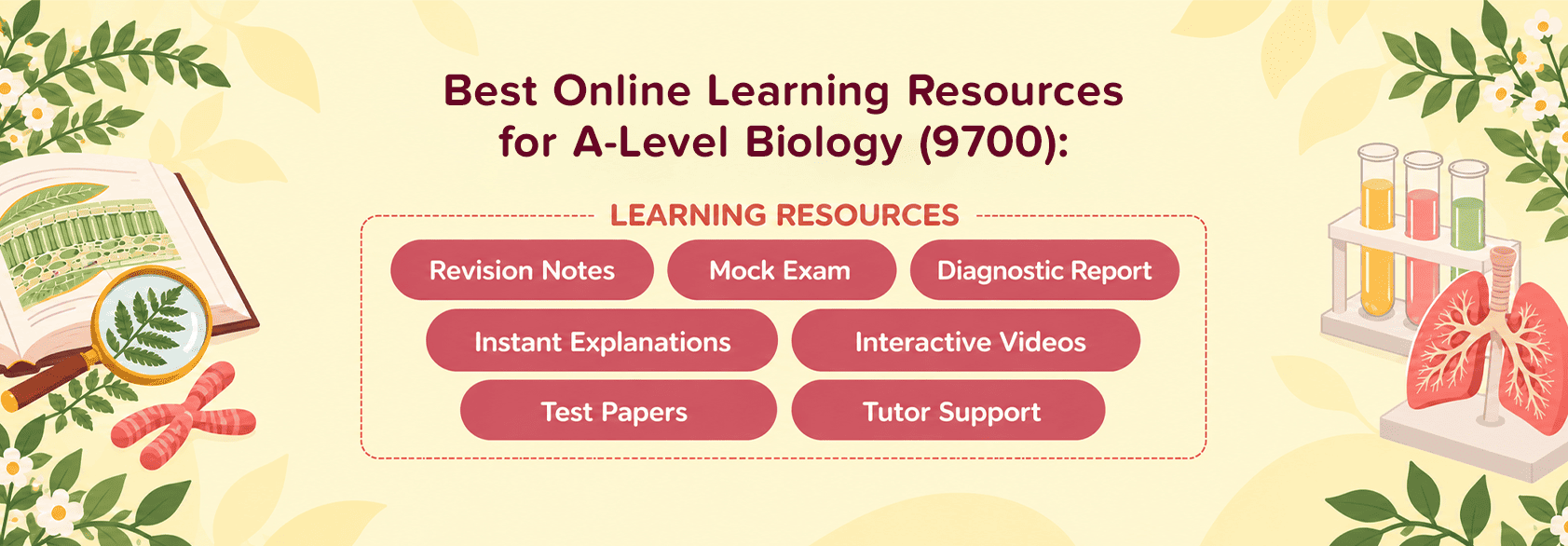
Preparing for Cambridge A Level Biology (9700) requires more than simply reading the textbook or memorising notes. The right combination of study resources can help you understand difficult concepts, practise exam-style questions, identify knowledge gaps, and prepare effectively for the final exams. Start with syllabus-aligned Revision Notes to review key concepts quickly, then use Interactive Video Lessons to visualise complex topics and biological processes. Once you understand a topic, use the Testpaper Generator to create targeted practice papers based on specific topics and difficulty levels, followed by Mock Exams to build exam confidence and practise working under timed conditions. Diagnostic Reports can help you identify your strongest and weakest areas and understand where you are losing marks, while Planbook helps you organise your revision schedule and stay consistent throughout the course. If you need additional guidance, Tutor Support can provide expert feedback to help you improve your answers and exam technique.
By combining these resources Revision Notes, Interactive Videos, Testpaper Generator, Mock Exams, Diagnostic Reports, Planbook, and Tutor Support—you can follow a complete revision cycle: learn, practise, analyse, improve, and repeat. For the best results, always make sure your study materials match the latest Cambridge Biology (9700) syllabus and focus your revision on the areas where you need the most improvement.

Conclusion
The Cambridge International A Level Biology (9700) syllabus covers a broad range of topics, from cell structure and biological molecules to genetics, evolution, biodiversity, and genetic technology. The course is designed to develop your biological knowledge while strengthening practical skills progressively, including data analysis, scientific reasoning, and the ability to apply concepts to unfamiliar questions. Whether you are studying AS Level or completing the full A Level qualification, understanding how the 19 topics connect can help you build a more effective revision strategy. Start by mastering the core concepts, then regularly practise exam-style questions, review your mistakes, and focus on the topics where you need the most improvement.
Using syllabus-aligned resources such as Revision Notes, Interactive Video Lessons, Testpaper Generator, Mock Exams, Diagnostic Reports, Planbook, and Tutor Support can help you move from simply covering the syllabus to studying with a clear and personalised plan. Most importantly, always check that your study materials match the correct Cambridge syllabus and examination series. With consistent revision, targeted practice, and a strong understanding of both theory and practical skills, you can approach your Cambridge A Level Biology exams with greater confidence and be better prepared to achieve your academic goals.
Frequently Asked Questions
How many topics are included in the Cambridge Biology (9700) syllabus?
The Cambridge International A Level Biology (9700) syllabus is organised into 19 main topics covering the full AS and A Level course. Topics 1–11 form the core AS Level content, while Topics 12–19 cover the more advanced A2 Level content. The topics progress from fundamental concepts such as cell structure, biological molecules, and transport to more advanced areas including homeostasis, inheritance, evolution, biodiversity, and genetic technology.
Is the Cambridge Biology (9700) syllabus changing?
Cambridge International periodically reviews and updates its syllabuses to ensure that they remain relevant and appropriately challenging. Changes can include updates to content, learning outcomes, practical requirements, assessment structure, or examination arrangements. Students should always check the official Cambridge International syllabus for their specific examination series rather than relying on older revision guides or past course materials.
Which topics are covered in Paper 4?
Paper 4 is the A Level Structured Questions paper and assesses the A Level content covered in the A2 section of the syllabus. Questions can draw on topics across the A2 curriculum, including energy and respiration, photosynthesis, homeostasis, control and coordination, inheritance, selection and evolution, biodiversity and conservation, and genetic technology. Students should also be prepared to apply knowledge and understanding from earlier AS Level concepts where these provide the foundation for A2 questions.
Which syllabus version should you follow (2026–2027) exams?
You should follow the Cambridge International Biology (9700) syllabus that is officially specified for your examination year and series. Syllabus availability and content can vary between examination years, so students preparing for 2026 or 2027 exams should check the latest official Cambridge syllabus document and confirm that their revision resources match it. This is particularly important when using older textbooks, notes, websites, or past revision materials.
Why does Cambridge update the Biology Syllabus
Cambridge updates its syllabuses to keep qualifications relevant, maintain appropriate academic standards, and reflect developments in education and scientific understanding. Updates can also help ensure that the content, assessment objectives, practical skills, and examination structure continue to prepare students for further study and future careers in science-related fields.
How to choose study materials that match the latest Cambridge Biology Syllabus?
Start by checking the syllabus code, examination year, and syllabus version shown on the resource. Then compare the resource's topic coverage with the official Cambridge syllabus and make sure it includes the relevant learning outcomes and assessment requirements. Ideally, use a combination of syllabus-aligned Revision Notes, Interactive Video Lessons, targeted practice papers, Mock Exams, and Diagnostic Reports. Avoid relying entirely on outdated resources, particularly when the syllabus or assessment structure has changed.
How AS Level Topics build the foundation for A2 Level Biology
AS Level provides the fundamental biological knowledge needed to understand the more complex A2 topics. For example, knowledge of enzymes and biological molecules supports the study of respiration and photosynthesis, while cell membranes and transport help explain homeostasis and nervous coordination. DNA, nucleic acids, and protein synthesis provide the foundation for inheritance and genetic technology, while understanding immunity and infectious diseases connects to wider applications of biology. Building a strong understanding of AS Level concepts can therefore make it easier to apply and connect ideas when studying A2 Biology.
What is the best way to revise Cambridge A Level Biology (9700)?
The best way to revise A Level Biology is tounderstand each topic, review your notes, practise exam-style questions, and regularly complete mock exams. Use diagnostic feedback to identify weak areas and focus your revision where you need the most improvement. A consistent study plan and regular past-paper practice can help you build confidence and improve your exam performance.