


Revision often feels productive, but exams aren't just about knowing the content. They are built to test how well you can apply that knowledge under pressure. You might finish your syllabus, but until you sit down and complete a full paper under timed conditions, it's hard to know where you truly stand.
This is exactly where mock exams come in. They show you how prepared you actually are before the final paper and help you spot what still needs work. If you're preparing for IGCSE or A Levels, understanding how they work can make a big difference. This guide will walk you through the proper way to utilise mock tests, why they matter, how they differ by level, and how to use them smartly.
What Are Mock Exams?
They are full-length practice papers designed to mirror the real exam experience as closely as possible. They follow the same structure, time limits, question formats, and marking standards set by boards such as Cambridge Assessment International Education and Pearson Edexcel.
How Mock Exams Replicate Real Exam Conditions
They recreate the pressure and discipline of exam day. You work within strict timing, under supervision, without access to notes or your phone. The paper layout, command words, and mark schemes reflect what you'll encounter in the actual exam hall. This structured environment trains your brain to think clearly under timed conditions.
Difference Between Mock Exams And Practice Tests
Practice tests are usually about one chapter. They check your understanding, and it's great for learning. However, mock tests suggest a full-length, timed simulation of the entire syllabus. It's the difference between practising a free throw and playing a 40-minute basketball game.
When Should Students Take Mock Exams?
Your first full mock should ideally be taken 8–12 weeks before your final exams, once the syllabus is complete and revision has started. If you're planning for 2026 examinations, take mocks only after you've covered the content.
The goal is timing it right: early enough to identify weaknesses and improve, but deep enough into the material to have the full knowledge base needed to perform properly.
Benefits Of Taking Mock Exams
1. Improves Time Management Skills
Ever run out of time during an exam? Many students lose marks not due to lack of knowledge, but poor time control. Mocks teach you how to allocate your time wisely, how long a 4-mark question should take compared to a 20-mark essay, and when to move on.
2. Identifies Strengths and Weaknesses Clearly
Mocks act like a diagnostic scan. They show you exactly where your “knowledge gaps” are so you don't waste time studying things you already know. They help you realise weak topics, tricky question types, or exam techniques that need work, helping you focus your revision efficiently.
3. Enhances Long-Term Memory Retention
Mock exams boost long-term retention by forcing active recall, retrieving information from memory under timed pressure. When you struggle to remember and finally retrieve the answer, your brain locks it in more permanently, making knowledge stick. Regular practice with mocks trains your brain to retain information more effectively than passive revision, like re-reading notes.
4. Boosts Confidence Before Finals
Mocks make the real exam feel familiar. Each full-length, timed practice helps you get used to the exam format, questions, and pressure.
After a few timed practices, nerves reduce, and you walk into the exam calm and confident, ready to perform your best.
5. Improves Answer Presentation and Structure
Examiners do not award marks for “almost correct thinking.” Especially in subjects like Maths or Accounting, how you show your work matters. Mocks help you perfect that layout so the examiner can actually follow your logic and give you marks.
Practising with mock exams ensures your logic is easy to follow, and a good presentation can even help raise your grade.
6. Encourages Exam Discipline and Focus
By attempting full-length papers, Mock exams train you to stay focused and maintain concentration for long periods. They build the mental stamina needed to work steadily through the entire paper without burning out.
Mock Exams For IGCSE vs A Levels
These exams vary in structure and complexity depending on the level, helping students adjust to the content depth, exam style, and assessment expectations of each level.
Structure and Difficulty Level Comparison
IGCSE mocks focus on a broad understanding across multiple subjects, testing recall and basic application. A Level mocks, in contrast, demand deeper analysis, extended essay-style answers, and critical thinking. The increased difficulty reflects the jump in expectations from factual knowledge to higher-order reasoning.
Subject Depth: IGCSE vs A Levels Expectations
IGCSE mock exams focus on a broad understanding of many subjects. You mainly need to know facts, definitions, and key concepts.
A-level mock exams require much deeper analysis, longer essay-style answers, and higher-order thinking. You need to explain how and why, making critical thinking and application essential.
Assessment Objectives and Marking Schemes
In A Level, questions use specific command words such as “Evaluate” and “To what extent”. These mocks help you interpret these instructions accurately so you can answer with the required level of analysis. If a question asks you to evaluate and you only describe, you risk losing valuable marks. Similarly, IGCSE mocks follow structured mark schemes that focus more on accurate knowledge, clear explanations, and basic application rather than in-depth critical analysis.
Study Approach Differences
For IGCSE, consistent revision of facts and practice questions is usually sufficient. For A Levels, practice must include connecting topics, applying knowledge in unfamiliar contexts, and structuring longer answers. Mock Tests highlight whether your current strategy is effective and where adjustments are needed.
Recommended Frequency of Mock Exams for Each Level
- IGCSE: Two full rounds of mocks are generally enough to get comfortable with the format and timing.
- A Level: Three to four full-length sessions are recommended, especially for subjects with long or content-heavy papers like Physics, Economics, or History. Repeated mocks build confidence, timing skills, and exam technique.
Common Mistakes to Avoid while taking Mock Exams
These exams are only effective if you approach them seriously. Here are some common pitfalls and how to avoid them:
Not Simulating Real Exam Conditions
If you take mock exams online while eating snacks or checking your phone, you are only cheating yourself. Treat it like the real exam: timed, distraction-free, and under exam-like conditions. This gives you an honest picture of your readiness.
Ignoring Time Limits
Giving yourself “just five more minutes” or spending too long on easy questions undermines the mock's value. Learn to allocate time wisely: shorter questions should take less time, while longer, high-mark questions need enough focus. Practising this pacing ensures you finish the paper in real exam conditions
Skipping Difficult Questions Entirely
Don't leave blanks. Leaving blanks wastes learning opportunities. Use mocks to practise educated guesses, attempt partial solutions, or note formulas. Even partial marks help.
Not Reviewing Mistakes Thoroughly
The biggest mistake isn't failing; it's not looking at why you failed. So, spend more time reviewing. Don't just glance over wrong answers, analyse why you lost marks, identify patterns, and correct misconceptions.
Cramming the Night Before
Mocks are for testing your long-term memory. If you cram, you're only testing your 8-hour memory, which won't help you during the actual month-long exam season.
Focusing Only on Favorite Topics
It's tempting to practice what you already know well, but this won't improve your overall grade. Use mocks to confront your weak areas and strengthen them before the real exam.
Last-Minute Mock Exams Checklist
- Exam Materials Ready: Make sure you have a scientific calculator (with fresh batteries), black pens, ID, and a clear water bottle.
- Review Key Formulas: Focus on refreshing important formulas and concepts; don't try to learn anything new at this stage.
- Practice One Final Timed Section: Do a 15-minute timed section to get your brain into exam mode before the real exam starts
- Mental Preparation and Confidence Boost: Take a deep breath. Remember, it's just a mock; it's better to make mistakes now than on the real exam.
Efficient Strategies To Take HomeSchool.asia's Mock Exams
HomeSchool.asia is an online learning platform designed specifically for CAIE IGCSE and A Level students. It provides teacher-made, exam-focused revision notes aligned with Cambridge standards, ensuring students study exactly what the syllabus requires.
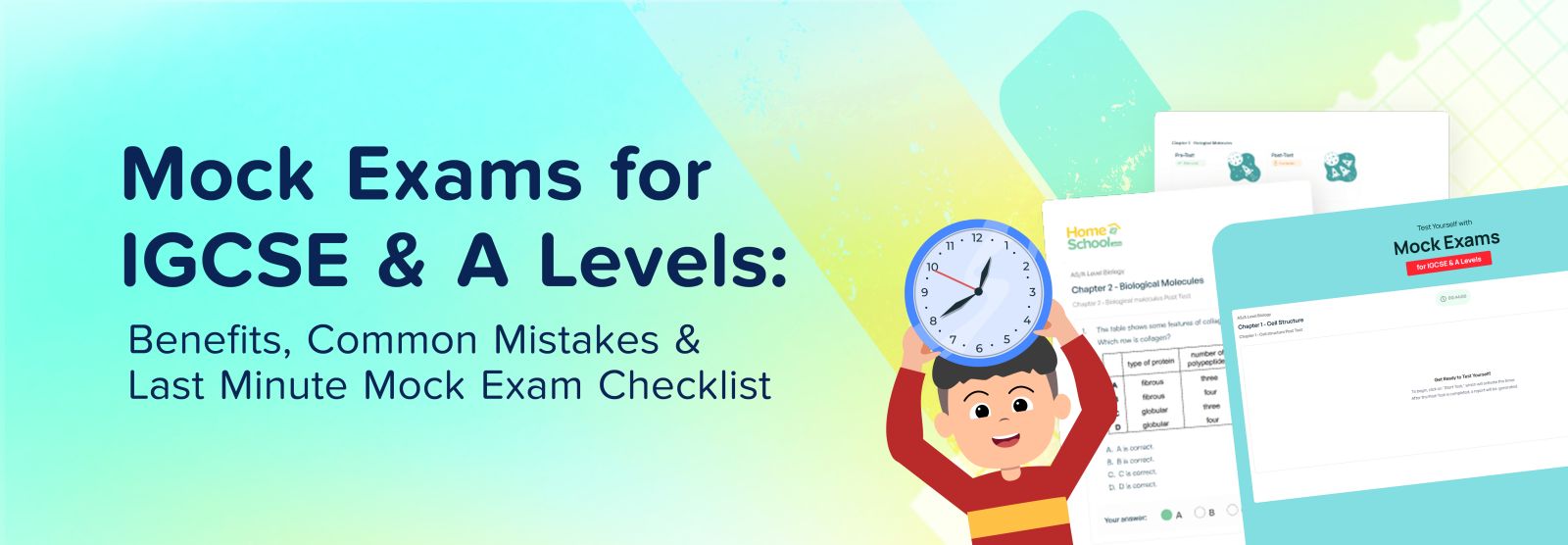
HomeSchool.asia also provides MCQ-based mock tests and topical questions that allow students to practise chapter by chapter. These mocks generate detailed diagnostic reports, helping students quickly identify weak areas and improve strategically.
In addition, students can access interactive video lessons, topical past paper questions, competency evaluators, and a structured planbook to organise their study routine, making preparation more focused, efficient, and exam-oriented.
Understanding the Exam Format Provided
HomeSchool.asia offers chapter-wise mocks as well as custom test papers prepared according to the Cambridge syllabus. This helps you to familiarise yourself with how these sections are structured, the question types, and timing before you start, so you know exactly what to expect on exam day.
Using Diagnostic Reports Effectively
After completing a Mock Exam, focus on the feedback mentioned in the report rather than just the overall grade. This report acts as a roadmap, showing exactly where to focus your revision to maximise marks.
Practising with Structured Revision Resources
Before attempting a paper, review interactive videos, revision notes, and practice mock exams on the platform. This prepares your brain for the types of questions you'll encounter and reinforces key concepts.
Staying Consistent
Don't treat mocks as a one-off task. Set a regular schedule for mock tests. Consistent practice, even in shorter sessions, is more effective than occasional intensive cramming.
Conclusion
Mock exams are not just “extra work,” they are a strategic tool to bridge the gap between knowing content and performing under pressure. They help you manage time, identify strengths and weaknesses, retain information long-term, build confidence, and perfect answer presentation and exam discipline.
Whether you're preparing for IGCSE or A Levels, taking mocks seriously, reviewing results carefully, and using structured revision resources like those on HomeSchool.asia can transform your preparation. In short, mocks give you a clear picture of where you stand, a roadmap for improvement, and the mental stamina to succeed, making the actual exam feel far less daunting.
FAQs
Are Mock Exams harder than real exams?
Sometimes, yes. Teachers and exam platforms may include slightly more challenging or unfamiliar questions to prepare you for worst-case scenarios. This ensures that if you can handle the mock, you'll feel more confident and prepared during the actual exam.
Are Mock Tests important?
Absolutely. Mock Tests are one of the most reliable indicators of your current performance level. They highlight gaps in knowledge, test exam technique, and give you time to improve before final board examinations.
How do I pass a Mock Exam?
Approach it seriously. Use active recall, practise past papers, revise weak areas identified in earlier tests, and manage your time effectively. Proper rest before the exam is also important, as focus and clarity significantly impact performance.
Is it okay if I fail a Mock Exam?
Yes. Mocks are designed for learning, not final judgment. Performing poorly in a mock allows you to identify mistakes and improve before the real exam. It's far better to struggle during preparation than during the final board exams.
Are HomeSchool.asia's Mock Exams useful?
Yes. They provide structured, exam-style questions along with detailed performance breakdowns. This feedback helps you identify specific areas for improvement, allowing you to refine your study plan and prepare more strategically.